



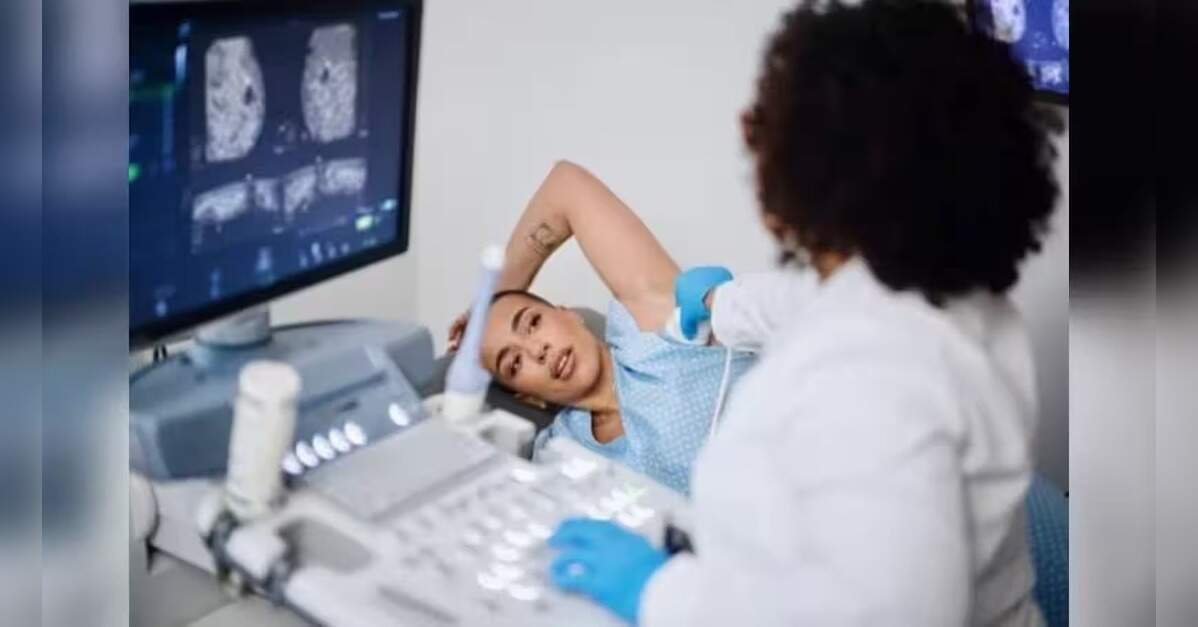
Each year about 237,000 Indian women are diagnosed with breast cancer and about 96,000 die of it (GLOBOCAN 2024): roughly four in every ten, against about one in six in North America. Incidence here is 31.2 per 100,000 women, against 95.2 there. Yet our death rate, 12.7 per 100,000, already exceeds theirs, 12.2. A disease that strikes a third as many Indian women per head kills at least as many of them.
The difference lies not in biology but in timing. In the national registries most Indian patients are diagnosed after the cancer has reached the lymph nodes or beyond; in the United States 63% are caught while it is still confined to the breast. Five-year survival is 66.4% in India and above 90% in the US.
We find cancer late because we do not look for it early. India relies on women reporting a lump, and on clinical breast examination by frontline health workers, offered free to women aged 30 to 65 at Ayushman Arogya Mandirs. Official tallies run into crores: the NAMS task force cites 10 crore breast screenings by 2023. Yet in the National Family Health Survey of 2019-21, only 0.9% of women aged 30 to 49 said they had ever had a breast examination. Both cannot describe the same women.
The state picture is starker. Tamil Nadu leads at 5.6%, then Puducherry at 4.2% and Mizoram at 2.7%. Uttar Pradesh is at 0.4% and Punjab at 0.3%; half of all states are below 1%. Urban women are examined more than rural women in most states. Kerala has built a Cancer Grid linking local facilities to cancer centres, and Punjab funded an AI thermography pilot that screened 15,069 women. None, to my knowledge, invites women systematically to mammography, and the machines are not there: India has about 3,000, fewer than one in ten of them digital, most in private hands in the metros.
Cost and capacity are the standard defence of examination-only screening, and the NAMS task force judged population mammography unlikely to be feasible. A 20-year Mumbai trial of 151,538 women, published in the BMJ, is often cited in support. It found a 15% fall in breast cancer deaths that was not statistically significant overall; a post-hoc analysis showed about 30% among women aged 50 and over, and none below 50. That is a serious flaw for India, where the median age of onset is around 45, a decade earlier than in the West. Examination should remain at the base of any programme, but we are leaning on a method that fails the women who need it most.So India should build a targeted, technology-enabled, mammography-led programme for every woman aged 40 to 60. Replicating the Western model is neither affordable nor necessary; we can leapfrog it with our digital public infrastructure.
A list, and a recall
The foundation is a registry drawn from Ayushman Bharat Health Accounts (ABHA). District call centres invite every eligible woman, book the slot and arrange transport; mobile units serve remote blocks; private centres are empanelled under PM-JAY at a fixed price, so public and private machines serve one list. England works the same way, inviting every registered woman and reaching about 72% of those eligible.
An interval the evidence supports
The US Preventive Services Task Force recommends a mammogram every two years from age 40. Trials comparing annual with three-yearly screening found no significant difference in deaths, but interval cancers, those that surface between screens, rise with longer gaps: about 12.5% of cancers at annual intervals, 28.5% at two years and 42.5% at three. I would screen every two years, with three years as the outer limit while capacity is built. Ultrasound for women under 45 should be urged, not mandated.
Reading
We will never have enough radiologists to read tens of millions of scans. In Sweden’s MASAI trial of over 100,000 women, AI-supported screening cut radiologists’ reading workload by 44% while detecting more cancers. AI acts as a triage reader that speeds normal scans through and flags suspicious ones; a radiologist still signs every report, and images from a village van can be read at state hubs within days. Before rollout the tools must be validated on Indian women’s images, including denser breasts.
Data
One screening registry holding the images, linked to the cancer registry and the Ayushman Bharat Digital Mission, so every new mammogram is compared with the last and we finally measure what matters: stage at diagnosis, time to diagnosis and treatment completed.
On my rough estimate, a three-yearly cycle at 60% participation means about 30 million mammograms a year, a few thousand crore rupees for the scans alone. That is why I would start in 20 districts across different states and judge success in three years by the shift in stage.
Finally, a programme that finds cancers it cannot treat is cruel. WHO’s yardsticks are 60% of cancers at stage I or II, diagnosis within 60 days and 80% of patients completing treatment. That needs a hub-and-spoke model: mobile units and primary health centres fast-track any suspicious lesion to a district hospital hub. There, image-guided core-needle and vacuum-assisted biopsy by interventional radiologists must replace surgical excision as the route to diagnosis. Pathology must reliably test ER, PR, HER2 and Ki-67; in one recent audit barely a third of 172 laboratories used the approved HER2 test. A tumour board of surgeon, medical and radiation oncologists can be convened remotely through the National Cancer Grid. Chemotherapy belongs at the 524 day-care cancer centres now operating in district hospitals, radiotherapy at regional hubs, and a navigator should see each woman through, so that no patient must bear the financial toxicity of travelling to an apex centre for standard curative care.
India’s breast cancer crisis is a socio-economic tragedy that claims women in their most productive years. It is time we stopped finding breast cancer as a visible mass, and started treating it when it is a whisper on a screen.
This article is authored by Dr. Navin Gnanasekaran, Head of Clinical Services – Radiology and Interventional Radiology for Apollo Group Chennai Region.
(DISCLAIMER: The views expressed are solely of the author and ETHealthworld.com does not necessarily subscribe to it. ETHealthworld.com shall not be responsible for any damage caused to any person/organisation directly or indirectly)
