


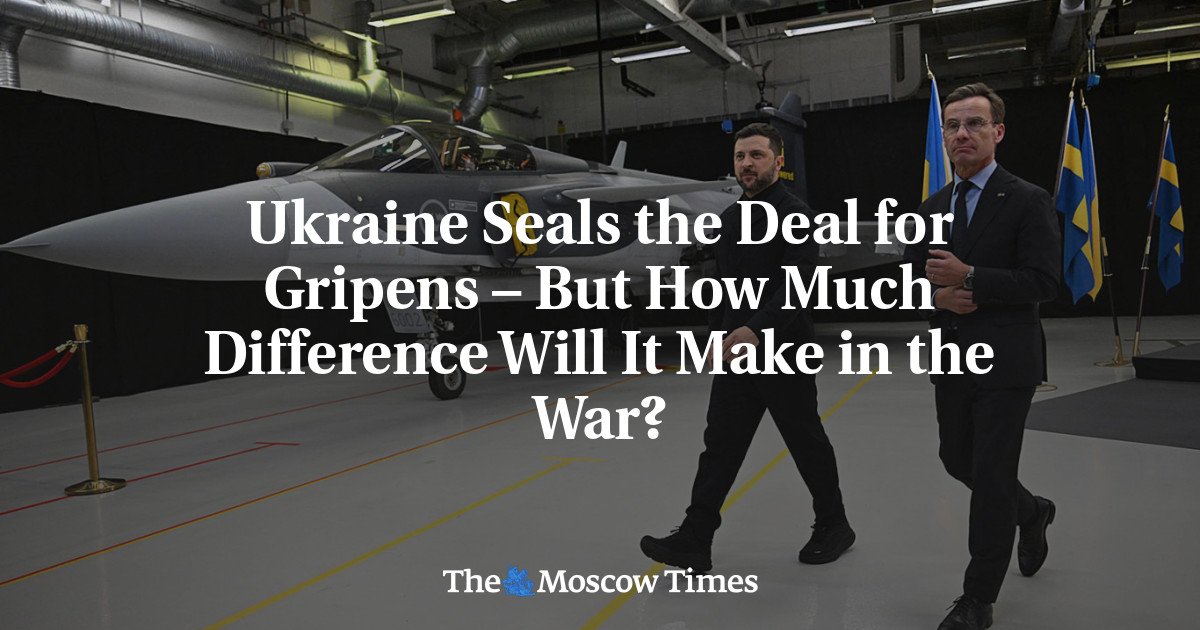
After years of discussion and preparation, Kyiv has struck a deal with Stockholm to obtain dozens of Gripen fighter jets to defend the country as Russia continues its intense aerial bombardment of Ukraine’s cities.
Sweden will donate 16 of its older Gripen C/D models to Ukraine, while Kyiv will buy a further 20 newer E/F models to be delivered over the coming years at a cost of 2.5 billion euros ($2.8 billion) financed buy the 90 billion euro ($105 billion) loan agreed with the EU. Kyiv’s ultimate goal is to acquire 100-150 of the famously versatile aircraft, which will more than double the size of its air force if delivered.
If the deal proceeds smoothly, the first jets could be delivered as soon as early 2027, Swedish Prime Minister Ulf Kristersson said at a press conference on Thursday. The country’s Defense Minister Pål Jonson said Ukrainian pilots were already being trained to fly the aircraft.
Though Gripens will not have a decisive effect on the war in Ukraine, Kyiv hopes it could put Russian aircraft in the crosshairs. But experts have long argued that the Gripen has attributes that make it well suited for Ukraine’s needs.
The agreement also comes at a politically significant time, days after Russia struck Ukraine with a hypersonic Oreshnik missile, while peace negotiations have fallen by the geopolitical wayside.
What’s so special about the Gripen?
For a country enduring its fifth year of war, under regular attack from above, the Gripen offers significant advantages over other jets. Anticipating that hangars and runways would be obvious targets for destruction in a war, Sweden designed the Gripen to be able to take off from short runways and even highways if necessary, meaning they can be dispersed away from their main base.
They are also easier to maintain than alternatives. All aircraft incur some damage during flight — especially military aircraft performing maneuvers faster than the speed of sound, pulling g-force measuring 9G and above.
Consequently, the Gripen spends 10 hours on average undergoing maintenance for every flight hour. That may seem like a lot, but it is much more efficient than the 17 hours F-16s need to fly one hour in good condition.
Gripens can also be refueled and rearmed to take off again in as little as 10 minutes, depending on the model, often with checks straightforward enough to be carried out by conscripts rather than professionals.
Another advantage is that it can operate without being entirely reliant on the United States for missiles. Some projectiles, including the Meteor, are produced using components manufactured across Europe, making continuing supply less reliant on Washington’s political priorities. The Iran war has already caused the U.S. to delay weapons shipments to Europe, some of which were ultimately intended for Ukraine, to protect its own stocks.
European leaders have sounded the alarm about whether the continent’s defense industry is stepping up production quickly enough to meet surging demand. MDBA, which manufactures Meteor missiles, say they doubled production of all products between 2023-25 and plan a further 40% growth over 2026. But the total number of missiles produced in a year is not publicly available.
What will the jets be used for?
Ukraine’s skies haven’t seen dogfights since the early days of the full-scale invasion of 2022 — a fact that won’t change anytime soon. Despite Russia’s failure to use its superior air force to achieve dominance over Ukraine’s skies, the aerial environment has become too hostile and full of threats to risk such valuable equipment.
As a result, Russia has kept its aircraft flying at high altitudes deep within its territory, firing glide bombs and missiles against Ukrainian cities, civilian infrastructure and military positions while staying out of range of Kyiv’s weapons.
Ukraine’s air forces have also faced constraints, being forced to fly at lower altitudes to avoid detection, which reduces the range of both its weapons and radar.
Instead, these Gripens will join Ukraine’s European F-16s, French Mirage 2000s and older Soviet-made aircraft as part of the country’s air defense network. These aircraft can deploy air-to-air missiles that can fly quickly enough to target Russian missiles while shooting down drones with their mounted guns.
President Volodymyr Zelensky said Thursday that he hoped the Gripen’s Meteor missiles could “stop Russian glide bomb attacks.”
The missiles are thought to have a range of up to 200 kilometers (124 miles), which would force Russian aircraft too far back from the Ukrainian border to launch the cheap but devastating projectiles.
Russian military aircraft still have an advantage over Ukraine in this respect. Their ability to fly at higher altitudes not only helps protect them from anti-aircraft weapons but gives them broader scope to monitor their surroundings for threats.
Ukraine’s use of drones and electronic warfare to suppress Russian air defenses on the southern axis had been successful enough that Russian aircraft launching glide bombs from above occupied Ukrainian territory could find themselves forced backwards, retired Air Marshal Ed Stringer, who served as Assistant Chief of Defense Staff in Britain from 2015-18, told The Moscow Times.
“If Ukraine continues to make advances as it’s doing at the moment, the picture only gets better for the employment of aircraft like the Gripen,” he said.
How have Ukraine’s F-16s fared?
Ukraine’s F-16s have flown over 1,600 sorties since entering combat in August 2024, during which they’ve shot down over 1,000 targets. In that time, Ukraine has lost four F-16s and three pilots.
Ukrainian officials have not confirmed whether its F-16s have destroyed any Russian aircraft. Kyiv has focused on targeting Russian aircraft at their bases with missiles, drones and sabotage.
Kyiv’s allies have pledged a total of 79 F-16s to be donated over the coming years. Around half of them have been transferred so far. But not all countries have delivered.
Norway’s six earmarked F-16s are currently being repaired in Belgium, which is itself yet to donate any of the 30 airframes promised to Ukraine. Brussels says the delay comes after new aircraft it ordered to replace the outgoing model have been delayed. Belgium also cited a request from Kyiv to hold back deliveries until more pilots have received necessary training.
Ukraine first asked to be sent Gripens in summer 2022, but switched to campaigning for F-16s a year later.
Although the F-16 is not as naturally suited to dispersed deployment as the Gripen and requires more complicated maintenance and support, it was more readily available as many European countries were by 2022 already in the process of replacing their functional F-16s with newer aircraft.
A Message from The Moscow Times:
Dear readers,
We are facing unprecedented challenges. Russia’s Prosecutor General’s Office has designated The Moscow Times as an “undesirable” organization, criminalizing our work and putting our staff at risk of prosecution. This follows our earlier unjust labeling as a “foreign agent.”
These actions are direct attempts to silence independent journalism in Russia. The authorities claim our work “discredits the decisions of the Russian leadership.” We see things differently: we strive to provide accurate, unbiased reporting on Russia.
We, the journalists of The Moscow Times, refuse to be silenced. But to continue our work, we need your help.
Your support, no matter how small, makes a world of difference. If you can, please support us monthly starting from just $2. It’s quick to set up, and every contribution makes a significant impact.
By supporting The Moscow Times, you’re defending open, independent journalism in the face of repression. Thank you for standing with us.
Continue
Not ready to support today?
Remind me later.
×
Remind me next month
Thank you! Your reminder is set.
