






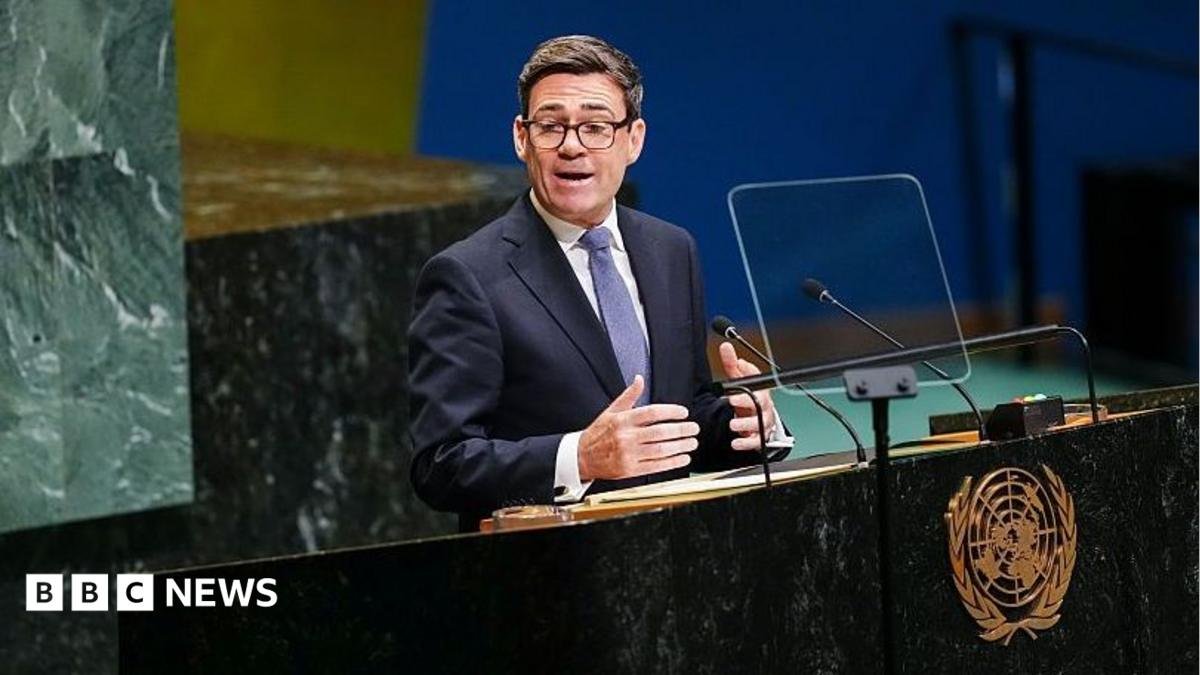
Before becoming prime minister, Burnham had said relatively little about how AI should be regulated.
Since taking power in July, Burnham’s government has stressed the need for international cooperation to combat the risks, as well as harness the potential benefits of the technology, warning that further regulation and legislation may be needed.
In his speech, Burnham described the most advanced “Frontier AI” as “one of the most significant challenges and opportunities of our age”.
He told world leaders AI would be “key to economic growth” but also a “multiplier of risk”.
The prime minister added: “We’ve all heard the warnings – which we must heed. I know how worried people are. So we have to rise to this moment.”
Burnham said the “UK has a unique position as an honest broker”, with close ties to the US and the European Union.
Burnham also highlighted the UK’s “world-leading” AI Security Institute, which was established under Conservative Prime Minister Rishi Sunak and tests major AI models to improve their safety before they are released publicly.
He pledged to put AI “at the heart of the UK’s G20 Presidency next year”, when leaders of the world’s biggest economies will gather in Manchester.
Burnham said the UK would work towards agreeing a set of global principles and standards to ensure transparency, access to AI models, and that development happens safely.
He added that this would “bring together welcome initiatives from others”, such as a proposal from Norway this week.
The declaration – which has the support of more than 20 countries, including Germany, Canada and Ireland – calls for AI to remain under human control and for mandatory pre-release testing of frontier models.
However, it has not been signed by the US and China, which dominate AI development, or the UK.
In his own address earlier, US President Donald Trump rejected “any attempt to construct a globalist scheme” to control AI.
Former cabinet minister Darren Jones, who served as chief secretary to Burnham’s predecessor Sir Keir Starmer, called on the PM to sign the declaration and offer to broker an agreement with the US on its implementation.
He argued there “should be a landing zone to agree mandatory testing”, without undermining competitive advantage between companies and nations.
The UK AI Security Institute’s testing of AI models is currently on a voluntary basis and AI company Anthropic reportedly refused to submit its latest model for testing.
Downing Street said officials had made clear in recent discussions with AI leaders that the government expects “full and total visibility of model developments”.
The prime minister has acknowledged that while developers have made significant commitments on transparency, nothing is off the table to keep the public safe, including legislation.
The Liberal Democrats and the Green Party have been putting pressure on the government to take further action on AI safety.
However, any international efforts to regulate AI would need the cooperation of the US and China.
Trump has dismissed warnings of AI destroying humanity as “a hoax” and rejected the idea of a global scheme to control the technology.
“We’re going to encourage it, not rein it in,” he told the UN General Assembly.
Meanwhile, the government has announced a new AI and Autonomy partnership between the UK and US, focused on protecting critical national infrastructure using AI tech.
Earlier in the day, Burnham and Trump had met, although Downing Street’s statement on the meeting did not mention that they discussed AI.


