



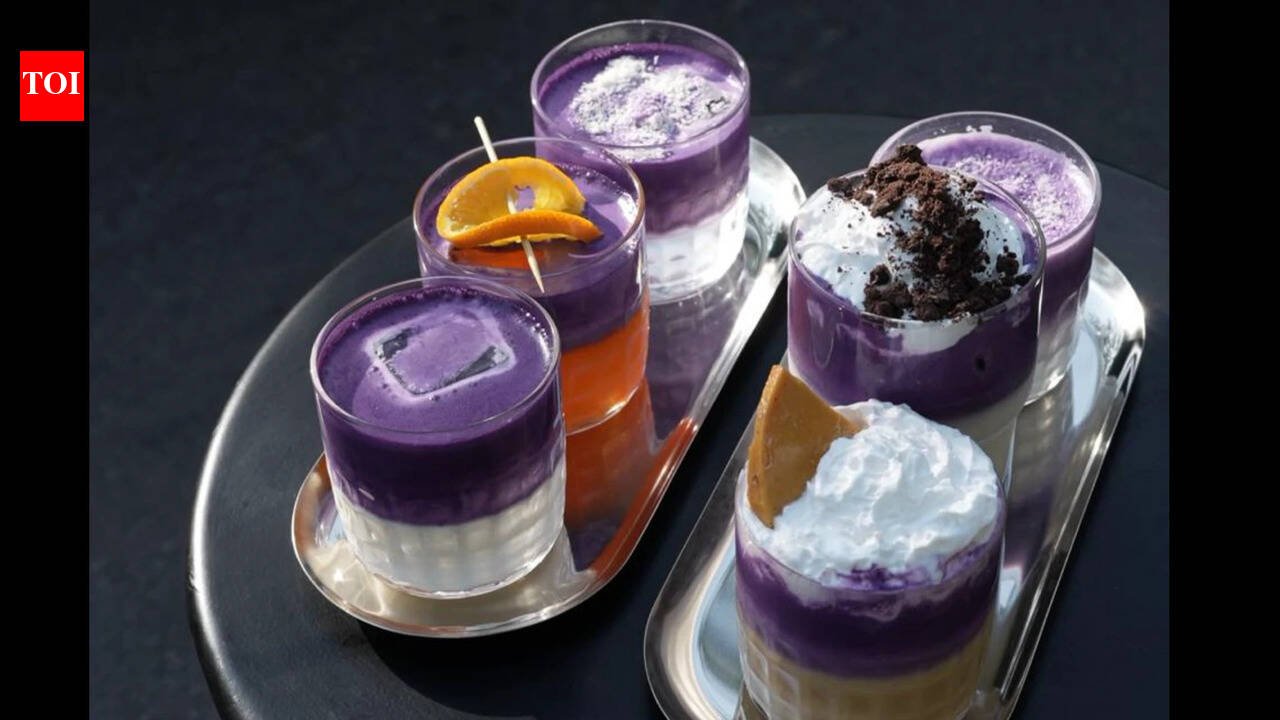
Have you noticed the purple wave hitting Hyderabad lately? That’s ube, the Filipino purple yam, and it’s showing up everywhere in lattes, mango coolers, and sweet treats popping up in your social media reels. It’s hard not to be drawn in by that crazy bright colour, but there’s more to this trend than just looks. Earning foodie cred right now means knowing exactly where to find the best purple drinks.
‘People are much more open to trying new flavours’Hyderabad’s café owners believe the city’s diners are adopting global café trends faster than before. “I don’t think Hyderabad is behind anymore. For example, the amount of matcha being consumed here is almost at par with global consumption. Earlier, trends took time to travel from the West to India, but today technology and social media have narrowed that gap. People are much more open to trying new flavours than they’re often given credit for,” says Sharath Chandra Reddy Gattu, co-founder of Bagel Brigade.
Dimple Wadhwani, food and travel creator @thefoodierider_hyderabad
I’d seen ube desserts all over social media, so I finally tried an ube cheesecake and it completely won me over. It had a creamy texture and a subtle, nutty sweetness unlike any cheesecake I’d tasted before. I’d definitely order it again
Rohan Mehta, software engineer
‘The colour starts the conversation; the flavour brings people back’For cafés experimenting with ube, the ingredient’s vibrant purple hue may be what draws customers in, but its flavour determines whether they return. “The colour is almost always the first conversation. It stops people in their tracks. But the repeat order comes from the flavour. Unlike matcha, where people have to develop a taste for its earthy bitterness, ube is creamy, gently nutty and subtly sweet, making it far easier to embrace on a first sip,” says Swati Upadhyay, co-founder of Conçu. Big Star Cafe founder and CEO Thulsi Ram Reddy B adds that the ingredient’s flavour makes it approachable. “Ube has subtle notes of vanilla, making it much easier for people to get used to. That’s what makes it work so well in beverages.”
It accounts for roughly 15–20% of our beverage sales and continues to grow as more people discover it through friends and social media. Just like matcha did a few years ago, ube is starting with curious customers and gradually building a loyal following
Neelima Tatini, co-partner, 9Bar Speciality Coffee
‘The appeal lies in its versatility’From Altr Ego’s ube sticky rice softie and ube cloud to Ruth’s Cafe’s ube shake and latte, cafés are increasingly experimenting with the purple yam in different formats. While ube has been popular across Southeast Asia for years, Hyderabad is slowly beginning to explore its potential. Food consultant Aditi Rao says, “What makes it exciting is that it offers both visual appeal and a flavour that’s subtle enough to work across desserts, beverages and even savoury applications. I think the city is at the stage where diners are willing to try something unfamiliar, provided it’s presented in a way that’s still approachable.”
Ube’s flavour is subtle, earthy and slightly nutty, making it stand out from the usual café flavours. It’s an acquired taste for me, but once you cross the hype and learn to appreciate it, it elevates the dish to a different level
Dimple Wadhwani, food and travel creator
Try it at home: Ube cookies
Ingredients
- 160g all-purpose flour
- 115g butter, softened
- 115g light brown sugar or caster sugar
- 1 egg
- 1 tbsp ube powder
- 1 tsp vanilla extract
- ½ tsp baking soda (optional)
- ¼ tsp salt
Method
- Preheat the oven to 170°C and line a baking tray.
- Cream the butter and sugar until light and fluffy.
- Beat in the egg, vanilla and ube powder.
- Fold in the flour, salt and baking soda (if using) to form a soft dough.
- Scoop portions onto the prepared tray and bake for 18 minutes, until the edges are lightly golden.
— Inputs by Shrestha Mukherjee


