



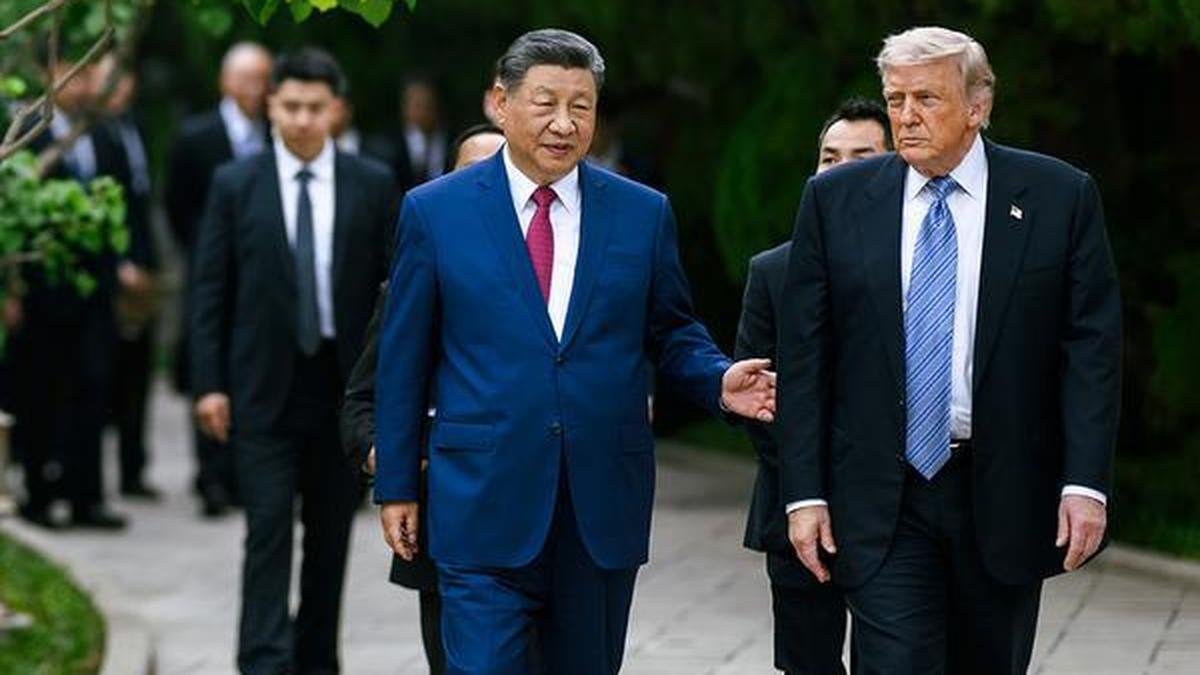
Donald Trump, U.S. President, visited China during May 13-15 to meet with his counterpart, Xi Jinping, after a nine-year gap. The visit was dominated by symbolism and lacked immediate tangible deliverables. Nonetheless, there was a clear acknowledgment from both sides about the need to restore stability after a decade of trade war.
What is the context and significance of Trump’s visit to China?
To understand the motivations behind Mr. Trump’s visit to China, it is important to look back at the trajectory of U.S.-China relations over the past decade. Mr. Trump’s first presidency initiated America’s trade war against China in 2018. This was aimed at decoupling the two countries from four decades of economic interdependence, which was increasingly strained by strategic competition.
After Mr. Trump’s return as President in 2025, he escalated tariffs on China, prompting equal retaliation from Beijing. Eventually, a one-year trade war truce was announced in South Korea in October 2025 during the APEC summit in Busan — the first and only other time Mr. Trump met Mr. Xi during the former’s second term. Though this meeting led to a freeze in the deterioration of U.S.-China ties, a thaw was pending. The recent visit was primarily aimed at initiating this thaw.
The visit is happening at a time when the world is facing an energy crisis resulting from the closure of the Strait of Hormuz during the ongoing Iran-U.S. war. Simultaneously, cross-strait ties between China and Taiwan are under mounting strain, with Taiwan’s pro-independence Democratic Progressive Party government facing off against Beijing, which has become increasingly assertive about reunifying the island with the mainland. Given Taiwan’s defence ties with the U.S., any cross-strait conflict can flare up into one involving the U.S. Consequently, cooperation between the U.S. and China has become imperative to safeguard global stability.
The visiting delegation was marked by the presence of the most high-profile American business executives representing the key private players in the American economy. The selection of the CEOs in Mr. Trump’s business delegation indicated that technology, semiconductors, aerospace, and agriculture were the key focus of the trade discussions. The inclusion of Pete Hegseth was unprecedented, as it marked the first time a sitting U.S. Defence Secretary (now Secretary of War) accompanied an American President on a state visit to China. His presence highlighted the U.S. efforts to dial down the military tensions with China amid the rising cross-strait volatility. By receiving U.S. Secretary of State Marco Rubio as an official state guest despite its own existing sanctions against him, Beijing underscored its commitment to restoring stability to the bilateral relationship.
What were the expectations from both sides?
Mr. Trump’s expectations from the visit seem to be based on three important objectives: salvaging ties with China at a time of global tumult, expanding market access in China amidst domestic challenges, and securing Beijing’s support to end the war with Iran.
It has to be noted that U.S. mid-term elections are due this year, which will decide the fate of the Trump administration’s remaining term. With energy costs climbing, Mr. Trump clearly aimed to use the visit to clinch a trade deal and open the Chinese market to American businesses. He desperately wanted China to buy more chips, aircraft, agricultural produce, and energy. Jensen Huang, CEO of Nvidia, was added to the business delegation at the last minute as Washington sought to convince China to purchase Nvidia’s H200 Graphics Processing Units (GPUs) in return for easing technology restrictions. The U.S. was also awaiting three deals — the three Bs (beans, beef, and Boeing). China had earlier targeted soybeans and beef during the trade war to inflict pain on the U.S., while purchases of Boeing aircraft had stopped since 2017 amid worsening ties.
Meanwhile, Mr. Xi’s expectations centred on keeping the U.S. away from Taiwan and bringing back a much-needed sense of normalcy in bilateral relations with the U.S.
In return for China’s diplomatic support towards winding down the Iran-U.S. war, Beijing may have expected Mr. Trump to formally denounce any efforts by the Taiwanese government towards Taiwanese independence. The visit by Cheng Li-wun, opposition leader from the pro-Beijing Kuomintang Party in Taiwan, may also have been timed to strengthen China’s negotiating position on Taiwan.
China has high stakes in Iran and the Strait of Hormuz — its ability to resolve the West Asian crisis diplomatically would not just secure its economic interests, but also deepen its strategic foothold in the region. As much as Mr. Xi would like to get some relief from technology restrictions, he may also have wanted to utilise the pageantry of the visit to bolster his image in the domestic political milieu, where power struggles within the Communist Party of China have reached levels of intensity unseen in decades.
What were the major outcomes of the visit?
The visit turned out to be more symbolic than substantial, with no joint statements published or agreements signed during the visit, contrary to expectations. Likely, the deals are still in process, and the details may emerge in the coming days and weeks.
What stood out during the visit was the personal chemistry between the two leaders, as they indulged in both formal and informal exchange of views for several hours in the Great Hall of the People, the Temple of Heaven, and the Zhongnanhai leadership compound in Beijing. At these venues, Mr. Xi projected China’s political and civilisational might in front of Mr. Trump. Some of the remarks and statements made during the interactions offered vague indications about where the two countries wanted to take the bilateral relations.
At the state banquet, Mr. Xi said that China and the U.S. should be “partners rather than rivals” and stressed that both countries “must make it work and never mess it up”. According to Chinese readouts, Mr. Xi said that Mr. Trump had agreed on a new vision of a “constructive China-U.S. relationship of strategic stability” for the next three years — the remaining period of Mr. Trump’s presidency. Mr. Xi also signalled openness to American exports, telling business leaders accompanying Mr. Trump that “China’s doors to the outside world will open wider and wider.”
However, Mr. Xi was very categorical about Taiwan to the American delegation. He warned that “the two countries will have frictions or even confrontation” if the U.S. does not handle the Taiwan issue “with great caution”.
Mr. Trump, meanwhile, expressed hope to usher in the “best U.S.-China relationship in history”, even using the controversial term “G2”. According to him, China had offered to buy 200 Boeing aircraft and 450-500 aircraft engines from the U.S. China’s commerce ministry later on confirmed that such arrangements were reached, without details.
As per Mr. Trump, Mr. Xi expressed interest in buying more oil from the U.S. to reduce dependence on the Strait of Hormuz, and in resolving the regional crisis. He further mentioned that China had agreed to buy American soybeans. It has to be noted that during the visit, China restored the licenses for hundreds of American beef plants.
Although Mr. Trump acknowledged that China is serious about developing its own chip capability, he retained hope about the sales of Nvidia’s H200 chips. Mr. Trump held on to America’s traditional “strategic ambiguity” about Taiwan during the visit, but he did mention to the American media after the visit that “the last thing we need now is a war 9,500 miles away”. Further, he remained vague about going ahead with arms sales to Taiwan.
Even though the visit gave an impression of a likely thaw unfolding, the questions posed by Mr. Xi to his guests remains, and perhaps may remain, unanswered — “can China and the United States overcome the Thucydides Trap and create a new paradigm of major country relations? Can we meet global challenges together and provide greater stability for the world? Can we build a bright future together for our bilateral relations in the interest of the well-being of the two peoples and the future of humanity?”
(Anand V. is an Assistant Professor (Senior Scale) of Geopolitics and International Relations at the Manipal Institute of Social Sciences, Humanities and Arts (MISHA), Manipal Academy of Higher Education (MAHE), Manipal. The views expressed are personal)
Published – May 18, 2026 08:30 am IST


