


Ahmedabad: Every morning, workers climb onto tractor trailers to reach factories located in the industrial estates along Changodar’s industrial belt. Nearly two weeks after the July 23 deluge, waterlogged roads in the area remain inaccessible to buses and smaller vehicles. Manufacturers said the flooding has stalled dispatches, raised transport costs and prevented production from returning to normal even 12 days after the downpour.Swastik Industrial Estate is among the worst-affected areas. Industrialists said workers have to be picked up from the highway and taken to factories in tractors every morning.
Changodar industry body writes to Gujarat chief minister for help after July 23 deluge floods area
“We employ around 200 people and have hired tractors to bring them to the factory every day. It is risky for workers to climb onto tractor-trailers, but we have no choice,” said Valkesh Prajapati, who owns an induction furnace manufacturing unit in the area.Prajapati said the flooding had brought material movement to a standstill. Dispatches of heavy induction furnace equipment worth nearly Rs 15 crore remained stuck, he added.Industry estimates indicate that factories where water entered production areas may have suffered losses of Rs 5 crore to Rs 10 crore each because of halted output. These losses are in addition to damage to machinery, raw materials, and finished goods, industrialists said.Sapan Majmundar, managing director of a textile manufacturing unit, said his factory had to stop production completely for six days after water entered the premises.“Roads are still under about 3ft of water,” Majmundar said. “Our customers run continuous production lines. When our manufacturing stops, the disruption travels further down the supply chain.”
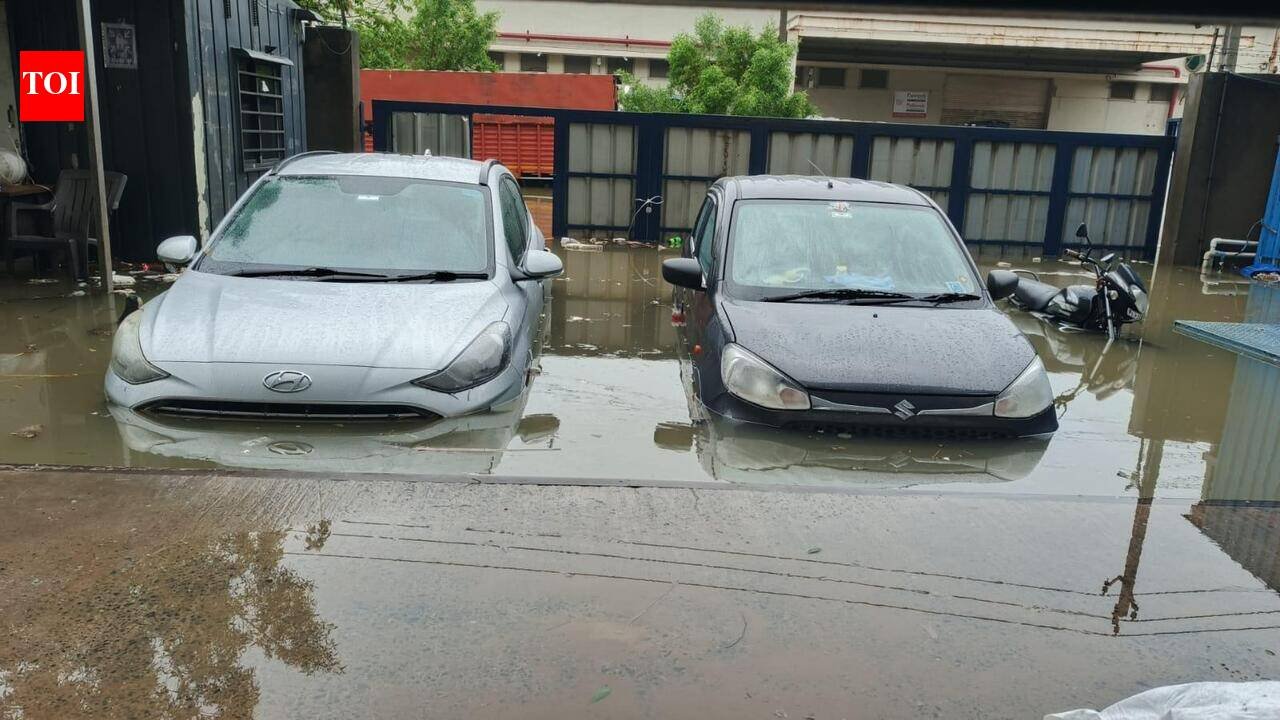
Car submerged after July 23 deluge in Changodar industrial belt
Floodwater entered parts of the factory even though its plinth is higher than the adjoining highway, he said. The company narrowly avoided damage to imported machinery valued at between Rs 15 crore and Rs 20 crore.“Had the water risen another two feet, machines imported from Germany would have been damaged. Replacements take about a year to arrive,” Majmundar said.The flooding has also made routine consignments considerably more expensive. Sukesh Shah, director of a cable manufacturing unit in the estate, said his company was hiring five-tonne trucks to carry consignments weighing just 300kg to 400kg because smaller commercial vehicles could not reach the factory.“We are paying nearly five times the normal transport cost. Transporters are reluctant to enter the estate, delaying deliveries and increasing expenses,” Shah said. A prospective customer from Madhya Pradesh also postponed a factory visit because of the flooding, he added.
Three feet of water still remain on roads in Changodar industrial belt 12 days after July 23 deluge
Industrialists say the recurring inundation points to a larger infrastructure failure rather than an unusually heavy spell of rain.They blamed inadequate stormwater drainage and development that they said had obstructed natural channels. “The level of the adjoining highway has been raised over the years, but no corresponding stormwater drainage network has been created for the surrounding industrial estates,” an industrialist said. “Water must eventually flow into an irrigation or stormwater canal, but development has blocked the natural contours and drainage routes.”Sources told TOI that the issue is not isolated and limited to 2026 alone. For the past four years, similar issues have been cropping up every monsoon, causing production losses in addition to damage to premises and equipment, and hampering movement of goods.
