



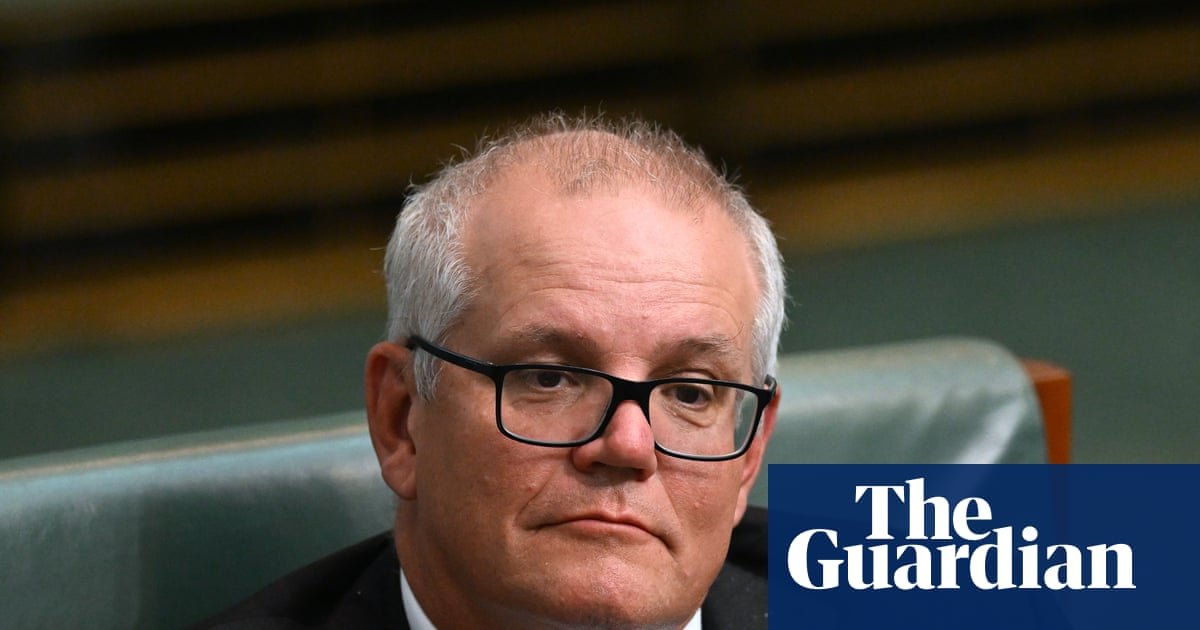
Two former public servants referred to the anti-corruption watchdog by the royal commission into robodebt have been found to have engaged in serious corrupt conduct while the former prime minister Scott Morrison has been cleared.
The long-awaited report into potential corruption related to the unlawful income averaging scheme, released on Wednesday, covered the six referrals made by the royal commissioner Catherine Holmes in 2023, which were restricted from the public view in a sealed chapter.
The National Anti-Corruption Commission’s investigation, which began in February 2025 after an independent reviewer said it should occur, examined the actions of the five former public servants and the former prime minister relating to the development, approval and implementation of the robodebt scheme in 2015, 2017 and 2018.
The Nacc initially declined to investigate the six individuals. But an investigation went ahead after its oversight body, the Nacc inspector, found that the decision was “affected by apprehended bias” after determining that the commissioner, Paul Brereton, had not removed himself from the decision-making process despite declaring a perceived conflict of interest.
The attorney general, Michelle Rowland, thanked the Nacc and said the federal government would move to table the previously sealed chapter.
The commission’s findings named the former human services department official Mark Withnell as having intentionally misled Department of Social Services (DSS) officers during the preparation of a cabinet submission in 2015.
The Nacc’s report found that Withnell had known at “all relevant times” that “automatic default averaging” would be key to the robodebt process, known internally as the online compliance intervention program. It found that it was “serious corrupt conduct committed by a high-ranking public official”.
The Nacc did not recommend his referral to the commonwealth director of public prosecutions because there was “not sufficient admissible evidence to establish either of those offences beyond reasonable doubt”.
The former social services deputy secretary Serena Wilson was also found to have engaged in serious corrupt conduct by intentionally misleading the commonwealth ombudsman during an investigation in 2017. According to the report, the Nacc did not consider the evidence sufficient to prove the offences beyond reasonable doubt.
The Nacc deputy commissioner Kylie Kilgour said publishing the report “provides transparency as to how those conclusions were reached”.
The watchdog described the investigation as “complex”, relying on evidence obtained through the royal commission as well as documents produced under statutory notices and evidence through interviews and hearings from more than 40 witnesses.
Sign up: AU Breaking News email
The other four names referred to the Nacc but not found to have engaged in any corrupt conduct included Morrison, Kathryn Campbell, Annette Musolino and Catherine Halbert.
The report found that Morrison’s failure to detect misleading advice from the department was caused by social services and human services departments both failing to advise him and other ministers that new laws were required.
Scott Morrison welcomes Nacc findings
Under Westminster conventions, government ministers are ultimately responsible for the actions of their departments. But the Nacc report said this did not mean Morrison was “personally at fault for not detecting the failings of DSS or that he set out to act dishonestly or in bad faith”.
In a statement, Morrison said the Nacc’s findings “rightly rejected the false political narrative, inferences and perceptions created and promoted by the Labor government regarding my conduct and involvement in the robodebt scheme”.
“The Nacc has rightly concluded that ministers must be able to rely on the accuracy of the advice provided by their departments, especially on matters of technical expertise, and receive that advice in good faith,” he said.
“Whether they follow that advice is a matter for those ministers. In this case, I relied upon, and followed, that advice. The departmental advice and warranties provided to ministers were wrong.”
The Nacc report also examined the conduct of Campbell, who was one of two department heads named by the Australia Public Service Commission in 2024. The APSC found that 12 public servants, including Campbell and the former department head Renée Leon, had breached the code of conduct 97 times during their involvement in the robodebt program.
Campbell was the Department of Human Services (DHS) secretary from 2011 to 2017 before leading the social services department until July 2021.
The Nacc’s report clears Campbell of corrupt conduct, saying it was more likely another public official, who has since died, had told PwC it wasn’t required to deliver its final report into the scheme. That full report determined the program would not deliver the projected savings, was producing a significant percentage of inaccurate debts and that it had been a failure.
Mixed reaction
The Greens’ social services spokesperson, Penny Allman-Payne, was critical of the report’s lack of further recommendations for those found to have engaged in corrupt conduct.
“There may be some small satisfaction found in the fact that two staff were found to have acted corruptly, but the architects of robodebt are still sitting pretty,” the senator said.
“No government minister has been held accountable, which means no government has been held accountable.”
The independent MP Andrew Wilkie said it was “a rare moment of accountability” but that many victims would find this “difficult” to square with the apparent lack of repercussions.
“Australians deserve a public service and a political system that protects the vulnerable, not one that harms them,” he said.
In June 2024, 11 months after the royal commission report was published, the Nacc announced it would not launch a corruption investigation into the six individuals as “it would not add value in the public interest”.
The Nacc claimed it did not see value in “duplicating work that has been or is being done by others”, reference the APSC’s then investigation of workplace code of conduct breaches.
By September, the Nacc inspector, Gail Furness, announced an investigation of the Nacc’s decision after receiving more than 900 complaints about the issue in just three months.
Furness concluded that the decision not to investigate was “affected by apprehended bias”. Guardian Australia revealed that Brereton held a “close association” with one of the referred individuals relating to his service in the army reserve.
While Brereton delegated the decision not to pursue an investigation, Furness found that Brereton’s “involvement in the decision-making was comprehensive, before, during and after the 19 October 2023 meeting at which the substantive decision was made not to investigate the referrals”.


