



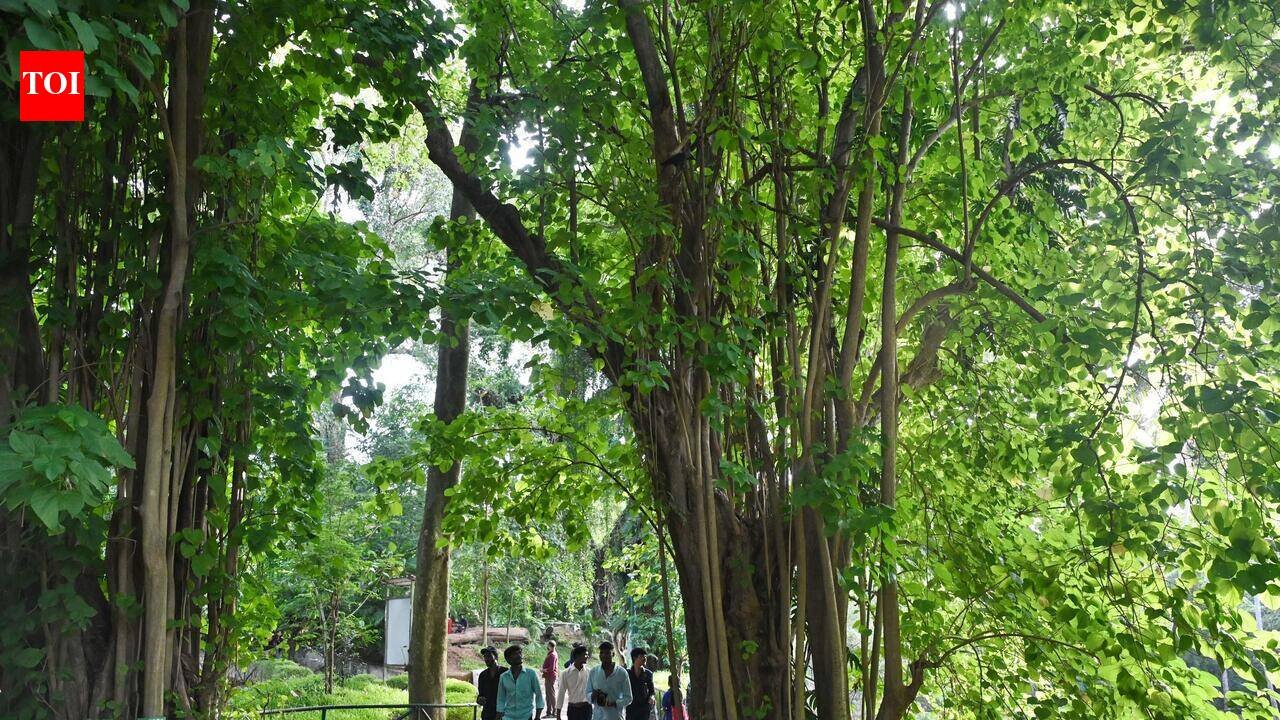
Thiruvananthapuram: From its oldest surviving rubber tree to a variety of rare, indigenous, exotic and endangered species, the 36-acre Zoological Park is home to nearly 200 tree species, creating a verdant oasis in the heart of a city grappling with rapid urbanisation.But its trees, bamboo groves, shrubs and ponds also home to around 93 species of free ranging birds, 120 species of butterflies now face an uncertain future, with concerns that several trees—some of which have grown tall and broad over more than a century—could be destroyed if the zoo animals are relocated and the vacated land is taken up for landscaping or redevelopment.Chief minister V D Satheesan has suggested that the zoo may be moved out of the city.
Chief minister V D Satheesan has suggested that the zoo may be moved out of the city
However, it serves as a vital greenbelt. True to this role, a large monkey-pod tree, or mazhamaram, with sprawling branches dominates the zoo entrance. The pathways leading to the animal and bird enclosures are lined with diverse species, including mahogany, cat-fruit, West Indian elm, Malabar kino, Indian copal, kaaral, Indian blackberry, American mahogany, devil tree, peepul, blackbean, cannonball, Trincomalee and rain trees. The dense tree canopy shielded visitors from the heat, creating a forest-like setting.A study on Trees of Thiruvananthapuram Museum and Zoo by Namitha L H and Gangaprasad A, says that there are 258 species of trees under 192 genera representing 55 families.Of this, the charcoal tree and Indian copal tree are classified as critically endangered. Velvet apple, Malabar ironwood, Malabar Humboldtia, illipe butter tree, candle tree, red sandalwood, small-leaved mahogany and wild jamun are classified as endangered, while star pine, jungli almond, Brazilian arara nut, Malabar nutmeg, Ceylon boxwood, Malabar kino and big-leaved mahogany are classified as vulnerable.The study said many trees were brought from around the world over a century ago, including a sprawling rubber tree from Sri Lanka planted during Uthram Thirunal Marthanda Varma’s reign.
The study said many trees were brought from around the world over a century ago
Gangaprasad, a retired professor from the dept of botany in University of Kerala, who supervised the study, said that many of the trees are exotic ones brought during the British times. “There are many medicinal plants, ornamental plants and local trees like Kudapana and other palms. People will not even identify many of the local trees,” he added.He said that the trees and plants need to be maintained as such even if the animals are moved because it is impossible to measure the contribution of trees, especially in generating oxygen and in controlling pollution.“It is not easy to remove these huge trees, and many are slow growing ones that have grown to this size after several years. I hope they will turn it into a park as the city needs this green space.”Environmental historian Sebastian Joseph said the zoo should be retained at its present location as an ecological space where plants, trees, animals, reptiles and birds coexist. He added that it also had social significance, as many people visited it to experience nature.“We must preserve it as a cultural eco-zone at a time when spatial and ecological memories are being lost. Whatever intervention is undertaken, some part of it will be destroyed,” he said. He said no such space existed elsewhere in the state.
Thiruvananthapuram had been a model city since the days of the erstwhile royal regime and had several firsts
Thiruvananthapuram had been a model city since the days of the erstwhile royal regime and had several firsts, including an underground electricity cable laid between Kowdiar Palace and the Museum in the late 1930s, he said, stressing the need to preserve its heritage.
