


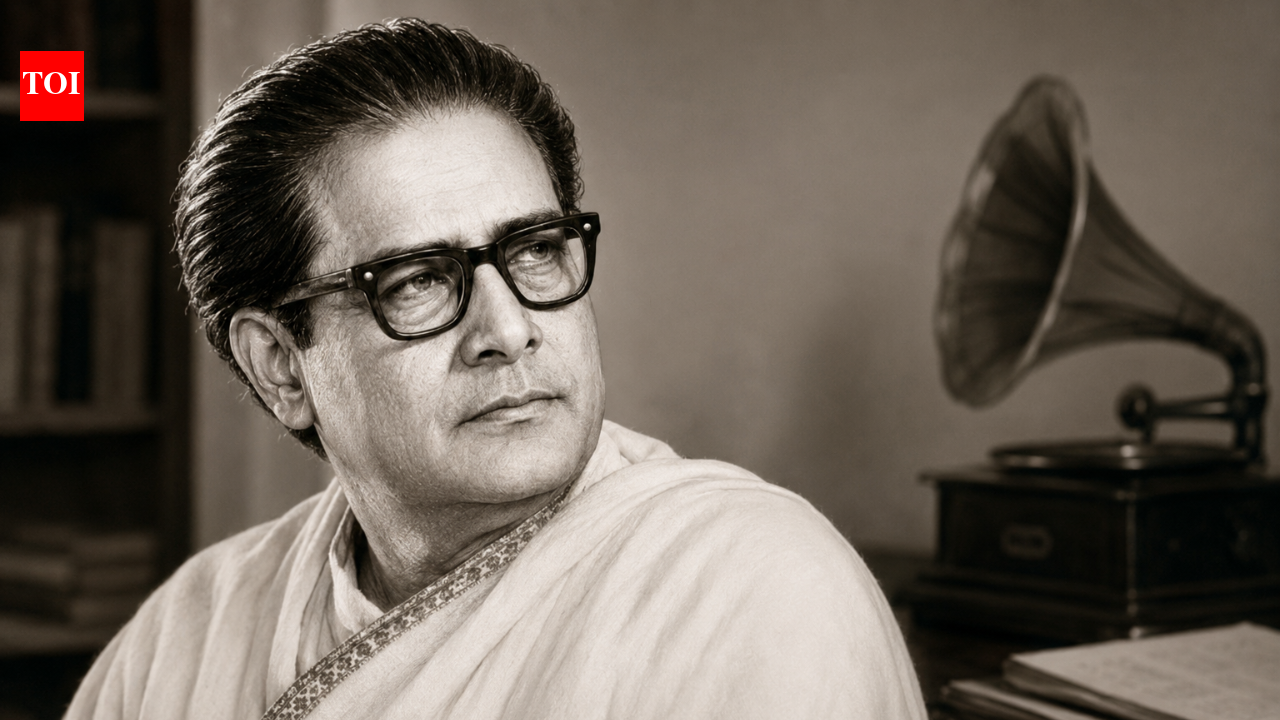
सिर्फ़ एहसास है ये रूह से महसूस करो……This is just a feeling, experience it with your soul. Gulzar’s lyrics and Hemant Kumar’s music. These words ring absolutely true when set to Hemant Da’s melody and songs. His voice had an emotional chord that could calm a listener, a voice that could kindle intense emotions, a voice that was called “voice of God” by nightingale Lata Mangeshkar. Every time Lata and Hemant da teamed up, they produced timeless tunes. In her Shraddanjali album, Lata mentioned that listening to Hemant da feels like hearing a hermit by the river or in a temple, singing with a heavenly voice. Listen Dheere Dheere Machal Ae Dile Bequarar. The combination of strings, flutes, and rhythm solely through the bass guitars creates such magic that Hemant has conjured! Unlike many of his peers in the 1950s and 60s, who leaned on elaborate orchestration, Hemant Kumar crafted melodies from silence, mood, and emotional subtlety. His compositions are lyrical, reflective, intoxicating and hauntingly beautiful.
One of the most beautiful night melodies ever created for Hindi films is from the 1952 film Jaal- “Yeh Raat Yeh Chandni Phir Kahan…” The soft rhythm, the airy accordion notes, and Hemant Kumar’s smooth voice created a mood, crafted a feeling of closeness that’s hard to beat. The song set the stage for a new genre romantic night song and inspired many future works. Director Guru Dutt was so taken by Hemant Kumar’s talent for creating mood that he kept working with him on other iconic films. Even in Pyaasa, though composed by S D Burman Guru Dutt opted for Hemant Kumar as playback for “Jaane Woh Kaise Log The”. The song in Hemant da’s voice beautifully captures the emotional essence of the film. His subtle interpretation of Sahir Ludhianvi’s lyrics set a standard for philosophical sadness in Hindi film music.When K Asif offered Mughal-e-Azam to Naushad his biggest concern was ‘Anarkali’. Not because the subject was the same but because of the song “Jag dard ishq Jag..” and how he could possibly outshine that enchanting song. Composed by C Ramchandra and performance by Hemant Kumar and Lata Mangeshkar made it a timeless melody. In fact whenever Lata and Hemant da collaborated, they created magical melodies. Like “Yaad kiya dil ne kahan ho tum” in Patita and “Nain se nain” from Jhanak Jhanak Payal Baje.As a composer Hemant Kumar created another masterpiece for Guru Dutt’s Sahib Bibi Aur Ghulam. The film’s songs are not mere interludes; they are emotional texts that reveal the inner life of Chhoti Bahu, perhaps one of the most tragic female characters of Hindi cinema. Two songs in particular I would like to mention. “Na Jao Saiyan Chhuda Ke Baiyan” and “ Piya aiso jiya mein samay gayo re”. In the first song Hemant Kumar’s composition unfolds gently, almost hesitantly, allowing Geeta Dutt’s voice to carry the emotional burden. Her singing is remarkable. It never becomes theatrical. The voice trembles with vulnerability, as though the singer herself fears rejection. It captures the fear of being abandoned by someone whose presence defines one’s existence. If “Na Jao Saiyan” is a lament, “Piya Aiso Jiya Mein Samaye Gayo Re” is a celebration. It depicts the rare moment when Chhoti Bahu experiences the happiness she has long craved. She feels transformed. Song is filled with happiness but there is also an undercurrent of fragility. Again sung by Geeta Dutt, the song possesses a delicate semi-classical grace. Hemant Kumar draws upon traditional North Indian musical idioms, creating a composition that feels intimate and aristocratic, perfectly suited to the decaying zamindari world of the film.Few composers in Hindi cinema grasped the essence of silence quite like Hemant Kumar. His tunes often seem to rise from quietness, conveying feelings too fragile for words. Perfect example is “Tum Pukar lo” from Khamoshi. The beginning is truly unforgettable. Before the lyrics fully unfolds, there’s an uncomfortable sense of waiting. As if someone has been waiting alone for years, hoping to hear a familiar voice. Hemant Kumar’s voice is key to its enchantment. Very few singers have such a rich but vulnerable tone. He performs not as an artist but as a man sharing his innermost feelings. Each line is simple, making the emotion feel real and close. Musically, the arrangement is minimal. That haunting whistle creates a sense of complete loneliness. Silence is valued just as much as sound. Listening to the song is like sitting in solitude, immersed in memories. “Yeh Nayan Dare Dare” beautifully captures the fragile uncertainty of love’s initial stirrings. Featured in Kohraa, the song’s greatest strength is its restraint. Sung by Hemant Kumar and penned by Kaifi Azmi, it stands out as one of the most exquisite portrayals of romantic hesitation in Hindi cinema. Hemant Kumar’s voice flows effortlessly through the melody, embodying pure tenderness. There’s a remarkable softness in his singing, as if he worries that too much emotion might break the fragile moment.
Any discussion or writeup won’t be complete without mentioning the iconic song “Man Dole Mera Tan Dole” from Nagin. The renowned producer S Mukherjee offered him the chance to compose the music for the film in 1954. The ‘Been’ (instrument used by snake charmers) sound created by his assistant Kalyanji Veerji Shah. Kalyanji played clavioline and other assistant Ravi Shankar Sharma played harmonium became a sensation and the film gave Hemant Kumar much needed success as a music composer. The tune not only transformed folk-inspired music into mainstream cinema but also demonstrated how innovative instrumentation could be used as a central dramatic character in film music. Later both his assistant Kalyanji with his younger brother Anandji set out to forge their own path as a prominent composer duo, while Ravi also established himself as a successful music director.The lasting appeal of Hemant Kumar’s compositions lies in the simplicity. His music compositions create a vulnerable emotional atmosphere. They remind us that the most profound emotions are often expressed in the quietest moments. If love is a passion and excitement, sometimes it is also a hesitant glance, a silent wait, a memory that refuses to fade. Just feel them from your soul.
