


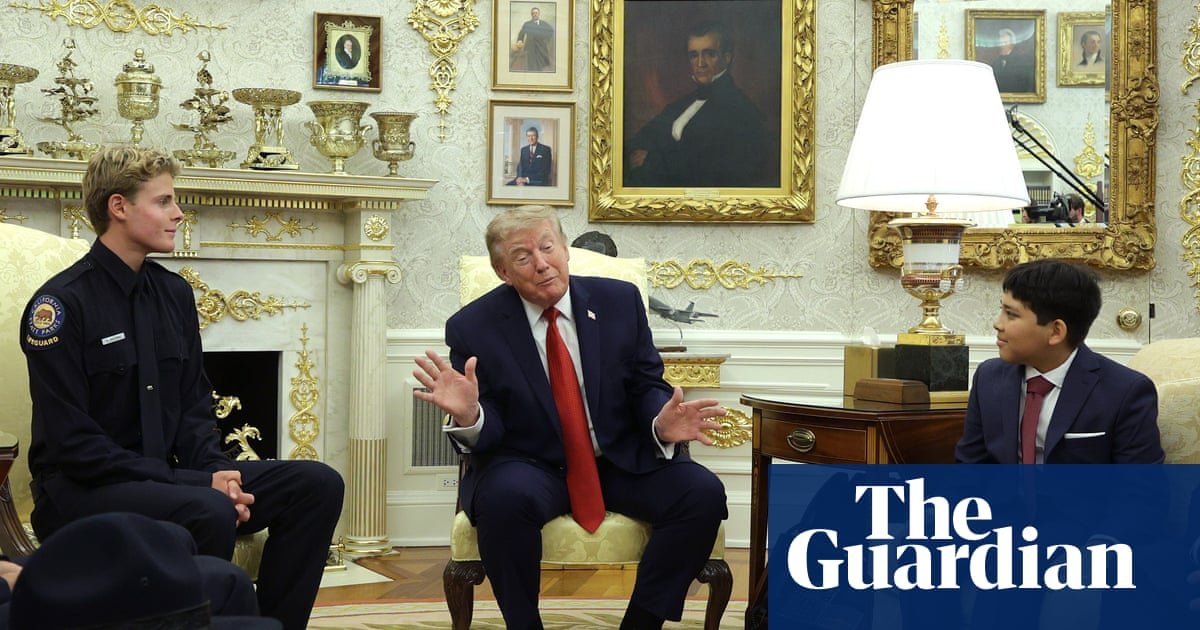
Nathanial Rai had been swept off his feet along the California coast, was rescued by a 16-year-old lifeguard – and was now sitting in the Oval Office with Donald Trump.
Of the rescuer, Ryder Williams, Trump said to Rai: “He’s a real hero. I don’t know if I’d do it.
“I wouldn’t, probably. You’re lucky I wasn’t on the service that day.”
Rai, 10, wore a dark suit and maroon tie and sat on a gold couch aside his father and Trump. Across from Rai was Williams, and both watched Trump speak of their ordeal, a video of which went viral.
Trump met the lifeguard and Rai after saying the teen deserved a civilian honor. Trump previously said on social media that he also would be inviting Williams to the White House to reward his bravery.
Dramatic video of the rescue went viral in late July. It showed Williams clinging to Nathaniel Rai as pounding waves repeatedly crash over them. The pair disappeared from view and reemerged after several seconds as the wave receded.
A second lifeguard, Aaron Bohnen, was eventually able to help get them both back to shore at Seabright Beach in Santa Cruz.
Trump initially commented on the video in response to a post from his son, Eric Trump, who said Williams deserved “the highest civilian honor”.
Meanwhile, Rai’s father, Sumit, told the Associated Press of Williams: “What he did, I can never repay. I’m forever grateful.”
As NBC Bay Area reported, Williams’s rescue of Rai unfolded as California state lawmakers reviewed proposed legislation that would officially make lifeguards first responders.
The outlet noted that analysts say giving lifeguards first responder status would bring them more professional recognition, support and resources – and could offer them better worker protections and benefits.
NBC Bay Area spoke with some people who could not believe lifeguards were not already first responders. But the outlet also spoke with Santa Cruz state senator, who said such a designation was not straightforward.
“Of course, lifeguards are first responders, but first responders also go through this rigorous training, so you’d have to decide – because in the peace officer standards training you go through eight months of training – so you’d have to decide what’s appropriate here,” NBC Bay Area quoted Laird as saying.
“How does it work? How does it get designated? What training comes with it? Who pays for it?”
The Associated Press contributed reporting
