



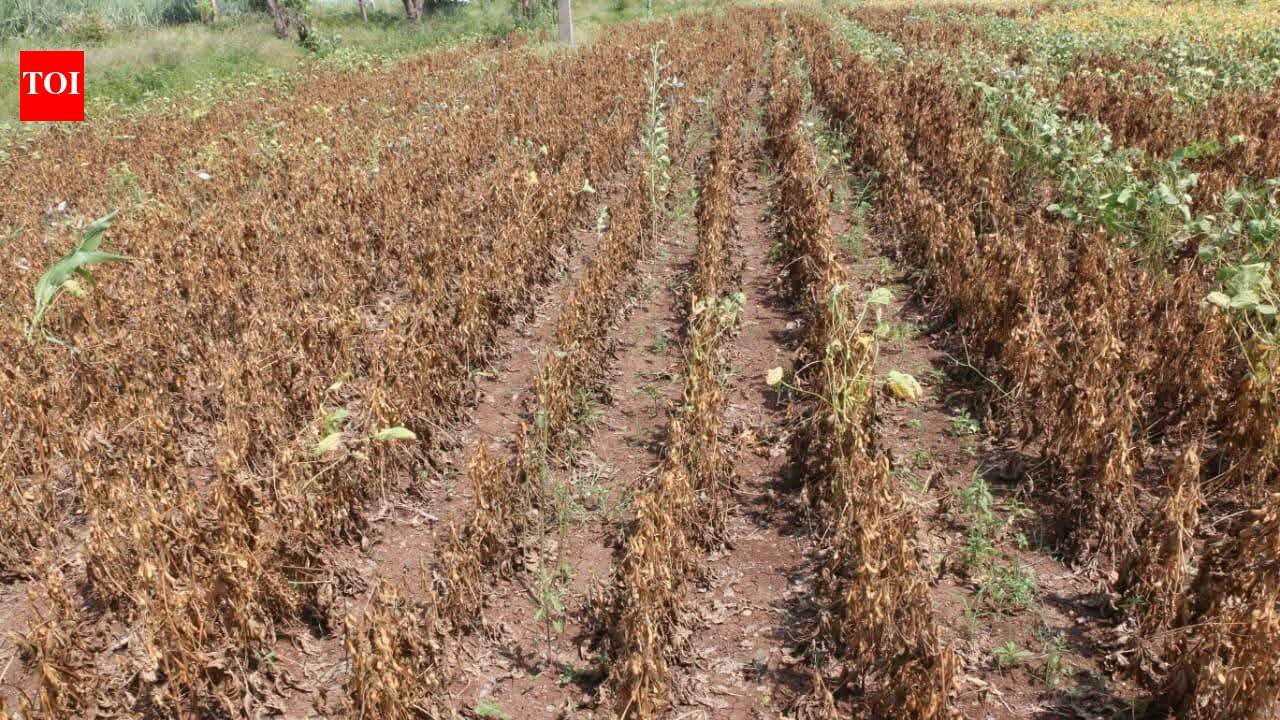
Pune: Trigger 1 drought declaration in 265 talukas of the state based on the manual for drought management is the first step towards relief for farmers on loans, education fees, and electricity supply.The trigger, a mandatory early warning system to establish drought conditions, is based on rainfall deviation, standardized precipitation index, and dry spells lasting three to four weeks.According to the manual, trigger 1 activation occurs if rainfall is deficient or scanty alongside a dry spell, or if precipitation is classified as “scanty” without a dry spell. During normal rainfall, a dry spell triggers the warning, whereas Trigger 1 is bypassed only when rainfall is normal and no dry spell occurs.The manual specifies that a seasonal shortfall of 50% or more during June-July (kharif) or Oct-Nov (eabi), or an overall seasonal deficit exceeding 25%, automatically sets off Trigger 1.Trigger 2 will be set off in the event of a finding of ‘severe’ or ‘moderate’ drought. The intensity of the drought depends on the severity of at least three of four impact indicators — agriculture, remote sensing, soil moisture and hydrology.If at least two of the selected three impact indicators are in the ‘severe’ category and one is in the ‘moderate’ category it is a severe drought and moderate if two of the three impact indicators are in the ‘moderate’ category.Pradeep Purandare, former associate professor, Water and Land Management Institute, said, ”Maharashtra has nine irrigation-related Acts, but rules have been framed only for Maharashtra Management of Irrigation Systems by Farmers Act, 2005. If the rules are not in place, implementation suffers. Droughts may be natural, but we have not adequately prepared ourselves to deal with climate change. Water is being wasted and little has been done to address it.”Joint secretary Sanjay Ingle said, “District collectors must immediately initiate loss assessment (panchanama) proceedings. A comprehensive crop condition report, accompanied by geo-tagged photographs with GPS coordinates reflecting standing crop conditions across the surveyed areas, must be submitted to the govt.”Officials said the package has 12 drought-relief measures and concessions. Under the directives, local authorities must ensure the immediate commencement of water conservation projects while strictly managing drinking water and livestock water requirements in line with previous govt guidelines.Govt has ordered remission of land revenue, the restructuring of crop loans, and an immediate stay on the recovery of agriculture-related loans.Financial relief also extends to electricity and education, featuring concessions on current electricity bills for farm pumps exceeding 7.5 HP—supplementing the existing waiver for pumps up to 7.5 HP—alongside a strict ban on disconnecting agricultural power supplies in scarcity-hit villages, and a complete waiver of examination fees for school and college students.The state will deploy water tankers, set up dedicated fodder supply networks for livestock, and food grain distribution mechanisms to prevent shortages among farmers and agricultural workers.Work norms under MGNREGA have been relaxed to generate maximum employment opportunities across affected regions.Collectors will prepare taluka-wise plans covering crop damage, water, fodder, foodgrain, power and employment for drought-relief measures, senior revenue officials said on Saturday.Crop-loss panchanamas will begin immediately, backed by GPS-tagged photographs, with consolidated reports sent through the agriculture commissioner. The assessment will form the basis for separate crop-loss assistance.Collectors will identify villages facing drinking-water shortages, arrange tankers and plan for water for livestock and fodder and they will ensure foodgrain availability for agriculture-dependent farmers and labourers.Revenue minister Chandrashekhar Bawankule said the comprehensive relief package covered 265 talukas, but more would be included if the situation worsens. He will tour districts to identify implementation-related difficulties and consider measures based on their geographical conditions.The measures include waiver of land revenue, restructuring of crop loans, relief on current electricity dues of agricultural pumps, concessions for school and college students appearing for examinations, relaxation in Employment Guarantee Scheme norms and establishment of fodder camps.Govt will also take up water-conservation works across the state, with water bodies to be brought under conservation measures on the lines of Jalyukta Shivar. Bawankule said crop loans must reach farmers immediately and indicated that further decisions could follow.Officials will also monitor availability of essential supplies and the progress of relief measures at the taluka level. Bawankule said the administration would have to ensure that govt decisions translated into timely assistance on the ground. The committee will examine district-specific requirements and recommend additional measures wherever necessary, while the authorities will continue to review the drought situation and expand coverage according to the prescribed triggers and changing conditions, as required.
