



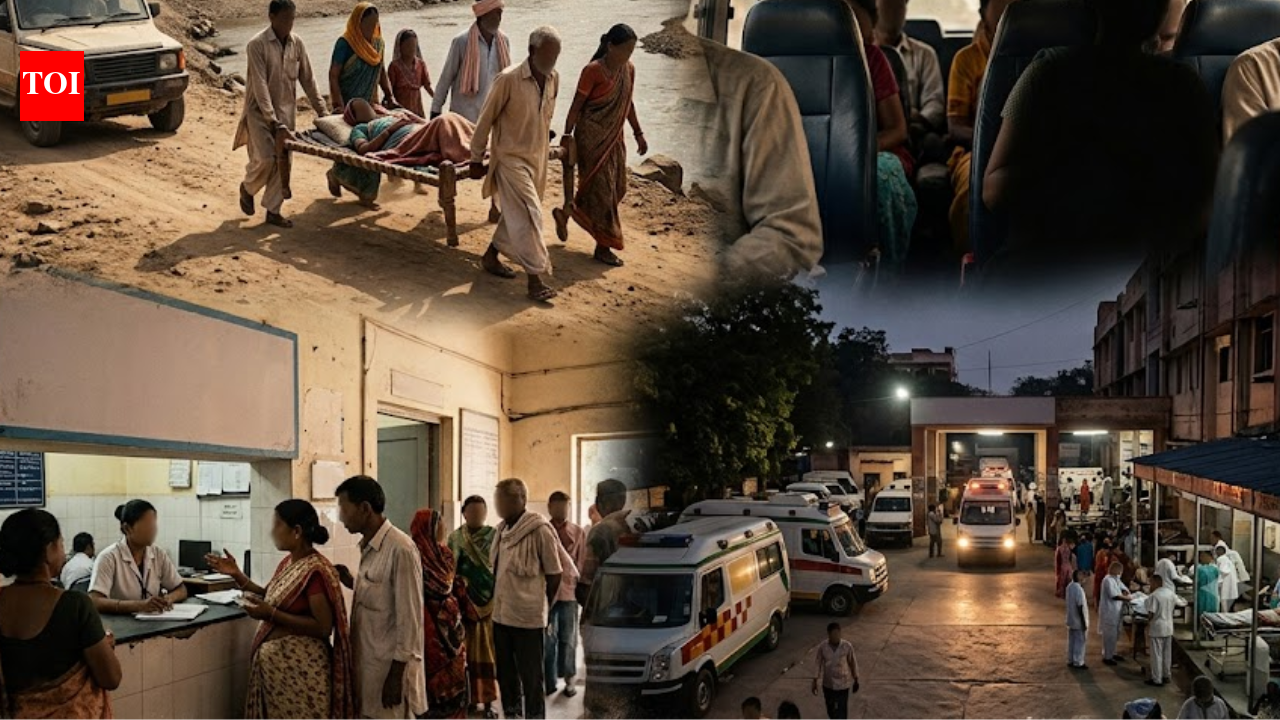
When 26-year-old Rachna from Rajasthan’s Alwar district developed severe abdominal pain and bleeding on July 27, her family began a desperate search for medical help. Over the next 48 hours, she was taken across four healthcare facilities, referred from one hospital to another, and shifted between districts in a bid to save her life.By the evening of July 29, she was dead.
Her journey — from Govindgarh Community Health Centre to a private hospital, then to Alwar’s Zenana Hospital and finally to Jaipur — has once again brought into focus a persistent challenge in India’s healthcare system: for many pregnant women, particularly those in rural and remote areas, reaching timely and appropriate medical care remains a struggle.Despite major improvements in maternal healthcare indicators over the past two decades, a series of incidents reported from across the country show that lack of nearby hospitals, specialist care, ambulance availability, transport connectivity and delayed referrals continue to put pregnant women at risk during one of the most vulnerable periods of their lives.A 48-hour ordeal across four hospitalsRachna, a resident of Kaimasa village in Alwar’s Govindgarh area, was around 14 to 16 weeks pregnant with her third child. Health department records show that she was registered on the Pregnancy and Child Tracking System and had received routine antenatal care.The crisis began when she developed severe abdominal pain and bleeding on July 27.She was first taken to Govindgarh Community Health Centre, where doctors administered primary treatment before referring her to Alwar’s Zenana Hospital.“Her platelet count was 27,000 per microlitre, which is severely low, and she was also suffering from renal failure. She was referred to the Zenana Hospital as there was no operation theatre at the Govindgarh CHC,” said Alwar chief medical and health officer (CMHO) Yogendra Sharma.
According to the inquiry report, the family was advised to use the 108 ambulance service to reach the government hospital. However, they instead shifted her to a private facility. From there, she was referred back to Alwar’s Zenana Hospital and later to Jaipur after her condition deteriorated further.She eventually died at NIMS Hospital on July 29.While officials and the family differ on certain aspects of the sequence of events, the case has once again highlighted how crucial the first few hours are in managing obstetric emergencies and how delays in reaching appropriate care can have devastating consequences.A pattern seen across statesRachna’s death is not an isolated incident.From Rajasthan and Maharashtra to Uttar Pradesh, Madhya Pradesh, Jharkhand and Uttarakhand, multiple cases over the past year have revealed how pregnant women continue to face significant barriers in accessing emergency medical care.The reasons vary — poor roads, remote geography, ambulance delays, shortage of specialists, weak referral systems or lack of transport facilities — but the outcome is often the same: critical delays during medical emergencies.Ambulance can’t reach because there is no roadIn June this year, 25-year-old Sangeeta Gedam from Ghodankappi village in Maharashtra’s Chandrapur district died after childbirth because an ambulance could not reach her remote settlement.Located in the hilly terrain of Jiwati taluka near the Telangana border, the village lacks proper road connectivity.Sangeeta developed labour pains during the eighth month of pregnancy and delivered at home. When severe bleeding followed, her family contacted health authorities.An ambulance was dispatched immediately but could only reach the nearest accessible point. Family members then attempted to bring her through difficult terrain, but valuable time was lost.She died before receiving medical treatment.Health officials later said they had repeatedly advised her to temporarily shift to a healthcare facility before delivery because of the village’s inaccessibility.Yet the incident underscored a harsh reality: emergency medical care is only as effective as the roads that connect patients to hospitals.Walking to reach an ambulanceIn October last year, a pregnant woman in Uttar Pradesh’s Prayagraj district was forced to walk around 1.5 kilometres while in labour because an ambulance could not enter her village due to the absence of a proper road.After experiencing labour pain, her family contacted the 108 ambulance service. The vehicle arrived but could not proceed beyond a certain point.The woman walked the remaining distance to reach the ambulance and delivered her baby during the journey to a community health centre.While both mother and child survived, the incident sparked outrage after a video of her walking in labour surfaced online.Carried on a cot across a riverA similar scene unfolded in Madhya Pradesh’s Chhindwara district in June.Residents of a remote hamlet carried a pregnant woman on a cot across a river after an ambulance failed to reach the village due to poor connectivity and lack of a bridge.Villagers said they had been demanding a bridge for years but had received no relief.The woman eventually delivered her baby before reaching a hospital.The images of villagers carrying her across the river became a stark reminder that in several parts of India, geography still dictates access to healthcare.When specialist doctors are missingTransport is only one part of the challenge.Even when women reach health facilities, they often face another hurdle — the lack of specialist doctors.In Uttarakhand’s Tehri district, a 28-year-old woman lost her life and her baby after allegedly being referred from a community health centre that lacked a gynaecologist.The district reportedly has only two gynaecologists against 15 sanctioned posts.Her family alleged that she waited for hours despite signs of distress before being referred to a higher centre nearly 50 kilometres away. She died during the transfer.The incident highlighted how shortages of trained specialists continue to affect maternal healthcare in many rural districts.Remote Villages Remain VulnerableIn Jharkhand’s Chatra district, an eight-month pregnant woman from a Particularly Vulnerable Tribal Group (PVTG) community reportedly died after an ambulance could not reach her home because there was no paved road.Health officials said the ambulance stopped nearly 500 metres away from the village. Family members attempted to carry the woman on a cot to the vehicle, but she reportedly died before reaching it.The case once again drew attention to the healthcare challenges faced by tribal and remote populations.The burden on urban hospitalsPoor healthcare access in rural areas also creates pressure on urban hospitals.Data from Maharashtra shows that more than 1,100 women died within 42 days of termination of pregnancy in 2023-24.In Nagpur, 112 maternal deaths were reported during the period. However, officials noted that a majority of these women came from rural districts and neighbouring states.NMC health officer Dr Deepak Selokar said that most of the deceased women did not hail from Nagpur.“These women often arrive at a city hospital in a critical condition and quite a few of them succumb despite getting the best medical attention,” he said.The trend suggests that many women are reaching tertiary-care hospitals only after complications have advanced significantly.Improvements, but challenges remainIndia records nearly 25 million births every year and has achieved substantial progress in reducing maternal mortality.According to experts, the maternal mortality ratio has fallen to 88 deaths per lakh live births, marking a sharp improvement over previous decades.Institutional deliveries have also increased significantly.Yet experts say that maternal deaths remain concentrated around labour and the immediate postpartum period, making timely access to quality care essential.“India especially has improved by more than 75 per cent, whereas worldwide the improvement is around 40 per cent.” said Prof. (Dr) Jyotsna Suri, Consultant & Unit Head, Incharge Obstetric Critical Care, VMMC & Safdarjung Hospital, according to TOI report.However, she stressed that rapid intervention remains critical when complications occur.“I have to be very vigilant and act in that golden hour,” Dr Suri said.Beyond access: The challenge of timely careExperts say the issue today is not merely whether healthcare facilities exist, but whether women can reach the right facility at the right time.Complications such as postpartum haemorrhage, hypertension, sepsis and severe anaemia can escalate rapidly. In such cases, even delays of a few hours can prove fatal.According to TOI report, professor (Dr.) Arti Maria, Former Dean, ABVIMS & Dr Ram Manohar Lohia Hospital, said that proven medical protocols already exist.“There is enough global and national evidence of what works. We know what interventions work,”she said.The challenge, according to experts, lies in ensuring that those interventions reach women consistently regardless of where they live.The last mile problemThe stories emerging from Alwar, Chandrapur, Chhindwara, Prayagraj, Chatra and Tehri point to a common problem — the last mile of healthcare delivery.For some women, the nearest hospital is too far away. For others, ambulances cannot reach their homes. In many places, specialist doctors remain unavailable. Elsewhere, referral systems require patients to travel long distances for treatment.The result is that a medical emergency often turns into a race against geography.India’s maternal healthcare indicators have undoubtedly improved, but these incidents show that progress remains uneven. For women living in remote villages, tribal settlements and poorly connected regions, the distance between home and hospital can still become a matter of life and death.As policymakers focus on reducing maternal mortality further, experts say strengthening rural healthcare infrastructure, expanding specialist services, improving road connectivity and ensuring seamless ambulance access will be crucial.Because for thousands of pregnant women every year, the greatest challenge is not receiving treatment — it is reaching it in time.


