


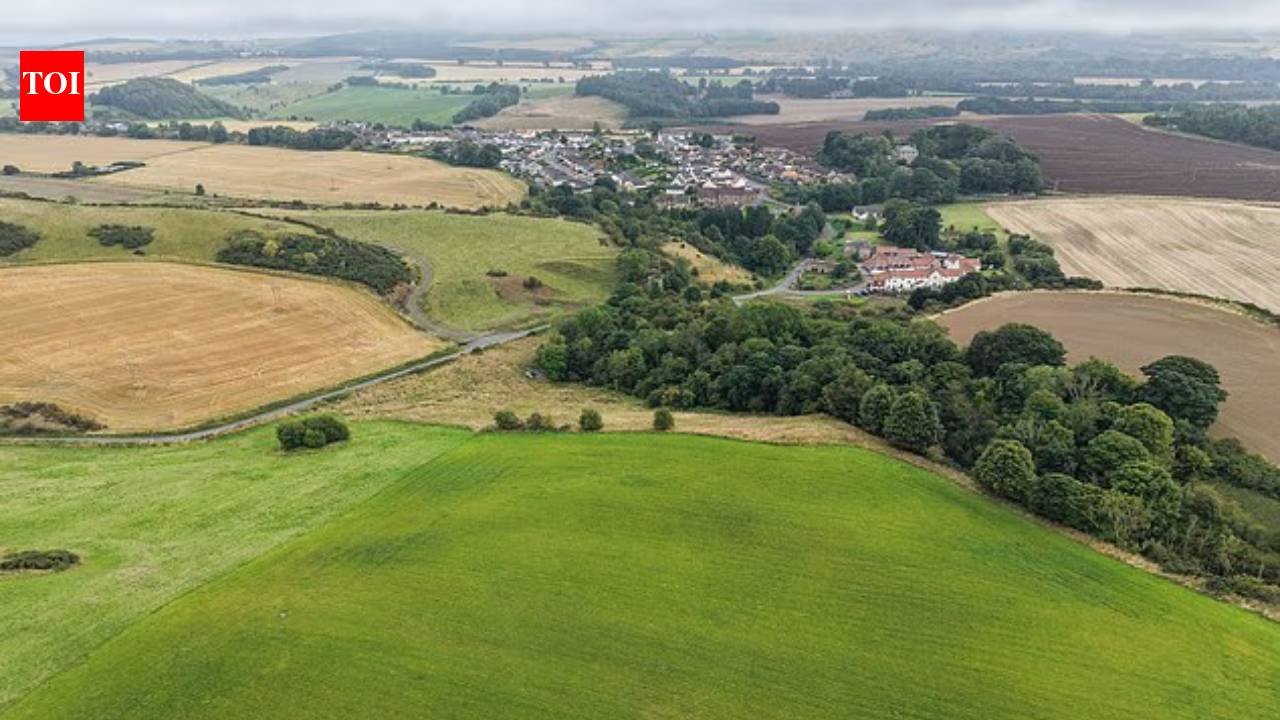
Residents of a tiny Scottish village have launched a fierce campaign against plans to build what has been described as the world’s second-largest data centre on their doorstep.The proposed Cato data centre in Auchtertool, Fife, would occupy a site larger than 100 football pitches and sit next to a village of around 200 homes.Locals fear the huge development could fundamentally change the character of their community, with concerns ranging from noise and light pollution to flooding, environmental impact and the potential effect on animals.More than 1,600 objections have reportedly been submitted against the plans, while protest banners have appeared outside homes, in the village park and on residents’ cars.For many people living in Auchtertool, however, the debate is about more than a major infrastructure project. They fear losing the quiet rural life they chose when they moved to the village.
‘Our peace is being threatened’
Speaking to the Daily Mail, Fiona Stewart, 53, who lives at Wilmar Cottage overlooking the proposed site, said she was shocked when she first saw the scale of the development.“When I saw the scale and size of the planned data centre I was horrified. It’s bigger than the village and right next to it,” she said.Stewart stressed that she was not opposed to data centres in principle and understood why they were needed in an increasingly digital world.“But I don’t know how you can ever justify putting them in a site next to a tiny village,” she added.Her concerns include light pollution, noise and flooding, particularly because parts of the area have previously flooded during periods of heavy rain.“I’m worried about light pollution. I’m worried about the noise that comes from them, worried about the flood risk,” she said.“It’s not like I’m against progress. We’re calling on the First Minister to just pause this, take a look at the plan and the framework, and make sure that these are regulated properly.”The strength of feeling has already prompted residents to prepare for a demonstration at Holyrood on September 3, alongside communities elsewhere in Scotland facing similar data centre proposals.
‘We chose to live here for the quiet life’
For Clare Williams, 51, who has lived in the area for nine years, the proposed development threatens something much more personal: the tranquillity of her home.The foster carer has put up a protest banner outside her house and said residents were initially given one impression of the proposed buildings’ height before being told they could be significantly taller.Williams said the potential scale of the development, as well as concerns about heat and noise, had left her deeply worried.“I’ve done the party life and I chose to live here for the quiet life,” she said.“We are in the countryside. And it’s quiet. My mum comes here and when she sits in the garden, she loves it. It’s just so peaceful and serene and you can sit outside and just hear the birds, but our peace is being threatened.”She added: “I’m angry, frustrated, worried, stressed, all of that.”Williams is also concerned about the potential impact on property values.“We have spent money on living here and wouldn’t be able to afford to sell up if it happens because the house wouldn’t be worth what it is,” she said.“People will lose potentially hundreds of thousands on their properties. We need more information.”Her objection, she insists, is not rooted in opposition to artificial intelligence or technology.“It’s not like I’m anti-AI and I’m not anti-data centres. But how many do we need? Do we need to have them on people’s doorsteps?”Her message to the developers is blunt: “Please reconsider and look at alternatives.”
Why are residents concerned about the data centre?
More than 1,600 objections have been lodged against the proposed development. (Photo: Daily Mail)
Data centres are large facilities designed to store, process and manage huge quantities of digital information. They are an increasingly important part of the infrastructure supporting cloud computing, artificial intelligence, online services and the wider internet.Scotland is attracting interest from the data centre industry because of its renewable energy resources and electricity infrastructure.But the rapid expansion of AI and cloud computing has also intensified debate over the environmental footprint of such facilities, including their energy consumption, water requirements, cooling systems, noise and impact on surrounding communities.In Auchtertool, residents say the sheer scale of the proposed development is at the heart of their concerns.Andrea Cail, chair of the community council, said locals first became aware of the proposal around March 2025.“We were concerned by the proposal because of the sheer size of the buildings [and] the site, because it’s just at the top end of the village, and it’s on agricultural land,” she said.At the time, Cail said, residents knew little about the data centre industry.“We knew very little about data centres at that point, but we twigged that it was going to be quite energy rich, and it would need a lot of electricity, and it would probably need a lot of water.”The facility would operate around the clock, she said, raising questions about its long-term impact on the surrounding community.“We know it’s a 24/7 facility, and once it’s up and running, it won’t just hum. It will make quite a bit of noise. We don’t know what the longer term effects might be.”
Environmental impact assessment becomes key issue
One of the major developments in the dispute concerns the environmental assessment of the project.According to Cail, Fife Council was initially asked to carry out screening to determine whether a full environmental impact assessment was required. She said the council initially determined that one was not necessary.However, the Scottish Government has since requested that a full Environmental Impact Assessment be carried out.For campaigners, the decision has provided some encouragement after months of frustration.“I’m frustrated. I’ve gone through being angry, very frustrated, but also slightly cheered, because last week, the Scottish Government decreed that there had to be a full environmental impact assessment done on this planning application,” Cail said.She said campaigners had also been working with communities elsewhere in Scotland that were facing similar proposals.“They’ve picked here because we have good grid connections and they will be able to get the electricity they require,” she said.
Horse owners fear impact on animals
Among the most anxious residents are Adele and Russell Seeth, who live at Glenniston Farm Cottage, close to where the proposed development would begin.The couple are particularly concerned about the potential impact on their horses and other animals.They say they were not included in some of the correspondence relating to the proposed development because their farm sits on the boundary of the site.Russell Seeth, who has lived at the property for 23 years, said the family had already experienced the arrival of several large renewable-energy projects in the surrounding area.“We’ve had the wind turbines. They told us that wasn’t going to make any noise, and it makes noise,” he said.“We’ve had the battery storages and 98,000 solar panels going around us, ten metres off the fence line… but when we saw this data centre, it was like, ‘wow’.”The couple said they were particularly concerned about their three horses, which they describe as high-performance British showjumping animals.Russell said the proposed facility’s round-the-clock cooling systems and emergency generators could create a challenging environment for the animals.“There’s a real concern to us that there will be acoustic shock to them,” he said.“They’re highly strung flight-sensitive athletes. The 24/7 low-frequency hum from massive industrial cooling fans, and sudden testing of emergency diesel backup generators, present a severe psychological and physical threat to their welfare and training.”Adele said the horses would be only around 270 metres from the proposed site.“Our daughters do British showjumping, so we put in the arena here a few years back to allow them to train here and ride here,” she said.“Their whole life is going to be disturbed and changed if this happens.”The couple have also cited concerns about the potential increase in local temperatures and have pointed to reports about the environmental impact of large data centres elsewhere.However, claims about specific temperature increases and alleged animal-health effects from other developments remain matters for scientific and environmental assessment rather than established consequences of the Auchtertool proposal.
Developers say the project will bring jobs and investment
ILI Group, the developer behind the Cato proposal, has defended the plans and said it understands the strength of feeling within the community.Mark Wilson, CEO of ILI Group, said the project was subject to the planning process and had already undergone technical assessments covering issues including noise, air quality, water, landscape and ecology.“Noise assessments we have undertaken show the project can operate within acceptable limits,” Wilson said, adding that the company welcomed the Scottish Government’s decision to require a full Environmental Impact Assessment.He also urged people to judge the proposal on the development actually being put forward rather than comparing it directly with data centres elsewhere in the world.“Comparisons with data centre developments elsewhere in the world do not necessarily reflect the design, technology, environmental standards or regulatory requirements that would apply to this proposal in Scotland,” he said.According to ILI Group, the built development would occupy only a small portion of the wider site, while plans also include new woodland, wetland and meadow habitat.The developer says the project could also deliver significant economic benefits to Fife.Independent analysis by BiGGAR Economics, cited by ILI Group, estimates the project could support around 1,450 job-years during construction and approximately 262 jobs in Fife once operational, including around 120 permanent on-site positions.“We are committed to continuing to engage constructively with the local community as the environmental assessment progresses, listening to concerns and providing clear, evidence-based information about the proposals,” Wilson said.
