



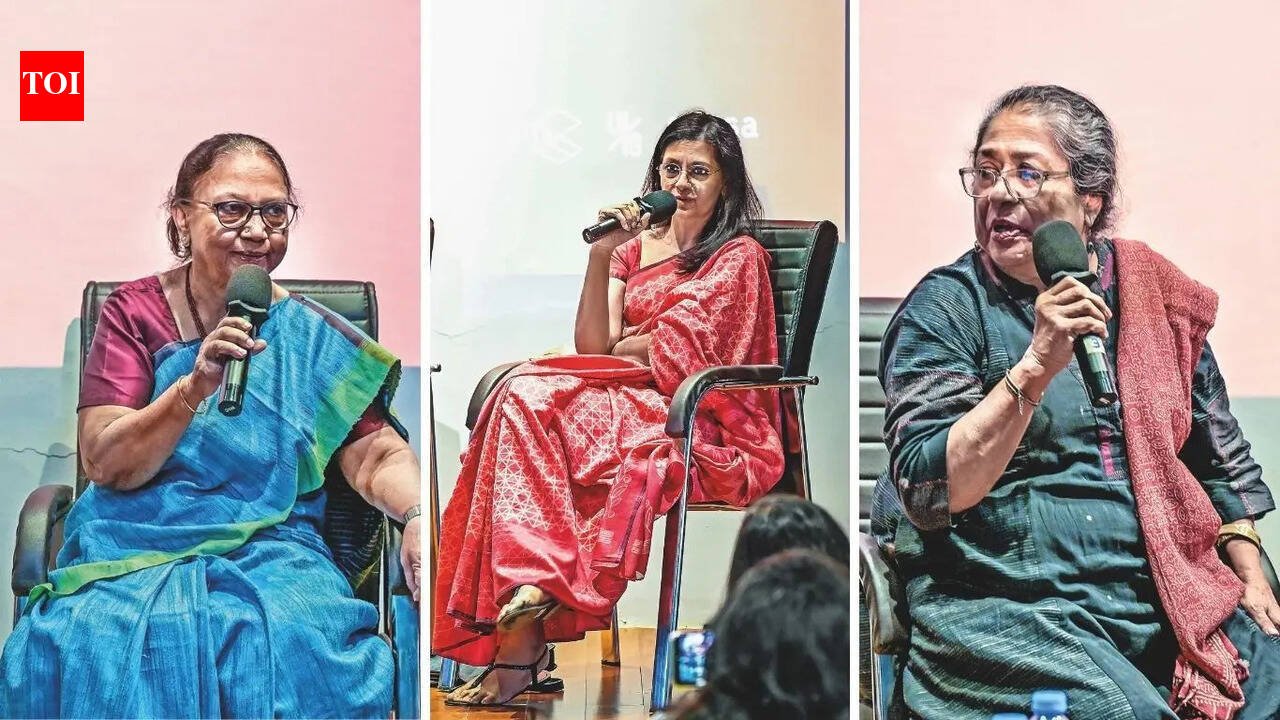
At a time when conversations around identity feel louder yet more complicated than ever, the panel Becoming and Unbecoming at the Bengaluru Art Weekend brought together actor-filmmaker Nandita Das, theatre veteran Arundhati Nag, and Booker Prize-winning author Banu Mushtaq. Moderated by Varun Rana, the discussion spanned masculinity, emotional expression, social media, AI, and what it means to grow as women in a rapidly changing world. Here’s a look: ‘It’s better to look confident than to be confused in today’s time’Nandita reflected on the pressure to appear certain in a world that rewards confidence over honesty. “There is a sense of falseness that has crept into our being. It’s better to look confident than to be confused. But confusion and questioning are the starting points of finding answers,” she said.She pointed out how young people today are navigating an overload of expectations, often without meaningful engagement. “There are too many prescriptive voices coming from all directions, but very little genuine interaction that allows for depth.” Her advice to the younger generation was simple, yet difficult to practice: “Throw yourself into different experiences without the fear of failure.”‘The grammar of patriarchy is the same’Banu placed the conversation within the larger framework of patriarchy. “The language, the strategy, and the medium may change, but the grammar of patriarchy remains the same,” she said.Even social media, she observed, reinforces these structures. “Patriarchy is speaking, conditioning and controlling even there. If a woman violates these expectations, she is severely punished. That is the power of social media,” she said. ‘Younger generations are juggling too much’ Arundhati brought in a perspective shaped by lived experience and resistance. “I’m not on social media — that’s my way of dealing with it. My only reason for being here is theatre; every decision I take is in its interest,” she said.
Youngsters today want to learn languages, take classes, and work jobs all at once. You can see the stress. Many last only three to six months in a new job — that seems to be the trend
Arundhati Nag
At the same time, she expressed concern about younger generations trying to do too much at once. “They want to learn languages, take classes, and work jobs all at once. You can see the stress. Many last only three to six months in a new job — that seems to be the trend,” she pointed out. ‘Writing was the only space left’When the discussion turned to personal journeys, Banu shared that writing was not a choice but a necessity for her. “Everything was ‘don’t do this, don’t do that’. The only space left for me was writing,” she said. “I didn’t know what to write or who I was writing for. Eventually, I reached a point where I could say I am writing about human beings,”
The language may change, the strategy may change, the medium may change, but the grammar of patriarchy remains the same
Banu Mushtaq
‘Art can move people beyond the obvious’Reflecting on her journey, Nandita spoke about the transformative power of art. “Street theatre opened up a whole new world for me. I met people I had never engaged with before. Art can move people — it appeals to the mind, the heart, and even subconsciously,” she said.
Social media is a tool — it has its good and bad. But algorithms amplify what you engage with. Our brains aren’t meant to jump from one thought to another so quickly
Nandita Das
‘We have not made our spaces open enough for dialogue’The panel also addressed masculinity and discomfort around femininity. Arundhati pointed to gaps in inclusivity, especially around transgender identities, “We pretend to normalise things, but we have not made our spaces open enough for dialogue.”AI is racing ahead—and we are not prepared’As the conversation inevitably turned to technology — its possibilities and its risks, Nandita pointed out: “You put on a filter and look a certain way, but when you see yourself in the mirror, it’s different. That gap is unsettling. Even tools like ChatGPT can tell you what words to use — but what happens to your own voice? We all are sound intelligent today, but are we really thinking? AI is racing ahead, and we are not prepared. Social media is creating confirmation bias — it shows you only what you already believe.”


