



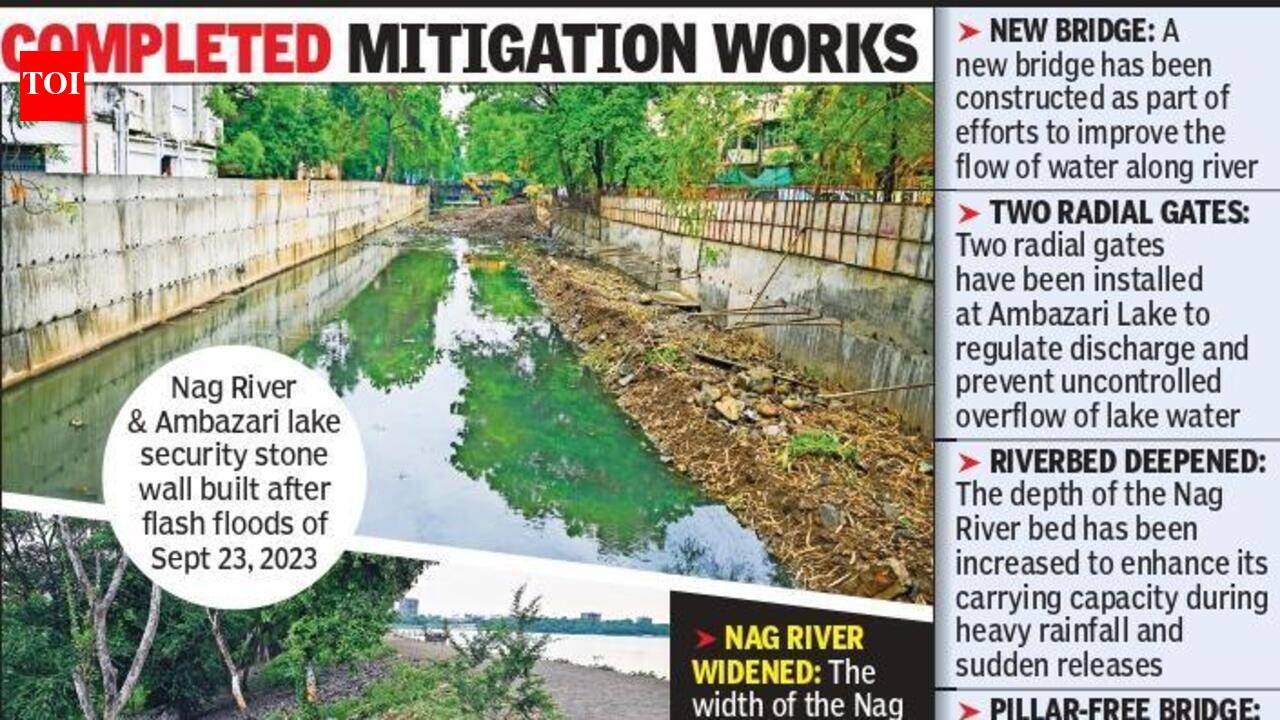
Nagpur: Three years after the devastating Sept 23, 2023, flood inundated thousands of homes downstream of Ambazari Lake and along the Nag River, a mix of major flood-mitigation works, and unfinished ground-level interventions continues to define the landscape.The deluge, triggered by around 109mm of rainfall in a few hours, sent a massive volume of water downstream of Ambazari Lake, flooding several parts of west Nagpur. The disaster exposed vulnerabilities in the city’s stormwater network and the carrying capacity of the Nag River.As the third anniversary falls on Wednesday, a TOI visit to the flood-hit areas found that while several engineering interventions have been completed, important works are still pending. Construction of a retaining wall is progressing at a slow pace, while several stormwater drains are either missing or clogged with leaves and other debris.In several localities including Shankar Nagar, Yeshwant Nagar and Ambazari Layout houses stand below the level of newly raised roads, increasing residents’ concerns over where stormwater will flow during intense rainfall.Dr Archana Deshpande, a Shankar Nagar resident, said the focus now needed to shift towards maintaining the stormwater network and ensuring that natural water channels remain unobstructed.“NMC is cleaning stormwater drains,” she said, while acknowledging that authorities had undertaken several works after the flood. According to her, the city needs to do much more to ensure that drains remain functional and capable of carrying sudden runoff.Deshpande also raised concerns over obstructions near the Ambazari overflow point and the Nag River. She also questioned the impact of the rise of road levels. “When roads are raised year after year, houses naturally go below the road level. Where is the water going to go,” she asked.According to Rameshwari Bansod, a resident of Yeshwant Nagar, widespread concretisation of roads has reduced natural water seepage. Roads, footpaths and other paved surfaces leave rainwater with fewer opportunities to percolate into the ground, she said.Yeshwant Khorgade, an Ambazari Layout resident and flood survivor, said several important interventions have been undertaken around the lake and downstream stretch. These include strengthening and widening of the embankment and measures to regulate the release of lake water.The Central Water and Power Research Station (CWPRS), in its study of the 2023 flood, had identified restricted water flow beneath a low-lying bridge on the Nag River as a major factor behind the flooding. The old bridge was subsequently demolished and a new structure with improved water passage was constructed.
