



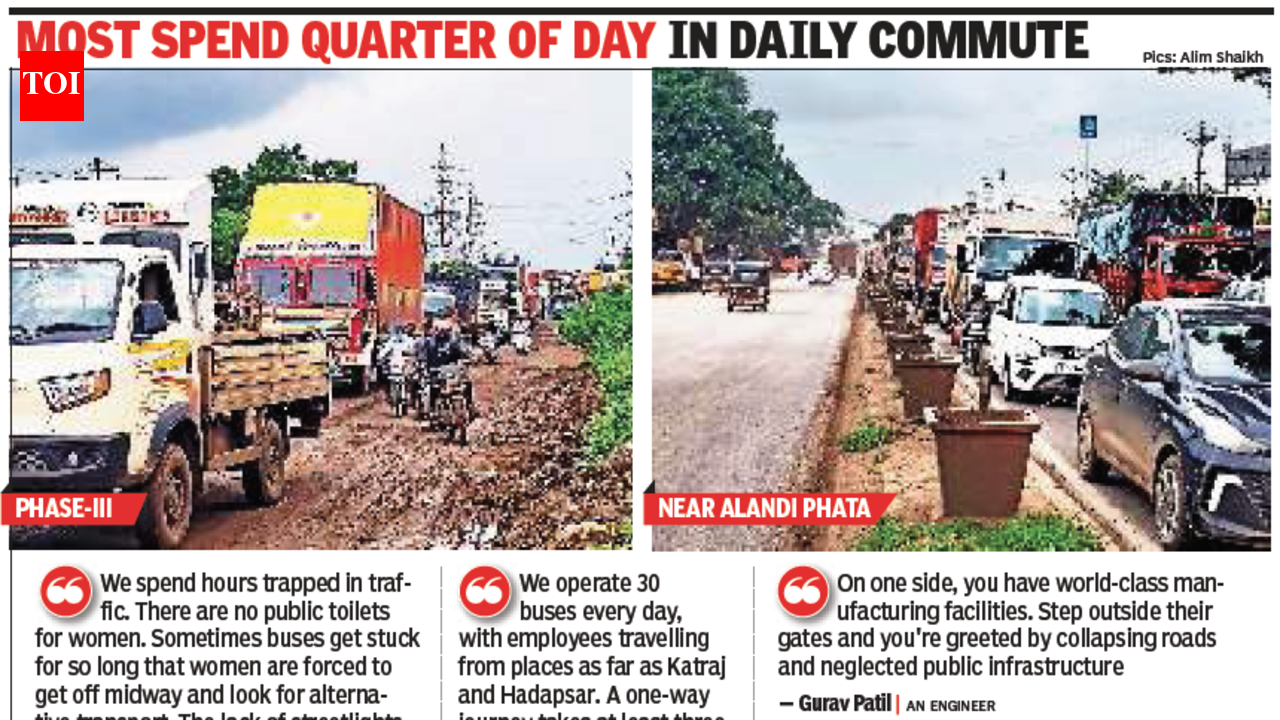
Pune: For truck driver Santosh Kumar, reaching the Nashik highway from Chakan MIDC has become a daily battle. On some days, he spends nearly three hours crawling through traffic maze just to exit Chakan, almost as long as it takes to drive to Mumbai.“The roads outside MIDC limits are in a terrible state. Some roads have virtually disappeared. Even heavy vehicles struggle to move, creating chaos during peak hours,” Kumar said.The infrastructure collapse is also hitting businesses hard. MSME owners said mounting delays had sharply increased transport costs and disrupted supply chains. Jaydev Akkalkote, who runs a casting unit in Chakan, said logistics expenses had risen significantly over the past five years. “Transporting a truckload used to cost around Rs 10,000 four to five years ago. Today, it costs nearly Rs 15,000. We now have to account for hours of delays even for deliveries within Chakan. The same problem affects raw material supplies, forcing us to maintain larger inventories as a buffer,” he said.Having worked in Chakan since 2012, Akkalkote has seen the area’s rapid expansion and infrastructure decline first-hand. “I would earlier travel from Spine Road in Pimpri to Chakan in 20-25 minutes. Now, even on a good day, it takes close to two hours,” he said.The deteriorating situation is also making it harder for firms to attract and retain talent. Vaibhav, an employee at an engineering firm in Phase V, said commuting woes had worsened dramatically over the last two years. “Most of us reach late despite leaving home early. Productivity suffers because employees are left with fewer effective working hours,” he said.For women employees, the struggle is even greater. Pooja Paswan, a chemical engineer from Dehu, recalled arriving in Chakan with high expectations around a year back. “Before coming here, I imagined Chakan to be a highly developed industrial hub. That perception vanished the moment I started living and commuting here,” she said.“We spend hours trapped in traffic. There are no public toilets for women. Sometimes buses get stuck for so long that women are forced to get off midway and look for alternative transport. The lack of streetlights makes us feel unsafe. By the time we get home, there’s barely any time left for ourselves,” she said.Asmita Bhise of Akurdi said the long commute was especially gruelling during emergencies. “Recently, there was a medical emergency in my family. I needed to rush home, but it still took nearly three hours to cover a journey that normally takes less than an hour. In those moments, your family starts wondering whether your job has become more important than a loved one’s health,” Bhise said.Fed up with the endless traffic jams, Devidas Navale switched from company buses to a two-wheeler in hopes of saving time. The decision came at a heavy cost. “I met with an accident last year because of the poor road conditions. I suffered a shoulder fracture and now I am back to depending on buses,” he said.Industry executives said some roads resembled obstacle courses rather than key industrial corridors. “The stretch from Nanekarwadi to Phase III is littered with crater-sized potholes. In several places, the tar road disappears entirely. Thousands of trucks and employee buses use this route every day,” an engineering firm executive said, adding, “The road leading to Alandi Phata is no better. There are open manholes on the road, making it dangerous not just for vehicles but also for pedestrians.”Industrialists pointed out that improving roads inside MIDC limits offered little relief when every approach road to Chakan remained in disrepair. “We pay crores of rupees in taxes but don’t get even basic infrastructure in return. We are ready to spend our own money repairing roads outside our factories if govt grants us a year’s tax exemption,” a business owner said.The HR head of an MNC said although the firm had capacity to accommodate more employees at its Phase V production unit, it rented an additional office near Chakan Chowk. The firm is paying Rs 5 lakh a month to house non-production staff there to help them avoid traffic delays.Frustration has hit a tipping point in Chakan, with at least 20 industrial units warning they might relocate due to the infrastructure crisis. On Sunday, industries minister Uday Samant met local industry representatives, acknowledged the severity of the situation, and sought to reassure businesses. “Agencies have been directed to bring Chakan’s infrastructure up to industrialists’ expectations and resolve all issues within 10 months. The meeting covered both immediate and long-term measures. All potholes in and around Chakan must be filled by Aug 31,” he said.


