



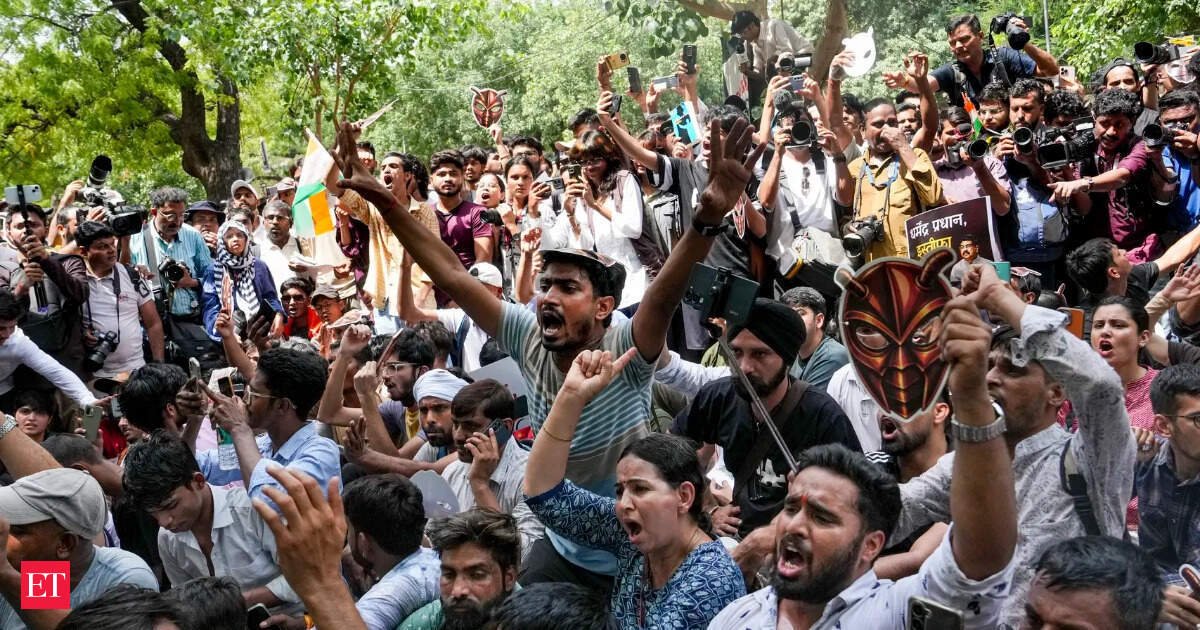
The demonstration, held under heavy security, drew participants from across age groups, including school and college students, job seekers and working professionals. Many protesters wore cockroach masks — the symbol adopted by the movement — while others carried flowers and the national flag.
‘You can delete our posts, but not us’
Addressing the gathering, CJP founder Abhijeet Dipke accused the government of focusing on the movement’s social media activity rather than addressing its demands.
“My friends, this is a long struggle. It has been a month since we started demanding Pradhan’s resignation on social media, but these individuals are so shameless that instead of taking action, they have been focused on other distractions, like hacking our accounts and getting our posts deleted. You may be able to delete our posts, but you cannot erase us from this space,” Dipke told supporters, drawing loud cheers from the crowd.
The protest marks the biggest on-ground mobilisation by the movement since it emerged online over allegations of irregularities in examinations and recruitment processes, including NEET, CUET, CBSE-linked examinations and SSC recruitment tests.
‘I was prepared to sacrifice my freedom’
Dipke, who arrived in Delhi on Saturday morning, described the lead-up to the protest as tense and emotionally charged.
Recalling his flight to the capital, he said, “I was fully prepared to sacrifice my freedom for this cause,” adding that moments before landing he felt as though he was living through his final moments of freedom.The activist also claimed that fear had led many people to compromise their principles.
“Lekin is desh ka chatra, yuva nahi bika hai (The youth and students of this country have not sold themselves),” he said, triggering another round of applause from the crowd.
Dipke informed supporters that activist Sonam Wangchuk would be joining the protest later in the day and thanked him for extending solidarity to the movement. Wangchuk has publicly backed the campaign and said he would undertake a six-week fast if Dipke were arrested.
Protest framed around ‘love and peace’
Ahead of the demonstration, Dipke repeatedly urged participants to maintain discipline and avoid confrontation.
In a post on X, he encouraged supporters to carry a book and the national flag and appealed to them to offer flowers to police personnel as a “gesture of compassion and gratitude”.
He stressed that the movement should be guided by “love and peace” and urged participants to engage respectfully with law enforcement personnel.
The CJP had also circulated detailed guidelines before the protest, emphasising non-violent conduct and instructing supporters to avoid any confrontation.
Six detained, security tightened
Delhi Police said six individuals were detained on Saturday as a precautionary measure to prevent a possible confrontation between supporters and opponents of the movement.
Officials said police had received inputs about the possibility of tensions near the protest site and acted to maintain law and order.
The six individuals were taken into preventive custody after they were found attempting to create a disturbance near Jantar Mantar, officials said.
No major incident was reported and the demonstration continued peacefully.
Sonam Wangchuk hails turnout, says ‘democracy has survived’
Activist Sonam Wangchuk, who joined the protest later in the day, praised the large turnout and described it as a sign of the strength of democratic participation in the country.
Addressing the gathering amid chants of “Hamara neta kaisa ho, Sonam Wangchuk jaisa ho”, Wangchuk said he was deeply encouraged by the number of young people who had assembled at Jantar Mantar and thanked CJP founder Abhijeet Dipke for bringing them together around a common cause.
“The topic that touched everyone was education,” Wangchuk said, adding that the issue had resonated across regions and backgrounds. Calling the mobilisation a victory for citizens rather than any individual or organisation, he told the crowd, “This is our country’s win.”
The activist said the demonstration showed that democratic values remained alive despite growing concerns among young people. “Democracy has survived, and this survival will continue,” he said.
Wangchuk also urged participants to look beyond examinations and recruitment tests, arguing that reforms were needed across institutions and governance systems. Describing India’s youth as an immensely powerful force, he said meaningful change would require improvements not only in education and examinations but in all systems that affect citizens’ lives.
Massive police deployment across Delhi
Security arrangements were significantly strengthened across the national capital ahead of the protest.
Police officials said additional personnel were deployed at Indira Gandhi International Airport, border entry points and other sensitive locations.
More than 1,000 police personnel were stationed across New Delhi district and other strategic areas as a precautionary measure. Barricades were erected around Jantar Mantar, while senior officers remained on the ground to monitor the situation and regulate the movement of participants.
Why the protest matters
The CJP has rapidly emerged as one of the most visible youth-led online movements in recent months, mobilising support around demands for greater transparency and accountability in examinations and recruitment processes.
Its campaign centres on alleged irregularities in major examinations and recruitment tests, including NEET, CUET, CBSE-linked examinations and SSC recruitment processes.
Saturday’s protest marks a significant escalation of that campaign, bringing hundreds of supporters onto the streets and turning what began as an online movement into a visible public demonstration.
(This is a developing story and will be updated with further details from the protest site, police authorities and organisers.)


