


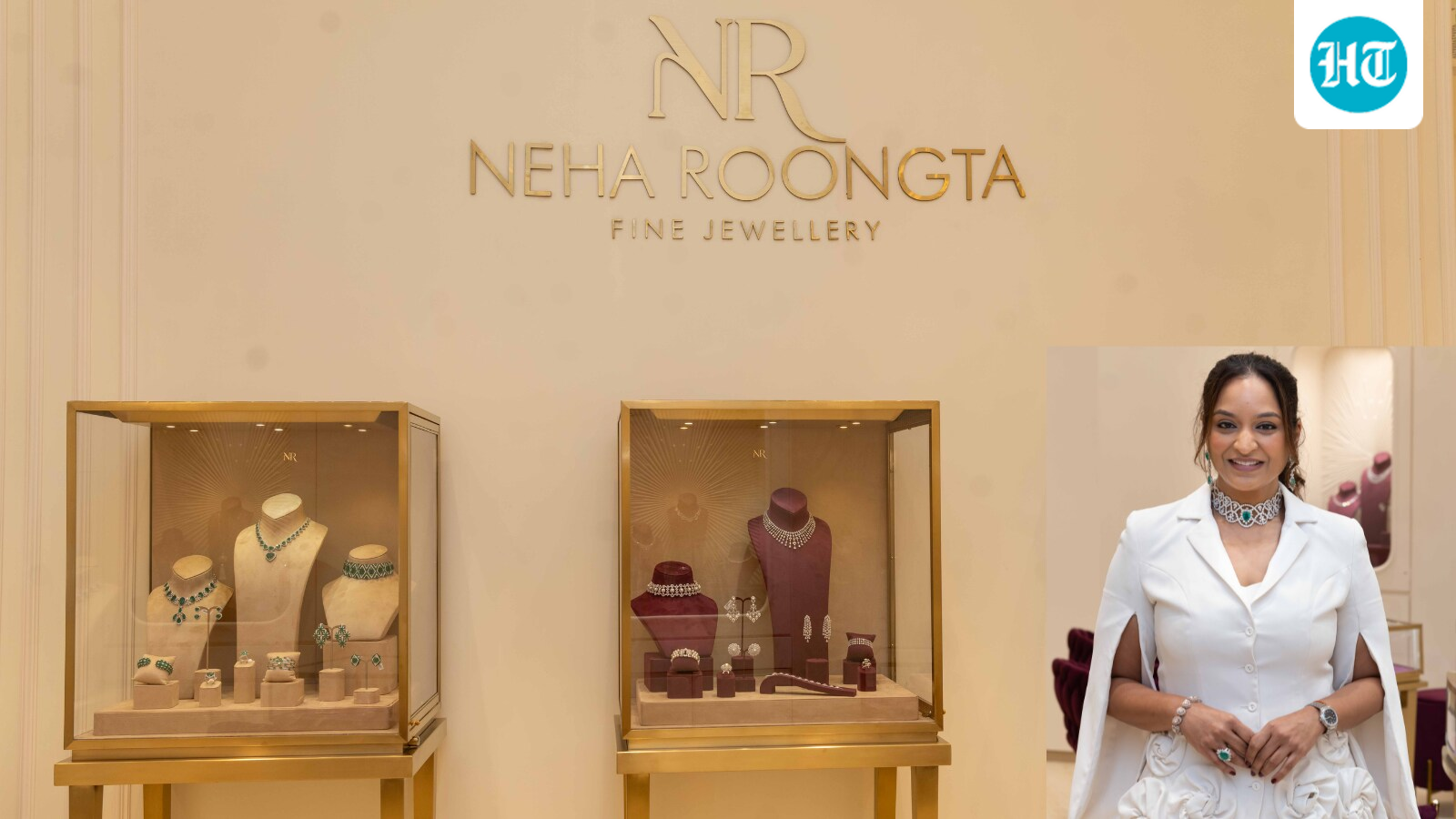
With a childhood spent surrounded by diamonds and fine jewellery in Hong Kong, Neha Roongta’s journey into jewellery design feels almost like a natural extension of her upbringing—yet it was a path she never initially planned to take. A certified gemologist with an instinctive eye for rare stones and contemporary design, Roongta entered the world of fine jewellery after moving to India post her marriage and noticing a gap in the market for pieces that combined modern aesthetics with timeless appeal.

Today, she champions the idea of modern heirloom jewellery, where the gemstone takes centre stage, and the design is created to enhance its individual beauty. Here is an interesting interview with Neha Roongta with HT Shop Now as she talks about jewellery from special-cut diamonds and colourful sapphires to emerging favourites such as tourmalines, kunzites and tanzanites.
Roongta’s design philosophy reflects the evolving tastes of the modern Indian jewellery connoisseur. In this conversation, she takes us through her journey, the rise of gemstone-led jewellery, changing Gen Z preferences and why the future of Indian fine jewellery is all about colour, individuality and self-expression.
Q. What inspired you to enter the world of fine jewellery design, and how has your journey evolved over the years?
Neha Roongta: I grew up surrounded by fine jewellery. My entire family has been in the business—my father is a diamond and jewellery manufacturer in Hong Kong, where I grew up, so it was always a part of my world. Since I was young, I remember watching him assort diamonds and manufacture jewellery. I also attended international jewellery shows such as JCK, Hong Kong and Bangkok.
However, I never really thought that I would enter the field myself. That changed after I moved to India around 17 years ago following my marriage. When I started visiting jewellery stores and shopping for myself, I realised that I couldn’t resonate with much of the jewellery being made here at that time. The styling and craftsmanship were very different from what I had seen internationally.
When I started about 10 years ago, there were very few people who truly understood the concept of fine, contemporary jewellery. There was often an excessive use of gold in a piece, rather than allowing the beauty of each stone to stand out. That made me realise there was a gap in the market for what I would call modern heirloom fine jewellery—pieces that are contemporary yet timeless enough to be passed down through generations.
Another important turning point came after I gave a talk on gems and jewellery at FICCI FLO. I am a certified gemologist, and after the talk, several people approached me with jewellery pieces from other jewellers, asking for my opinion on the quality, gemstones and design. That made me realise there was already a clientele that trusted my knowledge and design sensibility.
When people start coming to you for jewellery advice, it tells you that the trust factor is already there. I also had access to honest sourcing through my family’s manufacturing background. When I put these two things together—the sourcing expertise and an existing clientele looking for guidance—it felt like everything naturally fell into place.
Q. What is your clientele? Are there any Bollywood celebrities you have designed jewellery for?
Neha Roongta: A large part of my clientele comprises industrialists, business families, HNIs and UHNIs. I also work with CEOs and MDs. I don’t work with many film stars yet.
Q. Is there a particular piece you have designed that is especially close to your heart?
Neha Roongta: Whenever we design, our story begins with either a special-cut diamond or a gemstone. I believe the soul of the jewellery is the gemstone or the special-cut diamond. The design is then curated to bring out the beauty and life of that particular stone.
I don’t believe in designing something completely ad hoc. Every gemstone has its own beauty and personality. You can look at two emeralds and realise that they are completely different from each other. So, it is really about understanding the uniqueness, depth, beauty and lustre of that particular stone and creating a design around it.
Q. Having grown up in Hong Kong and now having spent many years in India, what differences do you see between Indian and Hong Kong consumers when it comes to jewellery preferences?
Neha Roongta: The Indian jewellery market has evolved tremendously over the last 15 years. One of the biggest changes has been the growing appreciation for gemstones and design-led jewellery.
If you look back around 20 years, jewellery was largely dominated by round diamonds. Then came the trend of fancy-cut diamonds such as pear and marquise shapes. After that, consumers began exploring special cuts—something we specialise in, such as tulip cuts, along with hexagonal and step-cut diamonds.
Then came the gemstone era. Initially, emeralds became extremely popular, followed by rubies and sapphires. Now, the latest trend is towards semi-precious stones that are increasingly becoming important in fine jewellery. We are seeing a lot of interest in multicolour tourmalines, rubellites, tanzanites and kunzites.
Jewellery lovers always want to add something unique to their collections. So, trends continue to evolve. The era of jewellery dominated only by round diamonds is largely over when you’re talking about designer jewellery. The journey has moved from fancy diamonds to special cuts, then precious gemstones and now to a much broader gemstone spectrum. I would definitely call this the era of colour and gemstones.
Q. What goes into creating a fine jewellery piece, from the initial sketch to the final product?
Neha Roongta: For us, the story first begins with a special-cut diamond or a gemstone. We then look at the inspiration around it—why we sourced that particular gemstone and what story we want to curate around it.
We have an in-house team that develops the design under my supervision. Once the design is finalised, we move to the manufacturing stage. This involves CAD, or computer-aided design, which transforms the concept into a technical design. After that, we have the wax model, followed by casting, polishing, gemstone and diamond setting, rhodium finishing and, finally, the finished piece.
Q. How long does it usually take to create one piece?
Neha Roongta: On average, it takes around 14 to 20 days. I would say two to three weeks is the minimum timeframe for a properly executed piece.
There are also very special pieces that can take two to three months because certain gemstones aren’t readily available. Sometimes, we have to collect specific stones to create a particular layout.
Q. Where do you source your gemstones from?
Neha Roongta: It depends on the gemstone. There is a common misconception that all gemstones are sourced from Jaipur. Jaipur is definitely very strong when it comes to emeralds and tourmalines, but when you’re looking at rubies, sapphires and tanzanites, Bangkok is a much more prominent hub. It offers greater availability as well as access to better-quality stones.
Q. Since you are a gemologist, what do you think about the belief that certain gemstones may or may not suit a person astrologically?
Neha Roongta: I think this is a conversation between faith and facts. No fact that wearing a particular gemstone will change your fate or your life.
However, I am personally a very spiritual person, and I believe that if something is not based on fact but isn’t harming you, it is something you can choose to follow. Ultimately, it comes down to faith and belief. If you want to wear a particular gemstone, you should wear it.
Q. Is there a jewellery trend you would like to see make a comeback?
Neha Roongta: I don’t really think any trend has disappeared completely. There are so many trends working simultaneously because our population is so diverse.
For example, we’ve seen hand chains, ear cuffs, chokers, jhumkas, statement necklaces and many other styles. Even the heart-shaped jewellery trend that Rihanna recently wore is something our mothers used to wear when we were young. It disappeared for a while and has now come back.
I think that’s the beauty of jewellery. Trends keep getting added rather than necessarily replacing one another.
Q. Is there any jewellery trend you feel is outdated and that people should move away from?
Neha Roongta: Not really. I love everything about jewellery, so I think all trends are beautiful. Ear cuffs, chokers, headphones, pinky rings—there are so many styles that are currently working.
I don’t think there is a particular trend that people should move away from. Ultimately, everyone should wear what they love and what suits their personality.
Q. Which jewellery designer or international brand has inspired you?
Neha Roongta: I particularly love the way Bulgari plays with geometry. If you look at its pieces, they are very geometric yet incredibly balanced. I admire how the design house has curated its pieces and positioned itself within the jewellery industry.
I also really like NAR. I love the way they set their gemstones and work with colour palettes. There are several design houses I look at, but I also believe jewellery design is a very strong form of self-expression. Every designer has a different design language shaped by their individual exposure and experiences.
Q. How do you balance traditional Indian craftsmanship with modern aesthetics?
Neha Roongta: When I first moved to India, the design language was largely very Indian. Over the last 10 to 15 years, however, the concept of modern heirlooms has really emerged.
People still want jewellery that can become generational because fine diamond and gemstone jewellery is inherently something that can be passed down. At the same time, there has been a strong shift towards modern aesthetics.
Many clients tell me they love my designs because they have a modern aesthetic. At the same time, I think Indian craftsmanship has grown tremendously over the last five years. We are now at a stage where Indian craftsmanship can compete internationally. There are still areas where we can improve, but the growth has been remarkable.
For me, the challenge is about merging modern aesthetics with Indian craftsmanship without losing our roots. An ultra-modern piece that works in Southeast Asia or America may not necessarily resonate with an Indian consumer.
Indian women also think about the clothes they will wear with their jewellery and how they can balance their overall style. So, the idea is to retain that cultural connection while adding the modern touch that today’s Indian woman wants.
Q. Is it difficult to design jewellery for consumers across different parts of India, given the cultural differences between regions?
Neha Roongta: Not really. The modern Indian woman I keep in mind when designing is quite similar, whether she comes from the North, South, East or West.
There may be cultural differences, but the liking, aesthetic and thought process are quite similar. She wants jewellery that reflects her personality and works with her lifestyle.
Q. What do you keep in mind when designing jewellery for men?
Neha Roongta: Men’s jewellery is actually one of the fastest-growing segments in India today. The number of men willing to wear stackable bracelets with their watches, chains and other pieces has increased significantly.
Men’s jewellery includes gemstone rings, often chosen for astrological reasons, but beyond that, Cuban links have become extremely popular. We are seeing demand for Cuban-link tennis bracelets, Cuban-link chains and, of course, cufflinks.
Another category that has grown significantly is brooches. Men today are using brooches to express themselves, whether through personalised designs that have meaning or through statement pieces.
Q. What about Gen Z consumers? Are they also gravitating towards gemstones?
Neha Roongta: Absolutely. Gen Z is very much in love with gemstones, but their mindset is different from that of millennials.
A millennial consumer may look at jewellery from an investment perspective—asking about buyback value, for example. Gen Z tends to ask, “Can I wear this? How often can I wear it? How versatile is it? Does it work with my personal style?”
So, Gen Z is much more design-oriented. They tend to prefer lighter-weight designer pieces. There has definitely been a shift in mindset.
Q. If you had to choose between diamonds, emeralds, rubies and sapphires for yourself, what would you pick and why?
Neha Roongta: I absolutely love sapphires. Blue sapphire isn’t a very conventional stone in India, particularly because of the astrological beliefs around it. It isn’t something that every woman chooses to wear.
But I think sapphires are very underplayed. I’m actually wearing one right now. What I love most about sapphires is that they are available in so many colours—blue, orange, purple, pink, magenta and many more.
Q. If you could design a jewellery piece for any Indian celebrity, who would it be?
Neha Roongta: That’s a very interesting question! There are so many possibilities, so let me think about it and get back to you. There are so many permutations and combinations that I would really want to put my head around who I would love to design for. But if I had to, I would love to design a piece for Priyanka Chopra. She is outspoken, bold, and carries herself really well. I would also love to design one for Ranveer Singh, as he is someone who loves to experiment a lot.
Q. Finally, which gemstones do you think Indian jewellery lovers should watch out for right now?
Neha Roongta: Emeralds are, of course, one of my favourite gemstones, and they are among the richest gemstones we have. They have already been extremely well explored in India.
Rubies are probably the next big trend after emeralds. But the latest movement is definitely towards stones such as kunzites, tourmalines, multicolour tourmalines, rubellites and tanzanites. These are increasingly being introduced to the Indian market.
For me, the exciting part is seeing how Indian jewellery lovers are becoming more adventurous and open to colour, unusual cuts and gemstones that allow them to express their individuality.
Similar articles for you
A new Ayurvedic wellness brand in the market: Is Ayurvedic the new buzz for gut health?
Here is why I focus on formula and not just brand names for my lipsticks
