



TECHNOLOGY & SOCIETY
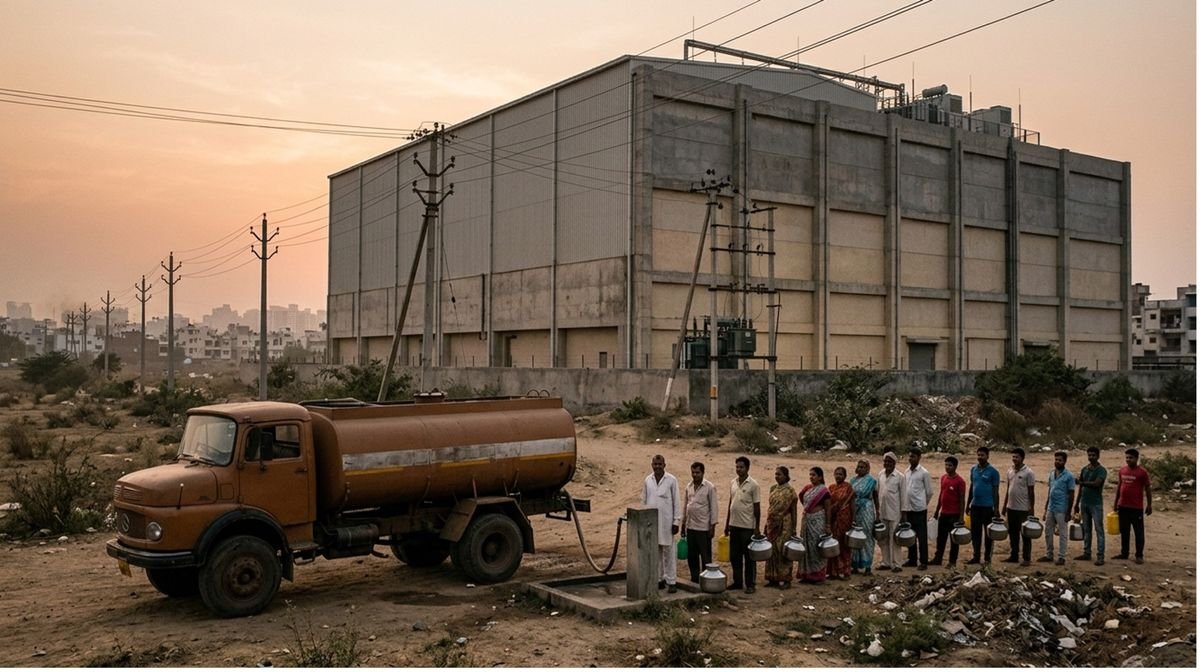
We talk about “the cloud” as if it floats. It does not. It sits in warehouses full of computers that run day and night, and they need electricity and water to stay cool.
On 14 October, India’s junior IT minister Jitin Prasada said the government plans a national data centre policy. Reuters reported that the aim is to let the sector grow without pushing up electricity bills for ordinary households.
That promise is easy to make and hard to keep. The cloud feels weightless to the people who use it. The bill for it lands somewhere real.
What the numbers say
India had about 1.5 gigawatts of data centre capacity in mid-2025. A study by CEEW, an Indian policy research group, expects 4.5 to 6.5 gigawatts by 2030. It says data centres used about 150 billion litres of water in 2024, and that figure could more than double by 2030.
Today the share is small. CEEW puts data centres at about 0.5 per cent of national electricity use. That is why many officials are relaxed. But Mongabay India reported in May that a map by WRI India shows more than half of India’s data centres sit in water-stressed regions.
The rules are thin. Data centres are not a separate category in India’s environmental clearance system, so they can be treated like ordinary buildings. The government drafted a national policy in 2020 and never finalised it. Mongabay also reported that MeitY, in reply to an RTI query, said it had no information about data centres.
Where the strain is already showing
In Visakhapatnam, Google is building a $15 billion data centre. The Next Web reports that the city gets about 410 million litres of water a day against demand of 480 million. The state has promised the project water for 20 years and says villages will not lose drinking water. Local campaigners are not convinced, and cases are pending in the environmental court. Google says its cooling design cuts water use but does not remove it.
Near Mumbai, residents living next to an Amazon data centre say it strains local power and water and adds noise. Amazon and Google reject the complaints, according to the Reuters report.
A cloud that costs households nothing on paper still has to be cooled by someone’s water and powered by someone’s grid.
Why this matters in Kashmir
I could not find any announced data centre plan for Jammu and Kashmir, so this is a question about the future, not a report on a project. But the pitch is already being made for mountain regions elsewhere. Nepal’s Himalayan data centre proposals are sold as naturally cooled and powered by hydropower, as the Nepali Times described in July. A researcher quoted there warned that the “natural fit” story is often told before the buildings exist.
Kashmir’s cold sounds like an advantage. Here is the catch. The cold comes in winter, and winter is when the Valley’s power system is already stretched. Kashmir Life reported in April that J&K imports more than 95 per cent of its electricity in December. Greater Kashmir reported that the shortfall for December 2025 was projected at 34.2 per cent, or 1,277 megawatts. Planners told the northern grid body they may need to prepare for a winter load of 6 to 7 gigawatts by 2029-30.
A big data centre here would not be pulling spare power from a surplus. It would be competing with heaters, hospitals and homes. The same cold that cools the servers is the cold that drives demand.
The fair counter-argument
Data centres are getting more efficient. Mongabay notes that Indian facilities now report power efficiency ratios near 1.3, down from close to 2. Some operators run on solar and wind. Better cooling and storage can also let data centres act as flexible loads that switch down at peak hours. CEEW recommends exactly that, along with public reporting of energy and water use.
Those are real fixes. They only work if the policy makes them compulsory and the figures are public. A policy that promises no rise in bills but publishes no numbers asks people to take it on trust.
Bottom Line
Growth in AI and data centres is coming, and India has good reasons to want it at home. The test of the new policy is simple. Will it make every large data centre say, in public, how much power and water it uses, and where it gets them? For a place like Kashmir, which already goes short every winter, the answer decides whether the cloud is a gain or one more demand on a stretched grid.
(The author studies Computer Science and Artificial Intelligence at Rutgers University, New Jersey, USA. He is interested in emerging technologies and innovation, and can be reached on LinkedIn at @arssh-kumar14)
