



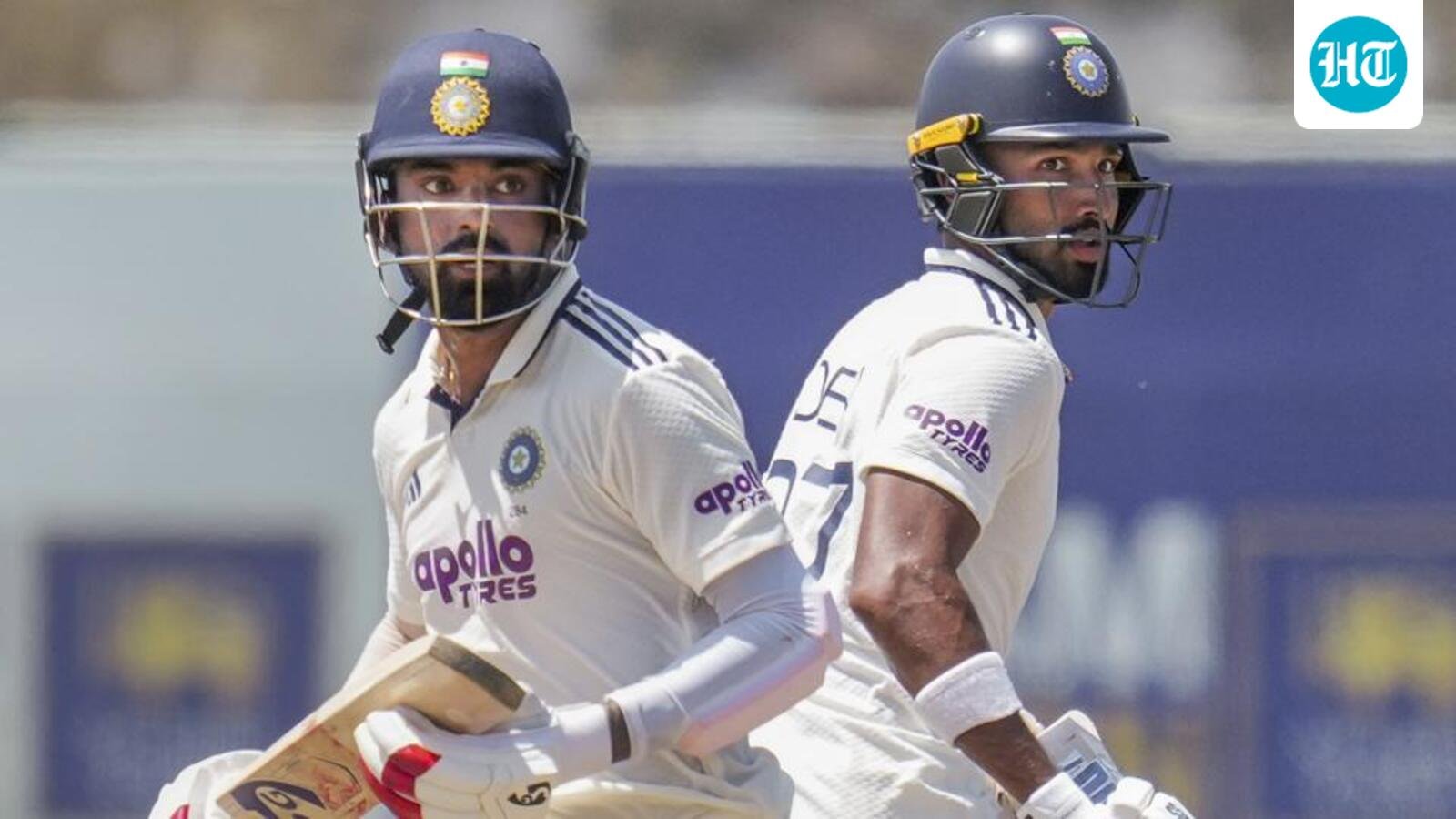
Kolkata: No one watching the Galle Test missed that big, warm hug KL Rahul gave Devdutt Padikkal out of relief after the review that he almost didn’t take went his way. Nor did anyone following that broadcast closely miss that peck Rahul almost planted on his cheeks. It spoke of gratitude, but also of the affection that grows among players who are on the road year-round.
For Rahul and Padikkal, it’s a bond that goes deeper because they turn out for Karnataka as well, churning runs while putting on massive partnerships together. So maybe it’s not bad after all that Padikkal is batting at No 3, lending India a top-order stability that they don’t have to work on for a change.
Rahul and Padikkal put on 150 for the second wicket in the first innings, then another 65 in the second. Padikkal made 167, the defining innings of India’s 165-run victory; Rahul made 82 and 35. Across their two partnerships they contributed 227 runs. But the numbers do not quite explain why it looked so natural.
Rahul is 34, a veteran of 69 Tests, and has spent years learning the peculiar demands of international batting while not being assured of a particular position for a long time. Padikkal, 26, is still an understudy. Yet he didn’t look overawed by the senior partner. Nor did Rahul appear to be managing him. They simply seemed to know what the other was doing.
The way Rahul was almost goaded into taking that review reflected that chemistry. Rahul had been given out lbw in India’s second innings in Galle and was already walking away. But Padikkal, at the non-striker’s end, wasn’t convinced. He told Rahul that the ball might have been high. Rahul, reluctantly, went upstairs. Replays showed the ball was missing the stumps.
The embrace that followed was a small celebration of something India rarely gets to manufacture—a batting partnership whose understanding exists before the players arrive at the crease.
Padikkal was confident enough to challenge Rahul, and he trusted him enough to listen. That isn’t just friendship, that’s trust.
“I felt like it was out,” Rahul said afterwards. “The only doubt that I had was, did I get outside the line?” Padikkal’s response was simple but practical. “When you get chances like that as a batter, it’s a gift, it’s a second chance,” Rahul said.
Beyond the winnings of this Galle Test, India may have stumbled upon something more valuable than a hundred from a No 3. This could be the beginning of a relationship at the top of the order, based on a familiarity built in Karnataka, through domestic cricket, India A and, increasingly, at the top level. There is something particularly useful about that history when the two are batting together.
“He understands the way I bat, the tempo in which I bat, and I do the same as well,” Padikkal said. “When you have that kind of chemistry, I think it helps in stitching that partnership and really pushing the limits of how far we can go.”
That last part matters since partnerships are essentially about knowing how far the other player can be pushed.
Rahul’s natural game, particularly in Test cricket, is built around time. Padikkal brings a different tempo. His 167 in Galle was not a frenetic counterattack but an innings of calculated pressure, particularly against spin. He could absorb the quiet overs before suddenly finding a boundary. Rahul could then settle into the rhythm alongside him. The result was complementary rather than competitive.
There were other benefits as well. Rahul’s presence appeared to give Padikkal the security to play his own game. He had been waiting for this opportunity, having last played a Test in 2024 and returning only because Sai Sudharsan was ruled out. He didn’t arrive in Galle as an established No 3. He left with the strongest possible argument that he should remain there.
Rahul understood the significance. He called Padikkal’s innings “the defining part” of the Test, praising both the tempo and the ability to turn a start into a substantial score.
“Hopefully he carries this confidence into the next game and into his Test career as well,” Rahul said. There is, therefore, a temptation to describe this as a small but crucial subplot in India’s Test transition: the experienced player shepherding the youngster, getting a hundred and significant partnerships along the way.
There could be more to this. If Rahul remains at No. 2 and Padikkal at No. 3, the distinction between veteran and understudy could become an advantage rather than a hierarchy for India.
As the emotional anchor, Rahul provides the knowledge to play out different conditions. Padikkal provides the freedom of someone whose international career is still in the early stages. And, crucially, they communicate all the time.
The best partnerships in Test cricket are often built on precisely that invisible currency. Sometimes it produces a valuable partnership, sometimes it simply stops a batsman from walking back to the pavilion. Either way, the team benefits.


