






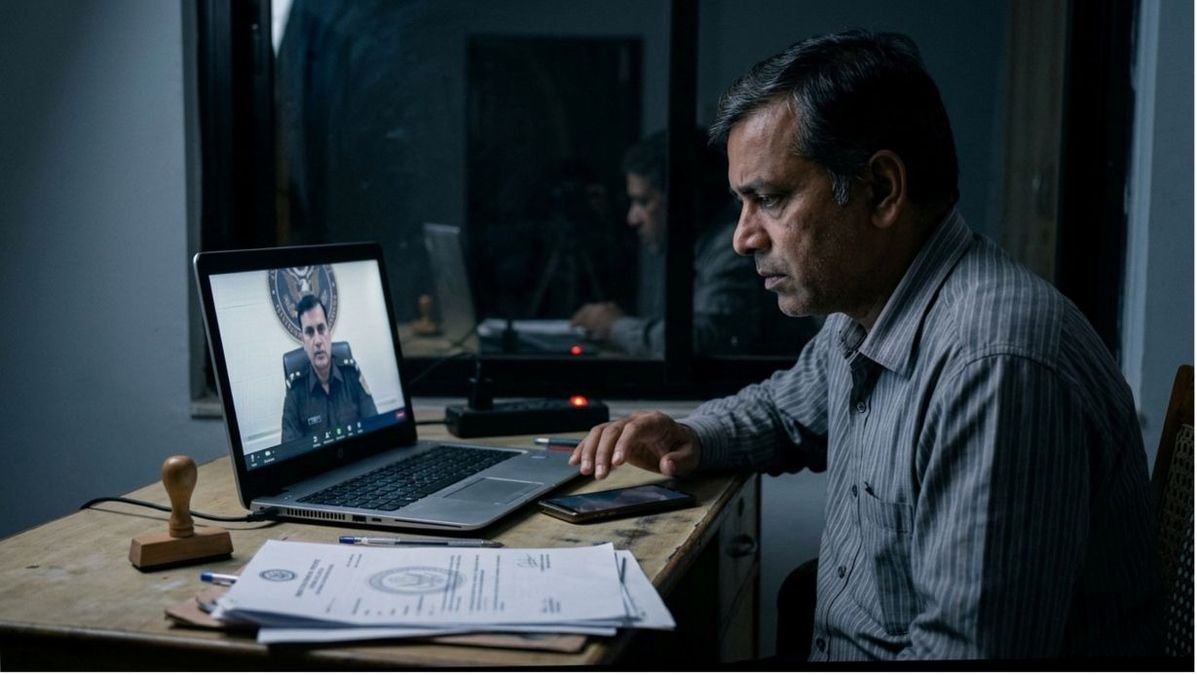
In its August order on digital arrest scams, the Supreme Court recorded a figure that looks like good news. Complaints filed under that label on the national cybercrime portal fell from 1,23,672 in 2024 to 58,239 in 2025, and to 16,377 in the first half of 2026.
Two months earlier, the same court heard that total cyber fraud in 2025 came to about Rs 22,495 crore, with complaints up 24 per cent to roughly 2.81 million. That is the Home Ministry data as reported from the 28 July hearing. The crime did not shrink. Its name did.
India’s answer to impersonation is more official digital contact: verified SIMs, bank alerts, e-notices, KYC calls. Each new official channel is also a new template to forge. Call it the verification paradox.
Authority has become a file format
The case began in October 2025, when the court took notice of an elderly couple in Ambala who lost Rs 1.05 crore after being shown forged Supreme Court orders. A CBI probe has since traced 238 victims across 67 first-layer accounts, with about Rs 80 crore moving through them and searches at 93 locations in 16 states.
Nobody was hacked in that case. The fraudsters supplied paperwork, and the victims did what citizens are told to do with a court notice. The attack surface is the habit of compliance. When obedience to officialdom is the habit, a forged notice only has to look official.
Deepfakes remove the last informal check. Justice Joymalya Bagchi observed in July that they can now be used for cheating and impersonation. If a face and a voice can be rendered on demand, “I saw the officer on video” proves nothing. A Fortinet executive at the India Mobile Congress this week said a single malicious WhatsApp link can turn a phone into a gateway to banking, OTPs and identity documents. That is a vendor’s view, but the mechanism is easy to credit.
The label moves faster than the law
On 28 July the court asked the Centre to create a standalone offence for digital arrest and to legislate on AI-generated deepfakes. The Solicitor General told the bench a draft bill is coming. A statute that defines digital arrest defines a script, and scripts are cheap to change.
The falling complaint count is consistent with that. I cannot verify from the published figures where the volume went, but total complaints rose while one category collapsed, which suggests migration to investment, job and insurance pitches rather than retreat.
Jammu and Kashmir is not exempt. A senior cyber police officer put J&K’s 2025 cybercrime losses at Rs 184.91 crore in January and named digital arrest as the emerging method. In October 2025, a Jammu trader lost about Rs 4.4 crore, and the arrests were made in Gujarat. The victim sat in Jammu. The mule accounts sat elsewhere.
Upstream has an owner
Prime Minister Narendra Modi told the Congress on 8 October that India wants a global mechanism to stop fraud before it reaches people. Upstream is the right place to fight. Twenty-six banks already use the RBI-linked MuleHunter.AI tool, and the court has told the RBI to circulate a temporary debit-hold procedure. The same status report said WhatsApp did not take adequate action on intelligence from the Indian Cyber Crime Coordination Centre, while Microsoft responded quickly.
The recovery side is thin. Rs 18.05 crore has been restored across 36,290 cases. The periods are not like for like, but set beside Rs 22,495 crore in annual losses, it is a rounding error. Only 14 states had notified their state cybercrime coordination centres when the court last looked.
There is a second cost. A filter that decides which calls and messages reach a citizen makes telecom operators and platforms the gatekeepers of contact. Kashmir knows what happens when connectivity becomes an administrative decision. A control plane built to stop fraud will be asked, sooner or later, to stop other things.
Bottom Line
Fraud that borrows the state’s face cannot be fixed by giving the state more faces. Verification has to start with the citizen: a call-back number that is never supplied by the caller, a bank hold the account holder can trigger, a court order that never arrives on WhatsApp. Until then, the labels will keep falling, and the losses will not.
(The author is studying Computer Science and Artificial Intelligence at Rutgers University, New Jersey, USA. He is interested in emerging technologies and innovation, and can be reached on LinkedIn at @arssh-kumar14)


