





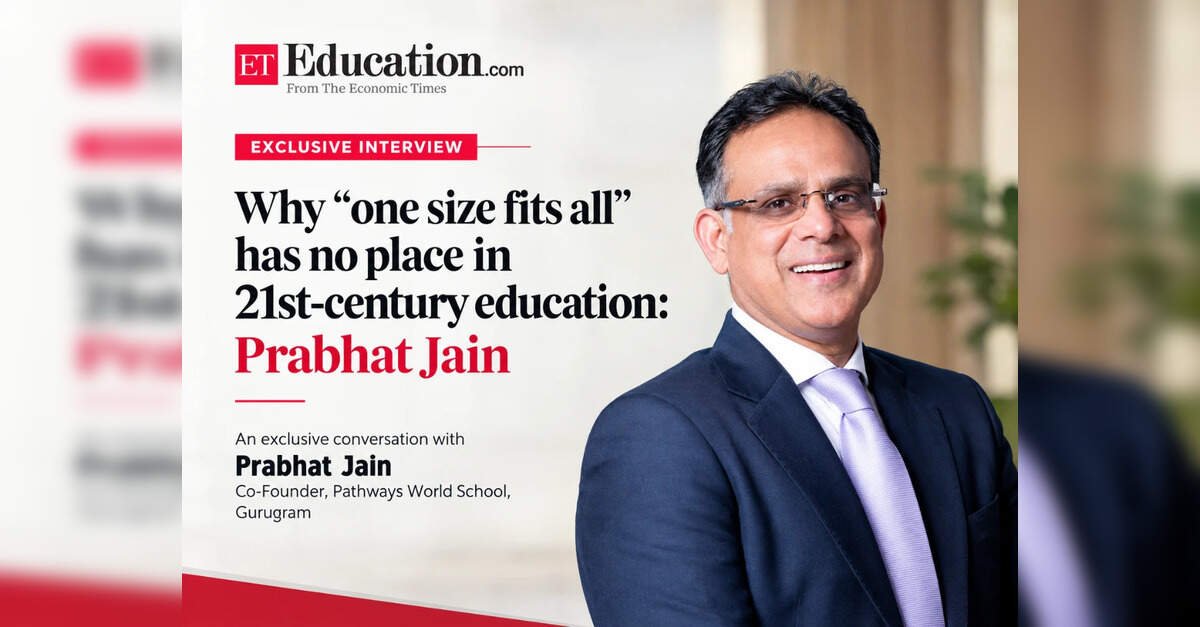
The world around schools has changed dramatically, from how people live and consume information to how they work and travel. Yet, according to Prabhat Jain, Co-Founder, Pathways World School, Gurugram, schools must continue to evolve with the times and with every new generation.
In an exclusive conversation with ETEducation, Prabhat Jain discusses why schools must move students from conformity to curiosity, nurture lifelong learners and embrace personalised learning. He also reflects on AI’s role in education, why teachers remain the most important investment for schools, and why schools must continue to evolve as “living organisms” to prepare students for an uncertain future.
Here are the edited excerpts from the interview.
Q. What is the biggest change Indian schools need to make today to prepare students for a world that is changing faster than the curriculum?
When we thought of setting up a school in 2000-2001, we asked why schools had remained much the same. That led us to two years of research and to develop a pedagogical model for the school.
Schools are living organisms. They should evolve, change and adapt with the times and new generations. The students entering classrooms today will probably get into a void which none of us can describe.
The only way to prepare today’s children to be successful in the world they will inherit is to make them lifelong learners. There needs to be a paradigm shift from teaching-based classroom transactions to learning-based ones, with teachers becoming learning facilitators and creating an environment where students inquire, explore and understand themselves.
Schools need to stop pushing students towards conformity. They have to shift from conformity to curiosity.
Q. Pathways has emphasised personalised and experiential learning. What should schools rethink if they want to move beyond a one-size-fits-all model?
The one-size-fits-all model has no space in the 21st century. One theory we came across while researching our first school was Howard Gardner’s theory of multiple intelligences.
Beyond logical-mathematical and linguistic intelligence, there are several other intelligences. It is about reading an individual student and using their strengths to teach them other domains.
Personalised learning is the only way to succeed today. Students have several pathways to success and careers we never imagined. Did anybody think prompt engineering could become a career?
We also need self-directed learning, where children can learn at their own pace through solo learning, group learning or one-on-one sessions with teachers. That is how learning can become effective.
Q. AI is reshaping how students learn, work and create. What should schools teach students that AI cannot?
Technology has always been an enabler, a tool and a means to an end.
When large language models emerged, some educational institutions wanted to block them because of plagiarism concerns. But technological innovations are there to be embraced and used meaningfully.
For example, students could use a large language model to write an essay and then be challenged to improve it. The first step comes through artificial intelligence; the next requires human intelligence.
AI can provide quick, filtered answers. But is that information authentic, correct or ethical? These are skills that can still be taught in classrooms. What AI cannot teach are human emotions and empathy.
Academics are at the core of K-12 education, but education goes much beyond academics. We learn through sport, teamwork and helping others. AI can supplement learning, but human intelligence, emotion, empathy and resilience have to come along with it.
Q. Should student wellbeing be considered as important as academic achievement?
Wellbeing and academic achievement are not exclusive. Academics remains the core of education, but education goes much beyond. An anxious student cannot easily be an active participant in learning.
Wellbeing and academic rigour go hand in hand. One cannot be ignored over the other. This is even more important today because of information overload, peer pressure and, sometimes, pressure from families to succeed or avoid failing. Mental health is also an important concern.
Q. Where should schools be investing more today: teachers, technology, infrastructure or student wellbeing?
All four go together. Technology helps with information, infrastructure creates possibilities and wellbeing is essential. But the person who combines all these things is the teacher.
Every school should invest in all four, but the most important is the teacher. When we were setting up Pathways, our schools became known for their infrastructure, but we do not consider infrastructure anything more than hygiene.
Schools are not made of buildings. It is the people who make schools. The teacher, whom we call a learning facilitator, is the most important element in education.
A good teacher is not somebody who has answers to every question. A good teacher encourages students to ask questions to which even the teacher does not have an answer, and says, “It’s a brilliant question. Even I do not know. Let us try to find it together.”
That is real learning. An experiment means trying something new with a different hypothesis. Not every experiment will succeed, but you learn what works and what does not.
Q. What separates a genuinely great school from one that simply has great facilities?
It is not the buildings that create schools, it is the people. What distinguishes a great school from one with great infrastructure is the culture we create.
A school brings together teachers and people from different backgrounds who create that magic with students. That cannot happen without a strong culture and passion for working with young people.
So, primarily, it is culture.
Q. What has running schools taught you that you did not understand when you first entered education?
Before starting our first school, we undertook two years of research and began with two questions. First, what is the purpose of schooling? Is it simply to help students get the number they need to enter university? If so, why are the most meritorious students by examination grades not necessarily the most successful in life?
Success is not only about money. It is about the life you live, how fulfilling and satisfying it is, and how good a contributor you are to society. There is a mismatch between academic scores and what life actually demands.
The second question was who we should benchmark ourselves against if we wanted to build a school comparable to the best nationally and internationally. We visited schools in India and overseas and learned from outstanding institutions, while also asking how we could prepare students for the future.
Interestingly, we did not even know that IB existed at that point. Pathways World School became the first IB school in North India in 2008, but it was not conceptualised to be an IB school. It was conceptualised to be a very good school with strong pedagogical practices.
We also experimented, made mistakes and learned. Qualifications and subject knowledge are important, but they do not alone make great teachers. A great teacher motivates students with different abilities, learning styles and interests. It has become more of an attitudinal play than purely skills.
Q. What is your long-term vision for Pathways, and what will future-ready schooling look like in 2035?
I believe it is difficult to predict what the world will be like even three years from today.
Back in 2000-2001, we tried to look 15-20 years ahead. Three years ago, while celebrating 20 years of Pathways, we realised those 20 years had passed. So now what? We have to reinvent ourselves.
That is what we have been doing and will continue to do. Schools have to be living organisms. Evolution is not only about pedagogy, but also learning spaces, how we interact with students and how we assess them.
There is not necessarily one answer to a question. Students must be allowed to make mistakes, fail and learn from them.
K-12 can never be replaced by technology because we are not creating robots by filling information into human minds. It is about nurturing human beings. Schooling will always remain, but practices will change as generations evolve.
Q. If you could change just one thing about Indian school education overnight, what would it be and why?
One issue we continue to grapple with is the focus on high-stakes, end-of-year assessment. Everything flows backwards from the Grade 12 examination. I think that needs to change.
The National Education Policy talks in that direction and is an aspirational vision of how education and learning should progress. Implementing it on the ground is where the proof of the concept lies.
We also need to invest much more in teacher capability. Historically, the teaching profession was highly credible, respected and held in great importance.
We have to “bring back the same glory to the teaching profession, just like we had for the gurus”. It has to be celebrated. They nurture generations.
Five Rapid-Fire Questions, Five Unfiltered Takes
Q. One quality every future-ready student must have?
I would say two instead of one. Adaptability for the kind of world that we live in, and resilience. It is very, very important.
Q. One thing schools should stop teaching?
Conformity. There is not always only one answer to a question. There could be multiple answers.
Q. A book every educator should read?
If one were to be selected, the starting point could be The Element by Sir Ken Robinson.
Q. One lesson you wish every parent would teach at home?
Encourage your children to be risk-takers. Take away from them the fear of making mistakes or failing. Because a failure or a mistake is only a stepping stone to success.
Q. One word that comes to your mind when you think about the future of education?
Endless possibilities.


