



There are moments in the history of a civilisation when a tradition, though never completely extinguished, appears to recede into the shadows of time. Its texts survive in manuscripts, its wisdom remains preserved in the memories of a few teachers, and its spiritual practices continue quietly within a small circle. Then comes an individual who reconnects the broken threads, restores confidence in the tradition and transmits its knowledge to a new generation.
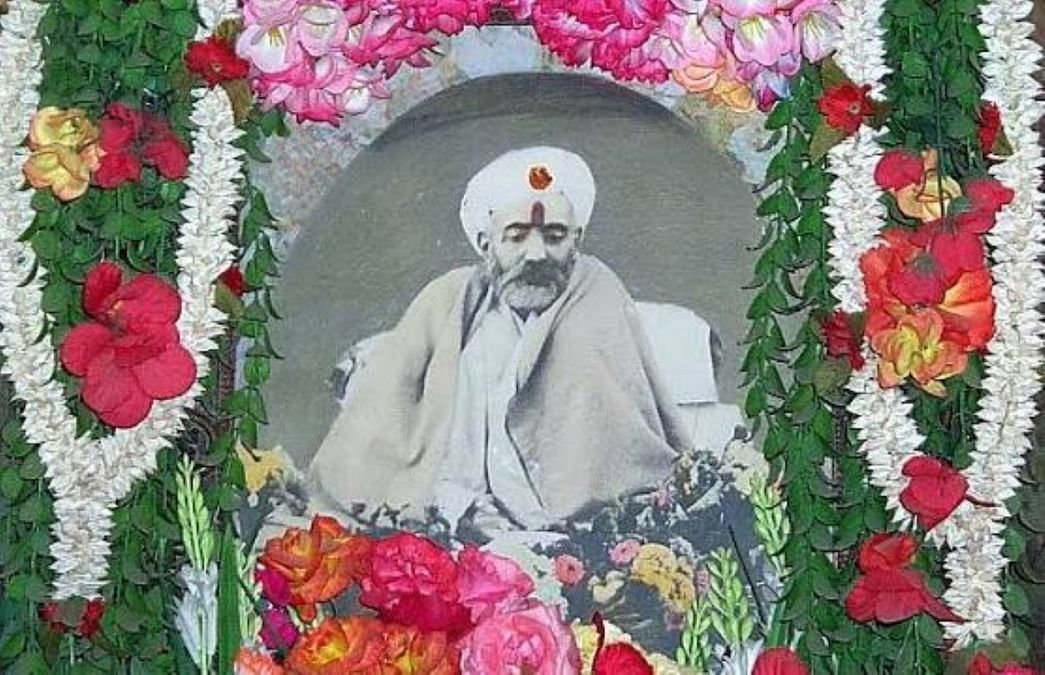
In the modern history of Kashmir Shaivism, Swami Ramji Maharaj (1854–1915) occupies such a significant place. A saint, scholar, practitioner and teacher, he helped revive the living study and practice of the Trika tradition in nineteenth-century Kashmir and prepared the ground for its remarkable transmission into the twentieth century. His influence was not merely personal or devotional. It extended to the preservation, teaching and publication of the intellectual heritage of Kashmir Shaivism.
Swami Ram was born in 1854 into a Kashmiri Pandit family in Srinagar. Accounts of his life describe an early inclination towards spiritual inquiry and the study of Shaiva scriptures. He came into the orbit of learned teachers who introduced him to the Agamas and the philosophical literature of Kashmir Shaivism. His spiritual formation eventually brought him into contact with Swami Manas Ram Mongra, popularly known as Maneh Kak, who became an important guru in his life and in the transmission of the Trika tradition.
To understand Swami Ram’s importance, however, one must first appreciate the intellectual grandeur of the tradition he inherited.
Kashmir Shaivism was not simply a sectarian religious doctrine. It represented one of India’s most sophisticated schools of non-dual philosophical thought. Its classical development is associated with masters such as Vasugupta, Somananda, Utpaladeva, Abhinavagupta and Kshemaraja. At its heart lies the recognition that ultimate reality is Shiva, an infinite, self-luminous consciousness, and that the universe is not fundamentally separate from that reality.
The word Pratyabhijna—recognition—is central to this philosophical vision. The human being does not have to manufacture an entirely new reality; rather, one must recognise the deeper nature of consciousness that is already present. The world, in this understanding, is not merely an illusion to be rejected. It is an expression of the dynamic power, or Shakti, of the supreme consciousness.
This philosophical inheritance had reached extraordinary heights in the works of Abhinavagupta and his successors. But the historical circumstances of Kashmir subsequently made the institutional continuity of many Shaiva traditions increasingly fragile. By the nineteenth century, the tradition needed not merely textual preservation but living teachers who could embody and transmit it.
It was in this environment that Swami Ram emerged.
His significance lay in bringing together scriptural learning, philosophical understanding and spiritual practice. He did not approach Kashmir Shaivism as an intellectual museum. The Agamas, the works of the great acharyas and the practices of the Trika system were, for him, a living path.
Accounts of his life describe periods of intense meditation, study and spiritual discipline. His teaching attracted both serious seekers and householders. This is important because Kashmir Shaivism does not necessarily demand withdrawal from worldly responsibilities as the only route to spiritual realisation. Its philosophical framework allows the spiritual quest to unfold while recognising the realities of human life.
Swami Ram eventually established his Trika Shaiva Ashram at Fateh Kadal in Srinagar, generally dated to the 1880s. The ashram became an important centre for the study and transmission of Shaiva philosophy in modern Kashmir.
From this centre emerged a remarkable lineage of teachers and disciples.
Among his important disciples were Swami Mahtab Kak, Swami Vidyadhar and Swami Govind Kaul Jalali. Swami Mahtab Kak would subsequently become the principal teacher of Swami Lakshmanjoo, one of the most important twentieth-century exponents of Kashmir Shaivism. Thus, the intellectual and spiritual influence of Swami Ram extended well beyond his own lifetime.
The connection with Lakshmanjoo is particularly significant.
Swami Lakshmanjoo was born in Srinagar in 1907. Accounts associated with his lineage describe Swami Ram as recognising the young Lakshman’s spiritual inclination and entrusting his further education to Mahtab Kak. Whether viewed through the language of traditional guru-shishya transmission or through the history of ideas, the succession is remarkable: Swami Ram → Mahtab Kak → Swami Lakshmanjoo.
Through Lakshmanjoo, the teachings of Kashmir Shaivism eventually reached audiences far beyond Kashmir. The revival initiated in the nineteenth century thus acquired a much wider intellectual and spiritual horizon in the twentieth century.
Swami Ram’s contribution, however, went beyond the immediate guru-shishya relationship.
One of the most consequential developments associated with the revival of Kashmir Shaivism was the systematic publication of its ancient texts. The Kashmir Series of Texts and Studies (KSTS), initiated under Maharaja Pratap Singh in the early twentieth century, became a landmark in making important Sanskrit works of Kashmir’s philosophical heritage available in printed form. Sources associated with the tradition credit Swami Ram with encouraging Maharaja Pratap Singh to undertake such a publication effort.
This was an extraordinary act of intellectual foresight.
A philosophical tradition cannot remain alive indefinitely if its principal texts are inaccessible. Manuscripts can disappear, deteriorate or remain confined to a small number of custodians. Printing transformed the possibilities of transmission. The KSTS therefore became an important bridge between Kashmir’s classical intellectual heritage and modern scholarship.
Swami Ram understood that preservation required both realisation and documentation, both guru and grantha, both lived experience and accessible texts.
That insight deserves particular attention today.
The modern world often separates philosophy from spirituality. Academic institutions may study philosophical systems primarily as historical objects, while spiritual communities may sometimes emphasise experience without sufficient attention to textual rigour. The Kashmir Shaiva tradition historically brought these dimensions together. Swami Ram represented that synthesis in the modern period.
He studied the philosophical works of the great masters and transmitted their ideas through oral teaching and spiritual discipline. Among the works associated with his teaching tradition were texts connected with Vasugupta, Utpaladeva and Abhinavagupta, including the Stotravali, Shivastotravali, Tantraloka and Panchastavi.
The deeper message of this tradition remains relevant.
Kashmir Shaivism places consciousness at the centre of its philosophical inquiry. It asks the individual to look beyond fragmented perceptions of the self and recognise a deeper unity. In a world increasingly marked by anxiety, polarisation and material preoccupation, the philosophical proposition that consciousness is not merely an accidental phenomenon but central to our understanding of existence retains considerable contemporary interest.
Yet Swami Ram should not be reduced to a philosophical slogan. His importance lies in the continuity he embodied.
Kashmir’s civilisation produced a remarkable succession of philosophers, mystics, poets and spiritual teachers. From Lalleshwari to Abhinavagupta, from Rupa Bhawani to Swami Ram and subsequently to Swami Lakshmanjoo, there is a fascinating history of intellectual and spiritual creativity. These figures belong to different historical circumstances and should not be artificially made identical. But together they demonstrate the remarkable resilience of Kashmir’s contemplative traditions.
Swami Ram’s place in this continuum is that of a bridge-builder between classical Kashmir and the modern age.
He inherited a tradition that had achieved its classical philosophical expression many centuries earlier. He revived its teaching in a period when its institutional presence had weakened. He created a space where seekers could study and practise. He trained disciples who carried the tradition forward. And he encouraged the preservation and publication of the textual heritage upon which future generations of scholars and practitioners could depend.
His legacy therefore belongs not merely to one community or one period. It forms part of the larger intellectual heritage of India.
In remembering Swami Ram, Kashmir remembers one of those quiet civilisational figures whose influence cannot be measured simply by books written or institutions founded. His contribution was to ensure that a profound stream of Indian philosophical thought continued to flow.
He passed away in 1915, but the lineage did not end with him. It moved through his disciples and ultimately reached new generations and new continents.
That may be the most enduring lesson of Swami Ram’s life: civilisations survive not merely because their monuments remain standing, but because their knowledge is transmitted from one generation to another.
Kashmir Shaivism is one such stream of knowledge. Swami Ram was among the modern custodians who helped keep that stream alive.
At a time when Kashmir’s ancient intellectual inheritance deserves renewed study—within India and beyond—his life invites us to look again at the philosophical treasures that emerged from the Valley. The story of Swami Ram is, in that sense, not only the story of a saint. It is the story of memory, continuity and civilisational renewal.
And perhaps that is why his legacy continues to matter: he did not merely look back at Kashmir’s great philosophical past. He helped ensure that it could speak to the future.
(The Author is a columnist, a public intellectual and a noted legal eagle)
