






What does a university need to provide to a student? Certainly, educational qualifications. Certainly, knowledge. But this is no longer enough in the fast-changing world we live in.
A college must teach students how to spot opportunities and also how to create something themselves. It should link what the students receive in classrooms with what the industries, communities, and the country really need. It is in this context that the idea of introducing the National Education Policy (NEP) is so important.
Due to the possibility of implementing interdisciplinary learning, flexibility, and better merging of skills with education, the NEP gives universities a chance to rethink higher education.
The university of the future must not only teach and provide diplomas. It should connect students with the needs of the industries, the world of opportunities, and the various ways of contributing to the development of the country.
From Degree Providers to Bridges Between Students and Industry
Higher education has operated on a predictable system for years: go to class, do homework, take tests and look for employment.
But the job market has become different.
It now needs people who are problem-solvers, can work interdisciplinarily, know tech tools and can adapt to changes. This is why universities need to reconsider the process of studying.
NEP’s emphasis on a multidisciplinary principle plays a vital part in this way. An engineering student should not only study engineering. Visiting entrepreneurship, communication, economics, design, data or environmental studies classes might help students understand the value of technology.
Same with management students: obtaining knowledge on artificial intelligence, digital platforms, sustainability, and other technologies will be beneficial.
The plan needs to be straightforward: to match multidisciplinary education with market needs.
Universities can facilitate this connection through internships, industry-related projects, guest lectures, live tasks, research work, and professional mentorship. When students know how the theory is applied in practice, their education gains sense and relevance.
The Placement Cell Should Give Way to the Startup Cell
The performance of a university should not be considered only by its students who secure employment, as this calls for asking: how many students have encouraged others to pave the way for themselves? This clarifies the need to change the focus from placement-oriented thinking to entrepreneurial thinking. Instead of limiting the role of the placement cell to a final stage of the academic student development process, educational establishments should work towards the establishment of successful Startup Cells which will enable students to be part of the entrepreneurial process. Various innovative ideas should be explored by students, starting from artificial intelligence and social media and finishing with clean energy, agritech and other areas. Students should receive any assistance they require.
Although it goes without saying that not every student will succeed in this endeavour.
However, success is not necessarily defined in terms of business.
Rethink the Course Structure: From Theory to Practical Capability
In order to achieve different results in the students, changes have to be made in the content and way of delivering the subject.
There has to be a shift not only from theoretical studies to practical and skills-based learning.
A business student can work on an actual business problem; an engineering student could create a functioning prototype; a media student could launch an online campaign; and a computer science student could devise an AI-based solution.
Universities can introduce more interdisciplinary initiatives, industry-related assignments, innovation contests, internships, field visits, research projects, and entrepreneurship initiatives.
It should be stated that learning content must not be limited to the classroom; learning should start from the classroom.
Give Young People a Voice and a Sense of Responsibility
Education consists not only in gaining professional competence. Education is also the process of becoming an active citizen. The universities must create an environment that stimulates students to ask questions, hold discussions, disagree in a polite way and learn to understand opinions other than their own.
Different types of student organisations, for instance, debating societies, sports clubs, and cultural centres, give students opportunities to develop their skills in leadership, teamwork, and communication.
It is also necessary that students take part in NSS and NCC programmes. These organisations teach students that citizenship presupposes responsibility.
Through social services and different types of social work, participation in community life, self-discipline and leadership, students learn what it is to be a citizen.
Nation-Building Begins With the Problems Around Us
Nation-building seems to be a noble cause. However, in real life, it usually starts with some small problem which someone chooses to tackle.
For example, a student creating a low-cost device for farmers is doing something for the well-being of the nation. A young businessman creating jobs is also contributing to the benefit of the nation. This also applies to a researcher working on improving healthcare, and a student involved in NSS volunteer work or developing leadership skills in NCC.
Universities are able to provide their students with the necessary knowledge concerning the problems that India faces in such areas as medical care, education, agriculture and work, environmental issues, infrastructure, technology, and social progress. But more importantly, they can help them understand these issues as something that gives them opportunities for contribution rather than just difficult tasks.
The aim of education should slowly shift from ‘What can I get from my education?’ to ‘What can I offer in return for what I have gained from my education?’
The University We Need for the India We Want
When we envision the future college, we need to think beyond just the physical aspects of building and infrastructure or placement figures. We should be asking:
Are the students learning in various areas of study?
Are they getting any real-world skills?
Are they motivated enough to start their own companies or come up with their own ideas?
Do they have opportunities to face real-world challenges?
Are they getting ready to take the lead?
Are they aware of their obligations to the state and society?
The future of India will be in the hands of educated youth who can learn, grow and innovatively build the future. Universities have an impressive opportunity to prepare them for this future.
If at the university students gain knowledge and skills, develop self-confidence and an entrepreneurial mindset and become responsible citizens, they get much more than just a degree.
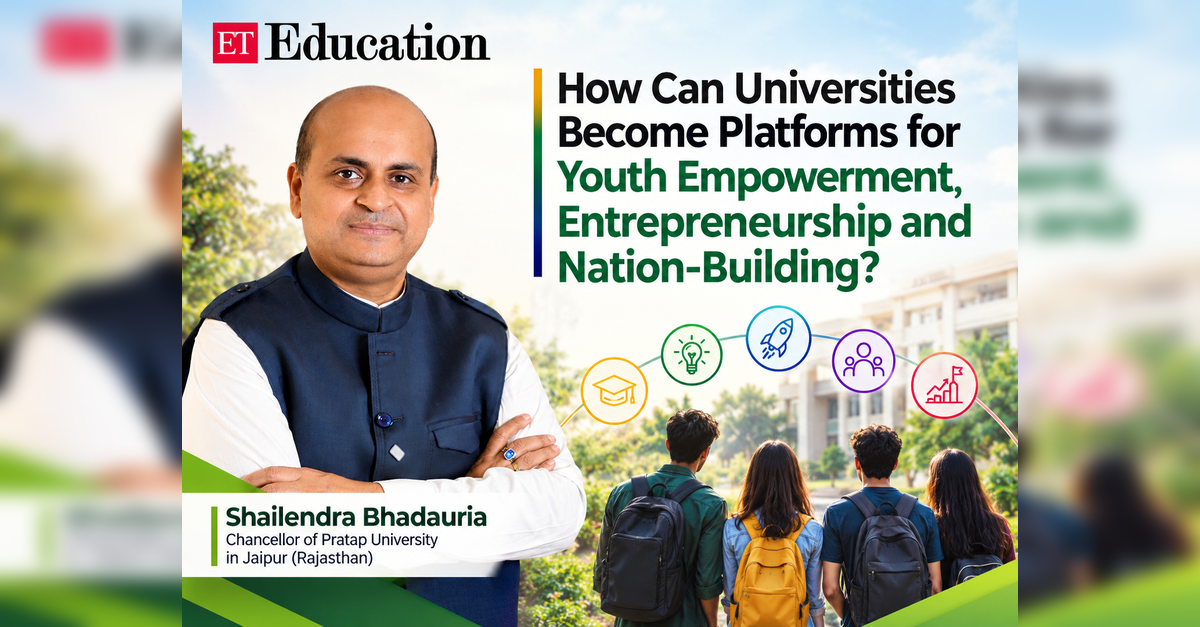
The author Shailendra Bhadauria is the Chancellor of Pratap University in Jaipur (Rajasthan).
DISCLAIMER: The views expressed are solely of the author, and ETEDUCATION does not necessarily subscribe to it. ETEDUCATION will not be responsible for any damage caused to any person or organisation directly or indirectly.


