









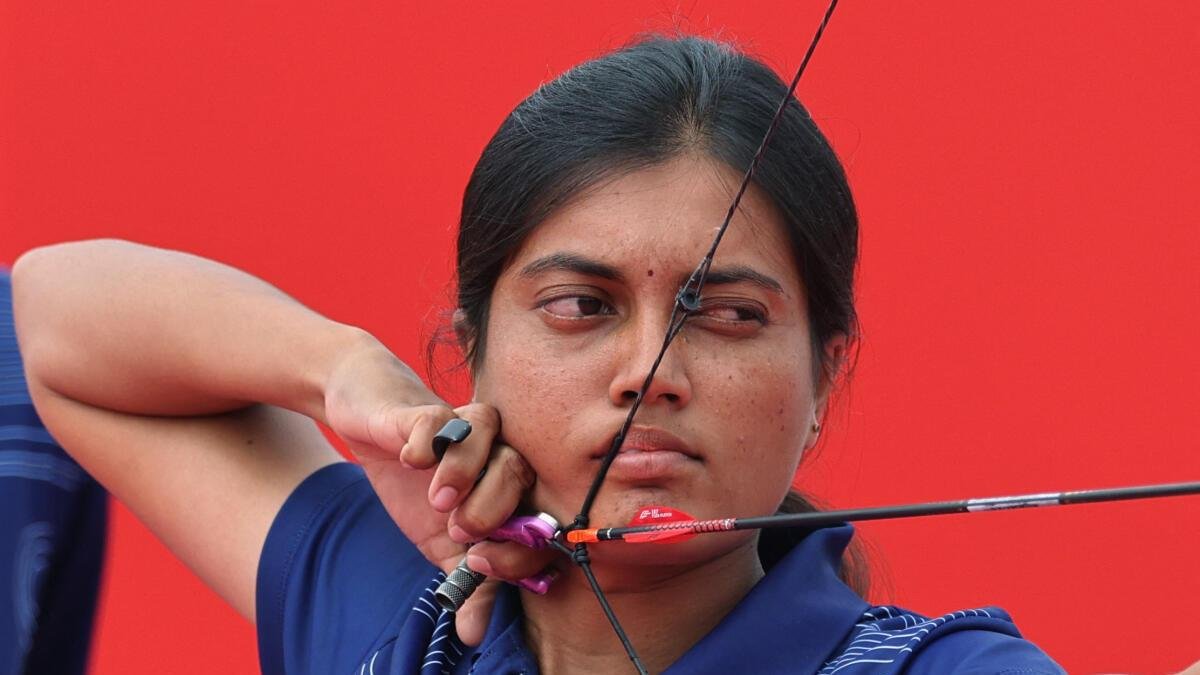
By now, the two gold medals she has snapped up at the 2026 Asian Games have catapulted the extremely shy compound archer Chikitha Taniparthi into the national headlines. The 221-year-old – who comes from a modest farming family in Peddapalli, Telangana – is a stranger to stardom and the sprinkling of opulence that sporting achievements usually carry along in India.
There are no fancy routines or competition-day playlists yet. She doesn’t even carry a pair of earphones. All she has is a burning hunger to become India’s most decorated archer ever. And she’s off to quite a start.
For all the reticence, Chikitha – a huge Mahesh Babu fan – finds inspiration in films that are of a more audacious ilk.
“There was a movie Ram Charan did last year called Game Changer. After watching that – and it usually happens when I watch certain films – I thought, what should I do or learn from this? I myself should change the game where I am,” Chikitha told The Hindu a few weeks before setting out to Japan for the Asiad.
“Now, everyone says, whatever rank Chikitha is in, she will somehow change the game and come up. Similarly, I watched a film called Biker, where the message blared, ‘No fear.’ It all registers somewhere.”
Of betrayal and faith
That itch to push beyond the ordinary is a Taniparthi family trait. Her father, Srinivas Rao – a huge sports enthusiast – combed newspapers for summer camps his own childhood never offered.
“Naanna (father) didn’t have any such facilities when he was growing up, so he was keen to ensure that I had access to all that, within our means.”
In school, Chikitha tried her hand at a multitude of options including volleyball, badminton, basketball and kho kho. But Srinivas wanted his child to pursue an individual discipline. Towards that end, she earned a black belt in karate. But archery was destined to be the one to stick with.
“Team sports are riddled with politics. Since archery is an individual game, whatever we do is directly visible and we do what we do for ourselves.”
The year was 2018. Chikitha’s uncle, on her father’s request, had got her a recurve bow from Decathlon with which she trained behind her house, shooting at haystacks. Eventually, she and a few of her classmates went to the Police Training Center to try and find a coach to teach them. There, someone asked her to switch to a compound bow and took money from Srinivas for the same, only to disappear without a trace.
ALSO READ | At peace with pressure: Understanding Jyothi Surekha
Disappointed but not disillusioned, the father and daughter persisted with the sport. Chikitha moved away from recurve and towards compound.
“Recurve bow needs a lot of practice and power. You need to train every single day. If you return after resting for a few days, you’ll see so many changes and will have to rework it all. With compound, I could train for two hours each in the morning and evening. It needed the archer to set themselves mentally and keep getting better.”
The next pursuit became trying to purchase a compound bow, but the COVID-19 pandemic arrived soon after.
Women’s Compound Archery team members Prithika Pradeep, Chikitha Taniparthi and Jyothi Surekha Vennam who won the Gold Medal at the Asian Games at Aichi- Nagoya, Japan, September 30, 2026.
| Photo Credit:
R.V. MOORTHY
“Our classes all went online, so I could train every day. At that point I didn’t know what a national medal was, but I wanted to win one.”
“During Covid, my father had set up a target and a 50m path so I could shoot. He would go to the field every morning. My brother and I would go running every morning along the edges of our field. That is when I became really fit. In fact, my father also joined us and improved,” Chikitha recalled. “Eventually I left for Sonipat, and my father settled back into the duties of the house. The family’s fitness streak sort of snapped there.”
Srinivas pushed beyond his means to support his daughter’s dream. He even sold the family’s paddy harvester. Meanwhile, YouTube videos formed the bedrock of Chikitha’s technical base, and one of the archers she grew to idolise – Abhishek Verma – would become her mentor.
Eventually, the District Collector’s office sanctioned funds for a compound bow. As she looked for a coach and a good training centre, Chikitha chanced upon the contact details of My Choice Archery Store, an equipment outlet run by Abhishek and his wife Sonali in New Delhi.
Guiding light
“I got her number from the shop they run and I knew she was Abhishek anna’s wife. He and his coach (Lokesh Chand Pal) agreed to take me in for training at the Yamuna Sports Complex for five days.”
This was in August 2021. As the world found a way to open up again, so did Chikitha’s prospects as an archer. Her uncle chipped in with funds for the trip to the capital.
There, Abhishek told Srinivas to leave Chikitha’s well-being to him.
The first goal was a sub-junior medal.
“I didn’t know much about archery, but I used to watch Abhishek anna’s videos and check with my father if I was getting things right. Anna then told me that my strength was good, but he changed my anchor technique. In the mornings, he used to let me shoot 50-100 arrows. In the evenings, there would be no shooting. We just trained holding the bow and arrow in place. This was to develop patience. I learnt all my basics there at the Yamuna Sports Complex.”
Chikitha entered the senior nationals in preparation for the sub-junior event and got a very low score there. Her mentor had notes, and the pair eventually struck off the first box in what would become a long checklist of turfs to conquer.
She then participated in selection trials to make it to the Sports Authority of India’s National Centre of Excellence in Sonipat. There, coach Vivek Kumar took her under his wing. “After my father, he is the only person I open up to after tournaments and cry with,” Chikitha said.
Sahil Jadhav, left, and Chikitha Taniparthi during the medal ceremony for the compound mixed team archery event at the 2026 Asian Games in Nagoya, Japan.
| Photo Credit:
PTI
“In 2021, I was in Hyderabad for the National Ranking Archery Tournament. Abhishek told me that there was a talented girl I should meet. Her father brought her to the hotel we were staying in. This girl was so small and frail. I asked her if she wanted to go to Sonipat. She nodded in agreement, but there were tears too,” Vivek told The Hindu.
Nonetheless, he persisted. “If a player like Abhishek recommends someone, you cannot ignore that. He told us she would become a good archer like Jyothi Surekha.”
Abhishek, it turned out, was right. The parallels between Chikitha and Jyothi are endless. Both are introverts by nature, content to shuttle between the training field and the gym. Both follow instructions to the letter, even when that means shooting 300-odd arrows, and both are always early, rain or shine.
ALSO READ | Indian archers hit the bullseye with three gold medals at 2026 Asian Games
Vivek remembers Chikitha clinging to her father until the moment they parted. Slowly, Sonipat won her over. By night, she had found the courage to make a request: biryani. The coaches understood how hard it is for someone from South India to move to a diet where rotis reign, and they indulged her.
Any doubts about her potential evaporated at the trials ahead of the 2022 Asian Games. She missed qualification but finished a commendable seventh, enough to convince her coaches that she could be shaped into an athlete who would make India proud on the global stage.
Chikitha’s reasons for liking archery are threefold. “First, because, as my dad wanted, it’s an individual sport. Second, archery is a sport where I can concentrate and focus with no distractions. Third, Anna told me, ‘You are a champion, and you will continue to be.’”
Others’ faith in her sowed the seeds of Chikitha’s ambitions; formal training is teaching her to nurture them herself. That process has not been without its hiccups. In 2024, Chikitha struggled to place among the top 16 and lost motivation mid-season.
“That period was a struggle and I couldn’t accept it. Before the national games, I wanted to get selected, but I was nowhere near the top. I was working with high poundage, and I said if I hit any more (shooting arrows), I might get injured. I didn’t feel like shooting. It took me some time to recover from that. I went to Tirupati, tonsured my head, prayed very hard,” she recalled.
“I have to get Abhishek anna the Asian Games plushie. I want to be able to buy another harvester for my father. The World Championships are next year. World Cups are there and then the Olympics are there in 2028. Anna told me to approach everything step by step and not put everything on my mind and take stress. Anna and Jyothi akka are consistent faces in the Indian team. I want to be able to do that too.”Chikitha Taniparthi
Through every hardship, Chikitha never once thought of abandoning archery. When her first substantial prize money arrived, after the 2023 National Games in Goa, she spent it on arrows, stockpiled for practice. A fresh set every few months is her idea of a treat.
“It is not about the money; it does not matter as long as the results come my way.”
It’s taken a village to get Chikitha out of Peddapalli and onto the world stage. Even efforts to watch her favourite Mahesh Babu on OTT is a family activity. OTPs for streaming apps will come from siblings nearly 1500km away. When she comes home for a few days every now and then, there is no TV for the family to unwind with together. She returns to a big family welcome, the open paddy fields and a progressively controlled anxiety of missing training.
Ask Chikitha what she is proud of and, along with the golds, she may mention the gift of deep sleep. Thunder can rattle every window, but she will slumber on.
“I don’t get sleep only when thoughts come to me, which happens when everything is silent.”
Then she went to Japan and became the lightning. Whether or not she slept through the aftermath, India did not. Two golds flashed across the sky, and a sport that thought it knew its stars blinked in the glare.


