



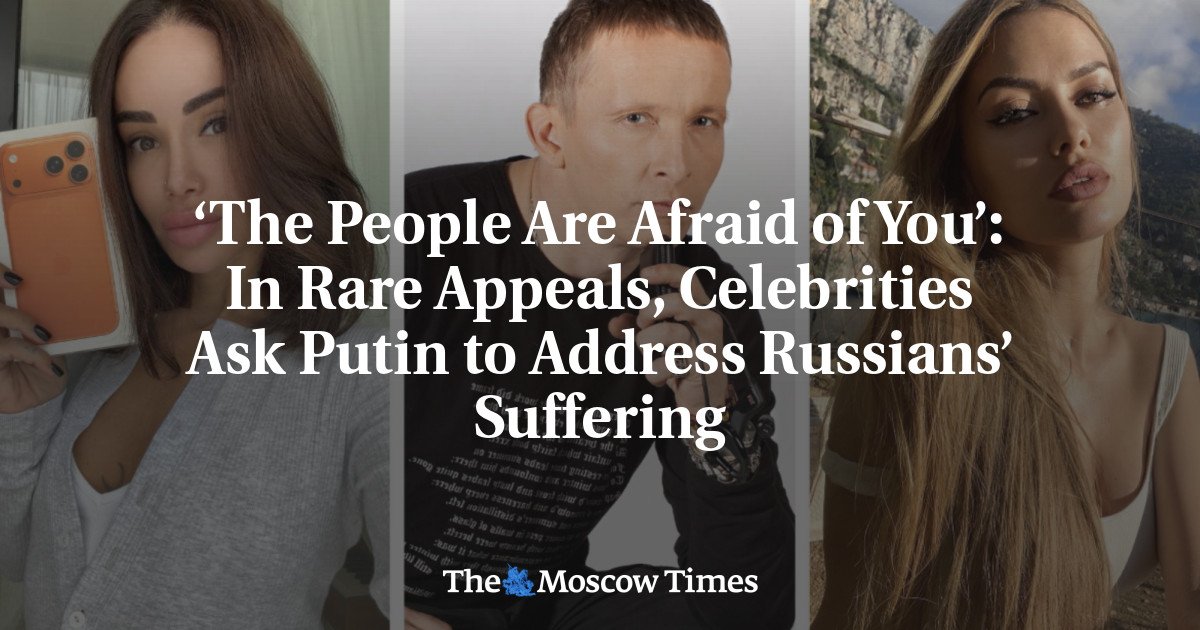
Russian influencers and public figures have issued a series of rare appeals to President Vladimir Putin, saying many Russians are afraid to speak up about problems they face and criticizing what they called “an intention to bring us back to the U.S.S.R.”
The appeals began when blogger and influencer Viktoria Bonya called on Putin to address mounting social and economic pressures that have dominated national headlines in recent weeks.
“The people are afraid of you, artists are afraid, governors are afraid,” she said, adding that she was not.
“There is a huge wall between you and us ordinary people, and I want to break through that wall,” she said in the 18-minute video, which has garnered 24.1 million views and over 1 million likes in the past two days.
“We consider you an excellent politician, but there is a lot you don’t know,” said Bonya, who is best known for appearing on the popular reality TV show Dom-2 (“House-2”) and lives outside Russia.
She listed issues “that no governor would tell” Putin about, including devastating flooding in Dagestan, oil pollution along the Black Sea coast, the culling of livestock in Siberia and internet shutdowns, as well as rising prices and tax burdens on small businesses.
“People are screaming out loud right now. They’ve been stripped of their last resources and they continue to lose more. Businesses are dying,” she said. “People are googling how to leave Russia. It’s one of the most popular search queries right now.”
As the video went viral, some viewers speculated that she could be aligning herself with the Russian opposition or was even acting on the instruction of foreign intelligence.
“I’m not some opposition figure. I never have been and I don’t plan to be. I’m just a person with a heart,” Bonya said in response to interview requests from exiled media. She later said she had not been paid to record the appeal.
Other critics questioned whether the appeals to Putin were actually a PR campaign aimed at portraying him as a “strong president” unaware of problems on the ground or a more nuanced signal from competing factions seeking to ease restrictions in Russia.
Public criticism of Putin or government policies can lead to prosecution and blacklisting by the authorities for both celebrities and ordinary citizens.
Kremlin spokesman Dmitry Peskov on Thursday said Bonya had brought up “very significant issues,” but that authorities were already working to address them.
“We have seen the video. It is quite popular and has received a large number of views,” Peskov said, adding that “none of these [problems] have been left without attention.”
Also on Wednesday, popular blogger Aiza (also known as Aiza-Liluna Ai or Aiza Dolmatova) posted an eight-minute video in which she sharply criticized corruption among lawmakers as well as rising taxes and utility tariffs.
In the since-deleted clip, Aiza suggested that Putin is likely “not actually aware” of what is happening and only receives information from specially prepared briefings.
The next day, she said she had “simply wanted to support people” and later deleted the video because of the media attention and “threats” she received.
“I’m very scared,” she said. “I didn’t say anything bad or anything that isn’t already in the media.”
Even pro-Kremlin actor Ivan Okhlobystin, who once described the full-scale invasion of Ukraine as a “holy war,” joined in the appeals to the Kremlin leader, calling the clampdown on the internet and foreign social media platforms “a huge mistake.”
“If they want to bring us back to the U.S.S.R., then a time machine would need to be built first. Without that, it simply won’t work,” he said.
“The very idea of restricting access to information for our science and culture is beyond comprehension,” he added. “Nothing can truly be ‘restricted’ these days — we live in the 21st century — and this lack of understanding will only further damage reputations.”
Putin’s approval rating has fallen to its lowest level (67.8%) since the February 2022 invasion of Ukraine amid the internet shutdowns, messaging app restrictions and price increases, the state polling agency VtSIOM said.
The public’s dissatisfaction with tightening internet restrictions has prompted some officials to warn of “political and economic risks” from the measures, Bloomberg reported this week.
Political analyst Stanislav Belkovsky said Bonya’s appeal fits the classic “Good tsar, bad boyars” narrative, in which problems are blamed on lower-level officials rather than the leader.
“To the all-powerful grandfather, generous and kind-hearted, who has simply become slightly lost in technological modernity — from a sweet granddaughter who still loves him and empathizes with him,” he said.
Political scientist and former Putin speechwriter Abbas Gallyamov said the appeals reflect “tectonic shifts” in Russian society.
“Many people in the opposition …are reacting to all this with mockery,” he said. “That is completely unfair, because [Bonya] is bringing a fundamentally new audience into the opposition camp that wasn’t there before.”
Nor did he believe the claims that the appeals were orchestrated by the Kremlin.
“She will bring with her people who previously had no interest in politics. Their dissatisfaction is also growing — there are problems with the internet, prices in stores are rising, the war is getting on their nerves, everything in general is exhausting them and the state is, so to speak, intruding into their private lives,” he said.
“Bonya is, in a way, a marker that this is a trend — people feel that they are not alone, that there are prominent figures who express emotions similar to their own,” he said.
A Message from The Moscow Times:
Dear readers,
We are facing unprecedented challenges. Russia’s Prosecutor General’s Office has designated The Moscow Times as an “undesirable” organization, criminalizing our work and putting our staff at risk of prosecution. This follows our earlier unjust labeling as a “foreign agent.”
These actions are direct attempts to silence independent journalism in Russia. The authorities claim our work “discredits the decisions of the Russian leadership.” We see things differently: we strive to provide accurate, unbiased reporting on Russia.
We, the journalists of The Moscow Times, refuse to be silenced. But to continue our work, we need your help.
Your support, no matter how small, makes a world of difference. If you can, please support us monthly starting from just $2. It’s quick to set up, and every contribution makes a significant impact.
By supporting The Moscow Times, you’re defending open, independent journalism in the face of repression. Thank you for standing with us.
Continue
Not ready to support today?
Remind me later.
×
Remind me next month
Thank you! Your reminder is set.


