






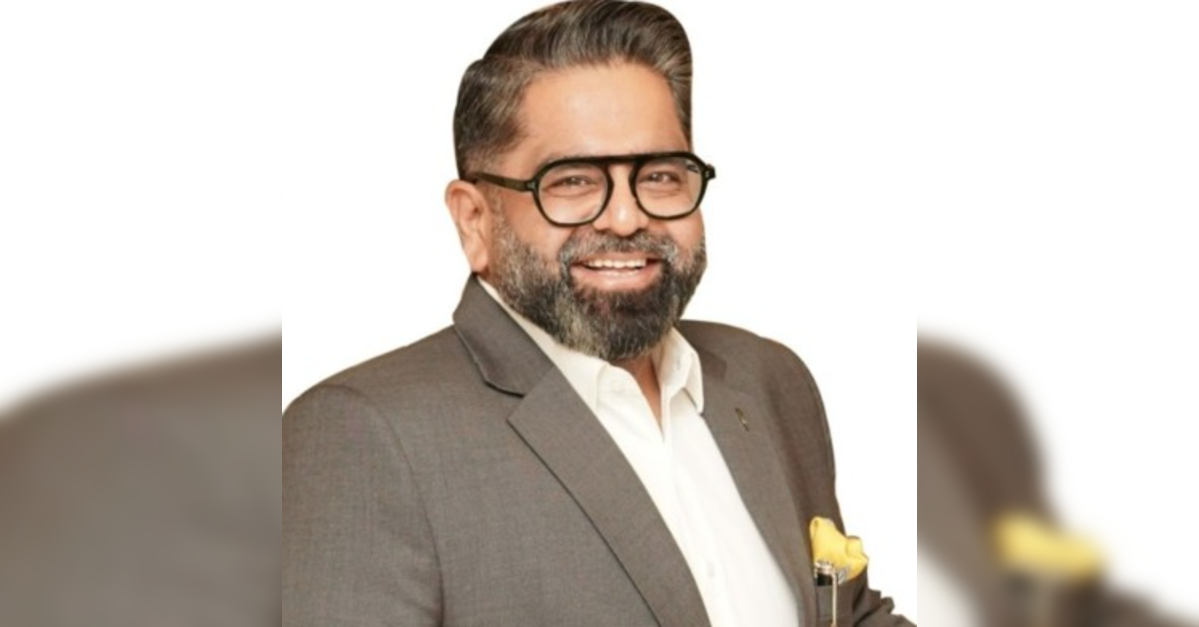
By Dr Amit Bhalla
Every transformative technology eventually recedes into the background. No one thinks of electricity as “technology” while switching on a light. Artificial intelligence is moving along the same trajectory, only at far greater speed. The navigation app that reroutes us around congestion, the bank that flags an unusual transaction, the platform that anticipates what we may want to watch next — AI is already at work in each of them, often without demanding our attention.
This is why AI cannot be confined to a single discipline. It is not an industry in itself, but a foundational layer, much as the internet became within the span of a generation. No one today asks whether a business “uses the internet”; it is simply assumed to sit beneath everything. AI is beginning to occupy that same position. Whether in a hospital, a farm, a bank, a courtroom or a classroom, its presence is no longer an exception. The question before every field is not whether AI will reach it, but how deeply it will reshape the way that field thinks, decides and creates.
The intersection of disciplines
What makes this moment particularly significant is convergence.
For generations, disciplines advanced largely in parallel, each with its own boundaries, vocabulary and methods. AI is beginning to dissolve some of those boundaries. It gives medicine, agriculture, finance, urban planning, design and education a common computational language, allowing insight in one domain to inform another.
The defining breakthroughs of the coming decades will therefore rarely belong to a single field. They will emerge at the intersections, and those who are able to think across those intersections will be better placed to lead.
AI has also given renewed strength to technologies already in our hands. Smartphones, cameras, sensors, cloud computing and robotics were powerful on their own. With AI, they can interpret context, learn from patterns and respond more intelligently to the situations before them. AI has not simply replaced earlier technologies; in many ways, it has brought them closer to maturity.
Yet the most consequential question about AI is not technical. It is human.
What education must prepare for
As machines absorb more routine cognition, the value of human judgment rises. A system may tell us how to accomplish something faster, but only people can decide whether it ought to be done at all. Framing the right problem, acting with integrity amid ambiguity and accepting accountability for outcomes will remain distinctly human responsibilities.
This conviction shapes the approach of Manav Rachna, an institution that has always been guided by the idea of Creating Better Humans. In the age of AI, that mission becomes more relevant, not less. Preparing students for this era cannot mean merely adding one more subject to the syllabus. It requires us to rethink what a graduate should be.
At Manav Rachna, we are therefore looking at AI across disciplines, whether a student is preparing to become an engineer, manager, designer, health professional, lawyer, educator or entrepreneur. The objective is not simply familiarity with today’s tools. Tools will evolve rapidly. What must endure is the capacity to learn continuously, question intelligently and use technology with judgment.
The students learning AI today are not merely its future users; many of them will become its future architects. They will build systems that may influence who receives a loan, a diagnosis, an opportunity or a job. Their responsibility will extend
far beyond technical proficiency. They will need to ensure that the systems they create are fair, transparent and accountable.
India’s opportunity is a human capital opportunity
India is particularly well positioned for this moment. With a youthful population, a rapidly expanding digital base and a proven ability to deliver affordable solutions at scale, the country has an opportunity to build AI that serves not only the privileged few, but society at large.
Whether that promise is realised will depend greatly on the quality of minds we nurture today. From Learning about AI to Building with It – the Founders’ 30 Scholarship for Class 12 Students
That is why opportunities for young people to engage with AI early must go beyond passive learning. They must be given the opportunity to ask questions, identify problems, build, experiment, fail, improve and present solutions of their own. It is in this context that Manav Rachna University is associated with the India School AI Challenge 2026, an initiative of ET Education that gives school students a platform to explore AI through learning and project-building rather than merely consuming technology.
For us, the significance of such an initiative lies not only in identifying students who already understand AI, but in discovering those who demonstrate curiosity, initiative, problem-solving ability and the willingness to learn. And as Manav Rachna completes 30 years, we wanted to take that commitment a step further. Through Founders’ 30, 30 exceptional Class XII students will have the opportunity to receive a 100% scholarship for eligible undergraduate education at Manav Rachna University, backed by a scholarship commitment of over ₹3.5 crore.
Importantly, Founders’ 30 is not an AI scholarship. AI is simply one of the ways through which we hope to discover how a young person thinks. A student’s journey may begin through the India School AI Challenge, but it can lead towards engineering, management, law, design, sciences, media, healthcare, education, commerce or other eligible undergraduate disciplines.
That distinction matters.
The future will not belong only to AI specialists. It will belong to doctors who understand AI, lawyers who can question it, designers who can humanise it, managers who can deploy it responsibly, educators who can use it wisely, and citizens who understand both its possibilities and its limits.
As we mark three decades of Manav Rachna, Founders’ 30 is our way of turning an institutional milestone outward — towards 30 young people whose journeys are only beginning.
Because in the end, the real promise of AI will not be measured by how intelligent our machines become. It will be measured by how thoughtfully, responsibly and imaginatively human beings choose to use them.


