


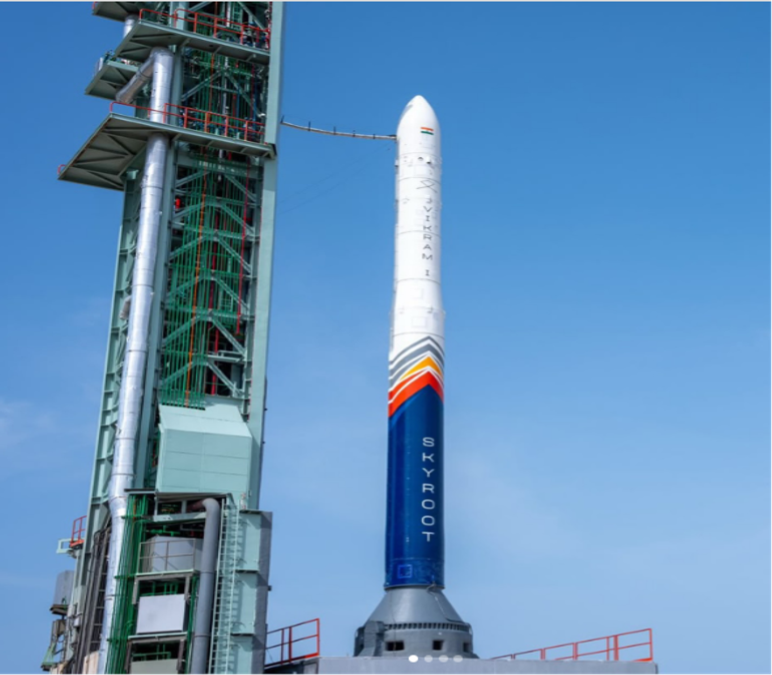
The successful launch of Vikram-1 by Hyderabad-based Skyroot Aerospace is much more than another rocket lifting off from Indian soil. It marks the arrival of a new era in India’s space journey—one where government agencies and private enterprises work together to transform the nation into a global space power. For decades, India’s achievements in space were almost synonymous with ISRO. Today, Vikram-1 demonstrates that the Indian space ecosystem has matured beyond a single institution and has evolved into a vibrant innovation economy.
This mission deserves to be celebrated not merely because it is India’s first privately developed orbital launch vehicle, but because it validates a vision that policymakers, scientists and entrepreneurs have collectively pursued over the past few years. The launch is perhaps the strongest evidence yet that India’s space sector reforms are beginning to bear fruit.
An orbital launch vehicle occupies a unique position in the space economy. Unlike suborbital rockets that briefly touch the edge of space, orbital launch vehicles place satellites into stable Earth orbits where they can provide communication, navigation, weather forecasting, Earth observation and scientific services for years. Vikram-1, capable of carrying 350 kilograms to Low Earth Orbit (LEO), enters this highly competitive global market at a time when demand for small satellite launches is increasing rapidly.
The rocket itself is an impressive demonstration of indigenous engineering. Built using an all-carbon composite structure, equipped with reliable solid-fuel boosters and powered by a sophisticated 3D-printed liquid engine, Vikram-1 represents the convergence of advanced materials, digital manufacturing and aerospace innovation. These technologies not only reduce production costs but also enable faster manufacturing cycles—an essential requirement for the emerging commercial space industry.
Mission Aagaman, the maiden flight of Vikram-1, carries significance far beyond its payload capacity. The mission deploys multiple customer satellites into a 450-kilometre orbit, demonstrating India’s readiness to serve global commercial clients. Payloads from Skyroot, DCUBED, Grahaa Space and Cosmoserve Space illustrate how Indian launch vehicles are becoming platforms for international collaboration.
Fig.The payloads include scientific instruments such as a robotic arm for removing space debris
Particularly noteworthy is Cosmoserve Space’s robotic arm, designed to capture orbital debris. Space sustainability is becoming one of the defining challenges of modern space exploration. With thousands of satellites expected to be launched in the coming decade, orbital debris poses serious risks to future missions. Carrying such a payload reflects India’s growing awareness that commercial success must be accompanied by responsible stewardship of space.
Equally inspiring are the symbolic payloads aboard the mission. “Cosmic Bloom,” a floral artwork of lab-grown diamond from Bengaluru-based Cosmos Diamonds, and an 18-karat gold micro-rocket carrying microscopic sculptures of Nobel Laureate C. V. Raman, Dr. Vikram Sarabhai and Dr. A. P. J. Abdul Kalam celebrate India’s scientific heritage. They remind us that every technological leap stands on the shoulders of visionaries who imagined a future long before the technology existed. In a symbolic gesture, a handwritten postcard by Prime Minister Narendra Modi bearing the words “Vande Mataram” was also sent to space, along with messages from Skyroot team members, investors, policymakers and well-wishers across the globe.
The story of Vikram-1, however, began much earlier than the launch pad. It began with a policy decision
India’s space reforms fundamentally altered the relationship between ISRO and private industry. Instead of being the sole operator, ISRO increasingly became an enabler, mentor and technology partner. The establishment of the Indian National Space Promotion and Authorisation Centre (IN-SPACe) provided the institutional framework necessary for private participation.
Supported by the Indian Space Policy 2023, IN-SPACe functions as an autonomous single-window agency that authorises and promotes both government and non-government space activities. More importantly, it offers a stable and predictable regulatory framework—something investors and entrepreneurs consider indispensable before committing resources to high-risk sectors like aerospace.
The numbers already indicate the scale of transformation. By June 2026, IN-SPACe had registered more than 4,500 organisations, issued 133 authorisations and signed 106 Memoranda of Understanding. It facilitated access to ISRO facilities, technologies and technical expertise, allowing startups to leverage decades of national investment in space infrastructure rather than beginning from scratch.
Its contribution extends well beyond regulation. During 2025 alone, IN-SPACe facilitated nearly USD 150 million in investments into Indian space startups. The country’s top ten space startups collectively secured confirmed order books worth another USD 150 million. By mid-2026, more than 118 technology transfer agreements and 189 partnership agreements had accelerated commercialisation and collaboration between research institutions and industry.
These figures reveal an important truth: successful space ecosystems are built not merely through rockets, but through policies, partnerships and investor confidence.
Globally, the commercial space economy is expected to exceed one trillion dollars over the next two decades. Satellite broadband, Earth observation, precision agriculture, disaster management, autonomous transportation, defence technologies and climate monitoring will all depend heavily on affordable access to space.
India possesses several natural advantages in this market. It offers cost-effective engineering talent, proven launch capabilities, a robust academic ecosystem and decades of ISRO’s technical expertise. Until recently, however, these strengths remained largely confined within government institutions. The emergence of companies such as Skyroot Aerospace, Agnikul Cosmos, Pixxel, Bellatrix Aerospace and Dhruva Space demonstrates that India’s entrepreneurial ecosystem is finally unlocking this latent potential.
For ISRO itself, this evolution is equally beneficial. As private companies assume responsibility for routine commercial launches, ISRO can devote greater resources to ambitious scientific missions, planetary exploration, human spaceflight, reusable launch systems, lunar research and deep-space astronomy. The relationship is therefore complementary rather than competitive.
There is another dimension that deserves attention. Vikram-1 has the potential to inspire a new generation of scientists, engineers and entrepreneurs. Young students no longer have to dream only of joining ISRO; they can now aspire to build the next aerospace startup, develop advanced propulsion systems, design satellites or create space-based services. This diversification of career opportunities is essential if India wishes to become a global knowledge economy.
Yet, celebration must also be accompanied by realism. Building a globally competitive commercial launch industry requires consistent reliability, repeated successful launches, international certifications, strong supply chains and sustained investments in research and development. Space remains an unforgiving domain where even minor technical failures can have significant consequences. The true measure of success will therefore be Vikram-1’s ability to establish a dependable launch record over multiple missions.
India must also continue strengthening regulations governing space safety, debris mitigation, insurance, intellectual property and international collaboration. As the number of private players increases, governance frameworks must evolve with equal speed.
The success of Vikram-1 ultimately represents something larger than a technological milestone. It reflects a shift in national thinking—from government-led capability creation to innovation-driven economic growth. It demonstrates how visionary public policy, institutional support and entrepreneurial ambition can together create globally competitive industries.
Dr. Vikram Sarabhai once said that India must be “second to none in the application of advanced technologies to the real problems of man and society.” More than five decades later, Vikram-1 embodies that philosophy in a new context. It carries not only satellites but also the aspirations of a nation determined to become a leading player in the global space economy.
If this momentum is sustained through continued innovation, supportive policy and strategic investment, historians may well remember Vikram-1 not simply as India’s first privately developed orbital rocket, but as the launch that ignited India’s commercial space revolution.
(The Author is the Dean-Academic Affairs, Garden City University, Bengaluru and an adjunct faculty at the National Institute of Advanced Studies, Bangalore, E-mail: [email protected] )
