



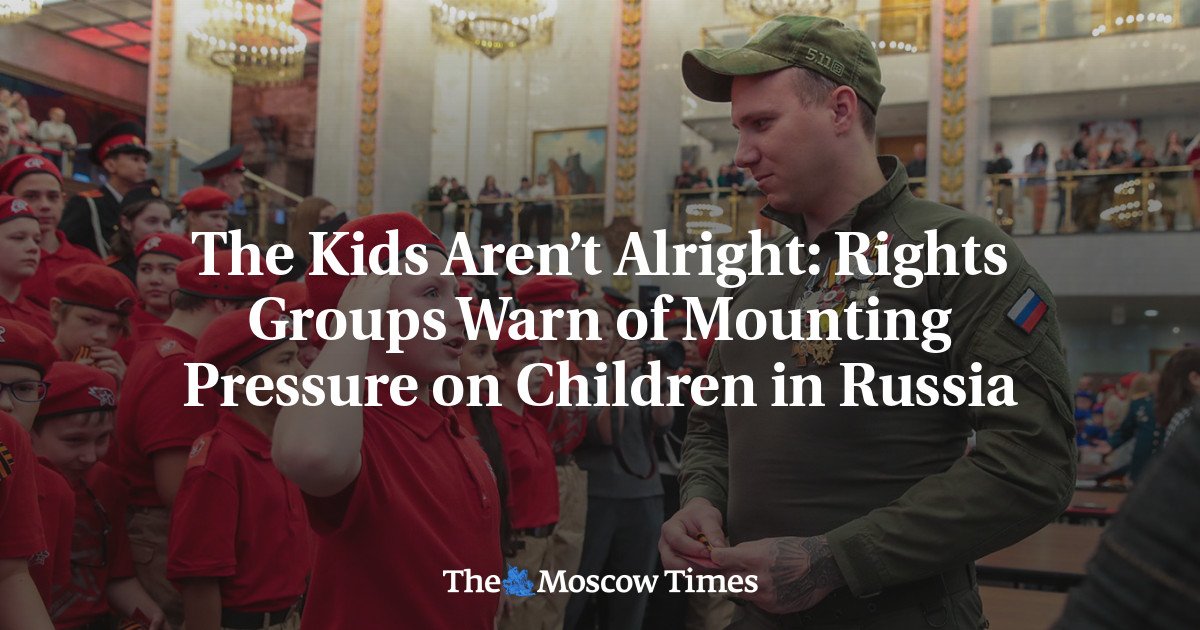
Each year on June 1, Russia marks Children’s Day, a day dedicated to protecting minors’ rights.
To mark the date this year, rights advocates and researchers are drawing renewed attention to the mounting political indoctrination and criminal prosecution of children amid the Kremlin’s wartime crackdown on dissent.
The Moscow Times looks at the growing political and legal pressures faced by minors in Russia.
Indoctrination
In a report seen by The Moscow Times, Amnesty International said Russian authorities have systematically transformed the country’s education system into a tool “to indoctrinate children” and “promote pro‑government and pro‑war narratives.”
“[Schools] are instructed to spread propaganda, often filled with disinformation, that undermines the notion of human rights, whitewashes violations of international humanitarian law in the name of Russia’s national interests,” said the report, which was published Monday.
The organization said the Kremlin has embedded patriotic and militarized messaging into schools through centrally controlled curricula, revised history textbooks and weekly classes known as “Important Conversations” that were introduced after the full-scale invasion of Ukraine in 2022.
Officially described as extracurricular lessons promoting patriotism and “traditional Russian values,” the “Important Conversations” are effectively mandatory in many schools, rights groups say. Similar classes are expected to be introduced in kindergartens this fall.
These policies “violate the human rights to quality education and to privacy and freedom of expression, including freedom of information,” Amnesty International said.
“The resulting education system is designed to deny children an opportunity to form their own opinions and learn independent, critical thinking at a formative age,” it said.
Militarization
Rights advocates also say schools are increasingly being used to expose children to military themes and wartime messaging.
Soldiers and veterans of the war in Ukraine — including members of units notorious for their brutality, such as the Wagner mercenary group — have regularly appeared in schools to deliver patriotic lectures.
In one case, a St. Petersburg school sent a letter of thanks for “contribution to civic-patriotic education” to Alexei Milchakov, the leader of Rusich, a neo-Nazi paramilitary unit whose members have publicly posed in front of the mutilated bodies of Ukrainian soldiers.
Andrei Lyubimov / Moskva News Agency
State Duma Speaker Vyacheslav Volodin said last year that veterans of the war should teach children in “every school.”
“All the young men taking part in the special military operation are heroic and patriotic,” Volodin said. “They made the decision to defend the country, all of us… Their qualities should be put to use in educating children. This is important for children.”
Last month, war veterans also attended graduation ceremonies and end-of-school-year celebrations in regions including the Omsk and Krasnodar regions as well as the republics of Buryatia and Bashkortostan.
In the southern Rostov region, parents and teachers organized a campaign urging families to donate money for military equipment to a Russian assault unit instead of buying flowers for school celebrations.
Russia has also launched projects in which teenagers can learn to operate and develop software for drones, as well as work on technologies with potential military applications.
Under an order signed by President Vladimir Putin, schoolchildren aged between 7 and 18 will be eligible to participate in a nationwide drone piloting championship starting this year.
Violence against children
Researchers have reported an increase in violent crimes against children since the invasion of Ukraine. According to a report by exiled news outlet Vyorstka and the University of Helsinki, nearly 11,000 cases of physical violence against children and teenagers were recorded in 2023, up 50% from the previous year and significantly higher than in previous years.
While the report said the causes of this increase cannot be fully determined, one possible explanation is that law enforcement authorities have become more likely to open criminal investigations. The true scale of violence against minors remains unknown due to a lack of publicly available data.
After reviewing more than 5,500 criminal cases from 2021-2025, the researchers found that at least half involved domestic abuse and that violence most commonly occurred in the home. Men accounted for 71% of perpetrators, while 52% of cases involved a close relative.
The most common punishment handed down for violence against a child in Russia is a fine of 5,000 rubles ($70).
Russia has not adopted a comprehensive law criminalizing domestic violence despite years of advocacy by human rights groups.
ti71.ru
Deportation of Ukrainian children
Russia has forcibly deported or unlawfully transferred thousands of Ukrainian children to Russia and occupied territories since the full-scale invasion, an act that amounts to a crime against humanity, a United Nations investigative body said.
The Independent International Commission of Inquiry on Ukraine said it had verified more than 1,200 cases by March 2026, while Kyiv places the number at 20,570.
Russia has said it moved some children from their homes or orphanages to protect them from active combat zones.
Foreign Ministry spokeswoman Maria Zakharova said Monday that protecting children remains a priority of Russian domestic and foreign policy and accused other countries of politicizing the issue and spreading disinformation.
“Children’s issues are being heavily politicized, double standards are being promoted and certain countries are unscrupulously exploiting the emotional nature of this undoubtedly sensitive matter to spread lies, slander and disinformation against other states,” she said, referring to widely verified reports of Moscow’s deportation of Ukrainian children.
In 2023, the International Criminal Court issued arrest warrants for Putin and the Kremlin’s children’s rights commissioner Maria Lvova-Belova over the alleged unlawful deportation of Ukrainian children.
Criminal prosecution
The Nobel Peace Prize-winning rights group Memorial warned that Russia “often fails to comply” with international standards governing juvenile justice.
Minors often face violations during detention and interrogation, Memorial said, and children are also frequently subjected to violence, intimidation and coercion. In many instances, minors are questioned without legal guardians present, while their right to legal defense is routinely undermined.
@free_arseny / Telegram
While Memorial said it is impossible to determine the exact number of minors who have faced politically motivated prosecution or how many of them are currently behind bars, it said it has documented at least 124 children and teenagers currently being persecuted on political grounds, including 107 who are imprisoned.
Overall, Memorial has recorded 427 people whose criminal prosecution began before they turned 18.
Separately, rights watchdog OVD-Info told The Moscow Times that 356 minors were added to Russia’s national register of “terrorists and extremists” in 2025, a twelvefold increase compared with 2021.
One of the most notable cases is that of political prisoner Arseniy Turbin, who was 15 when he was placed under house arrest and later sentenced to five years in a juvenile penal colony.
Authorities accused Turbin of joining the Freedom of Russia Legion, a unit of Russian volunteers fighting as part of the Ukrainian army that Russia designates a terrorist organization. Turbin denies the charges.
Another widely cited case is that of Yegor Balazeykin, who was jailed for six years at age 17 for attempting to set fire to army enlistment offices in protest against the war.
Both Balazeykin and Turbin were added to Russia’s federal registry of “terrorists and extremists.”
Khabarovsk region student Valery Zaitsev was sentenced at the age of 15 to 4.5 years in a juvenile penal colony on charges of allegedly participating in Ukraine’s Azov battalion, which Russia designates a terrorist organization, and undergoing training for “terrorist” activities.
Memorial has designated Turbin, Balazeikin and Zaitsev as political prisoners.
A Message from The Moscow Times:
Dear readers,
We are facing unprecedented challenges. Russia’s Prosecutor General’s Office has designated The Moscow Times as an “undesirable” organization, criminalizing our work and putting our staff at risk of prosecution. This follows our earlier unjust labeling as a “foreign agent.”
These actions are direct attempts to silence independent journalism in Russia. The authorities claim our work “discredits the decisions of the Russian leadership.” We see things differently: we strive to provide accurate, unbiased reporting on Russia.
We, the journalists of The Moscow Times, refuse to be silenced. But to continue our work, we need your help.
Your support, no matter how small, makes a world of difference. If you can, please support us monthly starting from just $2. It’s quick to set up, and every contribution makes a significant impact.
By supporting The Moscow Times, you’re defending open, independent journalism in the face of repression. Thank you for standing with us.
Continue
Not ready to support today?
Remind me later.
×
Remind me next month
Thank you! Your reminder is set.


