


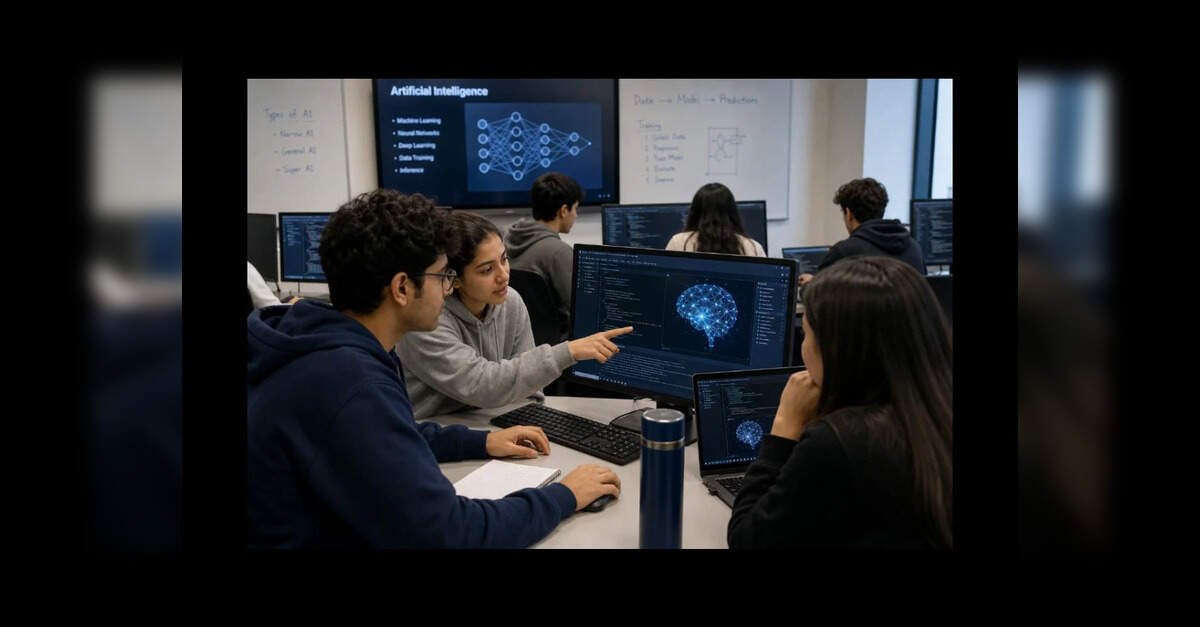
“AI is the new electricity.” When Andrew Ng, the Stanford computer scientist and one of the most influential names in modern machine learning, said this at an AI conference nearly a decade ago, it sounded like Silicon Valley hyperbole. It doesn’t anymore. Electricity didn’t stay confined to a handful of industries once it arrived – it rewired agriculture, manufacturing, transport, medicine, the home. AI is following the same trajectory, only faster. And just as no one today would consider basic electrical literacy optional, the question India now has to reckon with is whether AI literacy can afford to stay optional for the generation about to inherit an AI-run economy.Consider the scale of what’s already changed. Starting the 2026–27 academic session, an eight-year-old in Class 3 anywhere in India from a metro CBSE school to a Navodaya Vidyalaya in a small town will begin learning Artificial Intelligence and Computational Thinking as part of the core curriculum, right alongside mathematics and language. In its official framing of the shift, the Ministry of Education has said the aim is for AI and computational thinking to reshape how students learn, think, and are taught gradually building toward what it calls “AI for Public Good.” Few policy statements capture the scale of the change underway in Indian classrooms as precisely as that one does.It is, in effect, a formal admission of something educators and industry leaders have been saying with rising urgency for a few years now: waiting until college to introduce AI is already too late.
And the numbers make the case bluntly. NASSCOM projects that India will need close to a million AI-skilled professionals by 2027 – against a trained talent pool of roughly 5 to 6.5 lakh today. Separately, a 2026 industry skill-readiness survey found that barely one in four Indian organisations believes its workforce is adequately prepared to use AI effectively. Meanwhile, the country’s flagship employability benchmark, the India Skills Report 2026, notes that more than 90 percent of Indian employees are already using generative AI tools at work in some form often without any structured training in how to use them responsibly, or at all. Put together, these figures don’t describe a talent-acquisition problem that more hiring drives or bootcamps can fix. They describe a pipeline problem and pipelines are built years, not months, before anyone is old enough to apply for a job.
This is the backdrop against which India’s push to introduce AI education from Class 3 onward, and the wave of school-level AI challenges and hackathons that have sprung up alongside it, deserves to be read – not as a trend, but as a structural correction.
The skills gap is arriving faster than the curriculum
For most of the last two decades, technology reform in Indian classrooms followed a familiar script: install the hardware, train a handful of teachers, hope the rest follows. Smartboards arrived in thousands of schools with considerable fanfare; computer labs were built and, in no small number of cases, quietly fell into disuse. Artificial intelligence now stands at a similar inflection point – except this time, the stakes are structurally different. AI is not simply a subject to be taught alongside civics or economics. It is fast becoming the operating layer beneath how the next generation will learn, work and think.
A learner who first encounters AI concepts at eighteen on the cusp of choosing a career has already spent a formative decade without the vocabulary, curiosity or comfort needed to engage with the technology critically. Schools are where that foundation has to be laid, not because every twelve-year-old needs to become a machine-learning engineer, but because AI literacy is fast becoming as basic a competency as reading a spreadsheet or drafting an email. The Ministry’s own Class 3 rollout is, in effect, a policy-level acknowledgment of exactly this.
Starting early also changes the character of the learning itself. Adults tend to approach unfamiliar technology instrumentally – how do I use this tool to finish this task? Children, given the right environment, approach it experimentally: they ask what happens if. That instinct, nurtured rather than left to develop unsupervised through casual chatbot use, is precisely what responsible, creative AI engagement requires.
Responsible use has to be taught, not assumed
There is a tendency in policy conversations to treat “AI capability” and “AI ethics” as separate tracks – one about skill-building, the other about caution, to be addressed later. In practice, the two cannot be separated. A student who builds even a simple AI-powered tool runs almost immediately into the questions that matter: Where did this training data come from? Whose voices or experiences are missing from it? What happens when the model is confidently, plausibly wrong? These are not abstract ethics-class debates. They are practical design questions that surface the moment a student starts building something real.
This is also where the instinct still common in many schools to restrict AI access as a way of preventing misuse falls short. Restriction does not teach discernment; it simply defers the problem to a point where the student is using AI unsupervised, with no framework for evaluating it critically. The more durable approach is to let students build with AI early, under guidance, so that questioning the output becomes a habit rather than an afterthought bolted on later.
Creativity and problem-solving, not just code
It’s worth resisting the assumption that AI education is simply computer-science education under a new name. The most valuable outcome of early AI exposure may not be technical fluency at all; it may be the problem-solving instinct that comes from spotting a real issue in one’s own community and asking whether a tool can help address it. A student mapping groundwater scarcity in their district, or prototyping a simple reading-assistant for younger children, is doing something closer to design thinking than software engineering. The code is the vehicle; the habit of noticing a problem and iterating toward a solution is the actual skill being built and it transfers to every field the student eventually enters, AI-related or not.
Where initiatives like ISAC fit in
This is precisely the gap that structured, school-level programmes are increasingly stepping in to fill, turning a national policy conversation about “AI readiness” into a lived classroom experience. The India School AI Challenge (ISAC) is one such effort, organised around a deliberately simple progression: Learn, Build, Showcase. Students are first introduced to core AI concepts and tools, then guided through building a project grounded in a real-world problem they have identified, before presenting that work to a wider audience of peers, mentors and evaluators.
What makes this sequence worth paying attention to is less the competition format itself and more the pedagogy underneath it. Learning AI in the abstract rarely sticks; learning it by building something and then having to explain and defend that work to others does. The “showcase” stage, in particular, does quiet but important work: it teaches students to articulate not just what they built, but why it matters and where its limitations lie. That is itself a form of responsible-AI thinking, practised rather than preached.
Programmes like ISAC will not, on their own, close India’s AI skills gap. That will require sustained investment in teacher training, digital infrastructure in under-resourced schools where roughly half still lack basic connectivity or computing access, by some industry estimates and curriculum reform at genuine scale. But initiatives that give students an early, hands-on, guided encounter with AI serve a distinct and necessary purpose: they convert policy intent into practice, one classroom project at a time.
The real argument
The case for starting AI education in schools is not that every student should become an AI specialist. It is that AI literacy – the ability to use these tools thoughtfully, question them intelligently, and build with them creatively is quickly becoming a basic form of literacy in its own right, the way digital literacy did a decade ago. The earlier that foundation is laid, the more capable, and more discerning, the generation that inherits an AI-shaped world will be.
Schools are not a downstream beneficiary of that shift. They are where it has to begin and, for the first time, policy, industry and the classroom appear to be moving in the same direction at once.
