



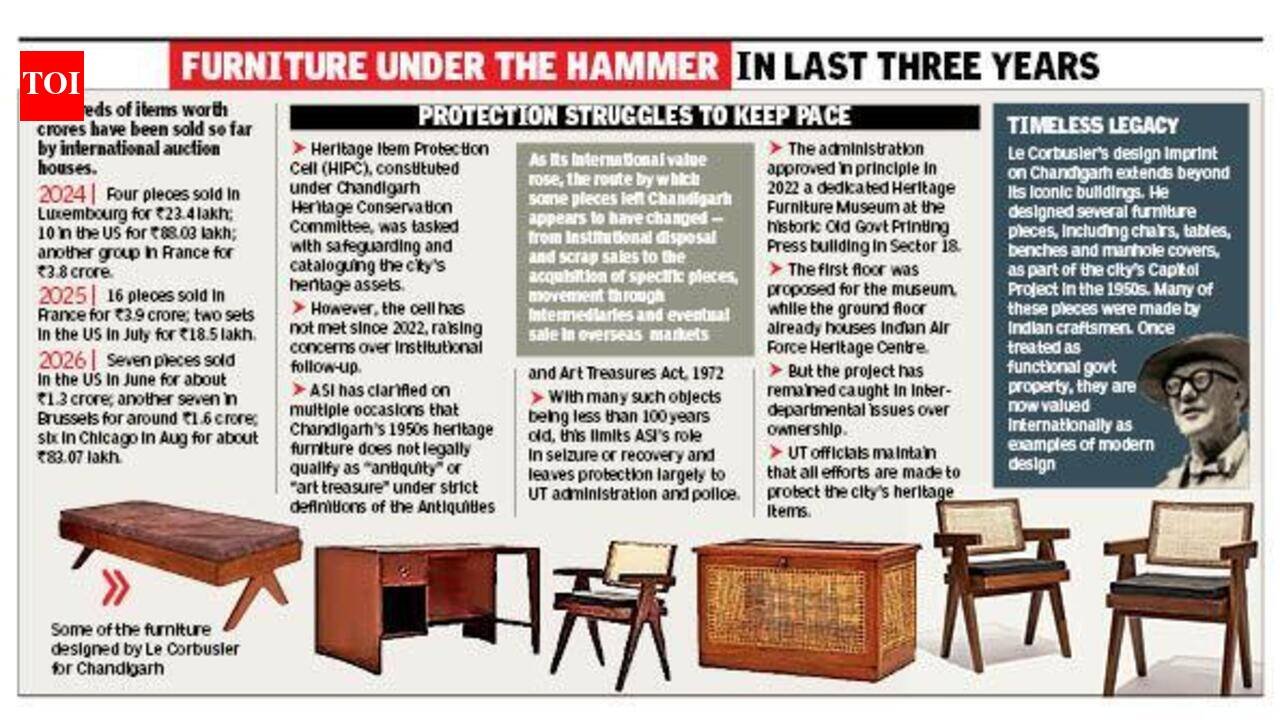
UT officials maintain that all efforts are made to protect the city’s heritage items.The staggering price difference came as a shock to city residents — and exposed, for the first time, the scale of how much of Chandigarh’s design heritage had already been lost or was at risk of disappearing.The objects at the centre of the story were never ordinary govt articles. Chairs, tables, desks, stools, beds, screens, benches and other furniture were designed by Le Corbusier and Pierre Jeanneret under Govt of India’s Capital Project during Chandigarh’s construction and crafted by Indian artisans.As its international value rose, the route by which some pieces left Chandigarh appears to have changed — from institutional disposal and scrap sales to the acquisition of specific pieces, movement through intermediaries and eventual sale in overseas collectors’ markets. Investigations have also raised questions over the use of false or misleading documentation to facilitate the movement of artefacts.Selling heritage for scrapThe loss began long before the international auction boom.During the 1990s and early 2000s, much of the furniture was considered old, damaged or surplus. Pieces were shifted to storerooms and yards, while some were disposed of as scrap. Govt institutions also sold hundreds of unused or damaged pieces to buyers, including foreign nationals.At the time, the international market had not yet fully recognised the design value of Chandigarh’s furniture. That changed rapidly as global interest in mid-century modernism grew and the names of Le Corbusier and Jeanneret became major attractions for collectors.Court intervention before banThe scale of the problem began attracting judicial and public attention around 2010-11. Heritage activist and advocate Ajay Jagga raised the issue before Punjab and Haryana high court, seeking directions to prevent Chandigarh’s heritage objects from being auctioned abroad. The administration told the court it was committed to protecting the city’s heritage.The court intervention came before Centre formally moved to stop further disposal.On Feb 22, 2011, Ministry of Home Affairs issued an order directing that further disposal of Le Corbusier-Jeanneret furniture be prohibited. The order described the objects as “valuable heritage items to be treated with care” and directed that wear and tear should be addressed through conservation and repair rather than sale.A 2012 inventory subsequently identified 12,793 heritage items across 131 categories. But maintaining a complete, continuously updated inventory across the many institutions and govts holding these objects remained a challenge.Jagga said the value of the heritage had since spawned an organised commercial market.“It has become a big business. City’s heritage worth crores of rupees have been sold but protection efforts, at best, are half-hearted and piecemeal. Carpenters from Saharanpur, local scrap dealers and foreign based sophisticated antique dealers have all found a way to make huge sums out of the city’s heritage.”Scrap yards to targeted overseas ordersA DRI investigation provided an important glimpse into how the trade had evolved.Records examined by the agency included a 2015 email seeking specific Chandigarh and Punjab heritage pieces, including a rosewood table and V, X and Z chairs, for major overseas sales. Invoices from 2016 also recorded the sale of 19 Chandigarh and Punjab heritage pieces to a Seoul gallery for Rs 12.62 crore.The records indicated that overseas buyers were no longer simply acquiring unidentified old furniture. Specific Chandigarh designs and pieces from particular institutions had become commercially valuable.This is significant because it suggests a shift from indiscriminate disposal of unwanted furniture to targeted sourcing of objects whose Chandigarh connection itself had acquired market value.Customs catches heritage on way outOne of the clearest instances came in June 2018, when Customs officials at Delhi’s Inland Container Depot, Tughlaqabad, intercepted 14 heritage chairs being sent to Belgium.One chair carried the marking “PUL-116”, with others bearing similar PUL markings. Panjab University was asked to verify the pieces. The university subsequently lodged a police complaint, and Chandigarh Police registered a theft case.The available record neither established when or how the chairs had left the institution or the ownership of every chair. But the interception demonstrated that Chandigarh-linked heritage furniture was being moved through international cargo channels.The same year, a PGI employee spotted govt-stamped furniture being offered for sale on a website. A check at Vitte-Yojna Bhawan in Sector 33 found 30 heritage furniture items missing — including 10 tables, 13 chairs, four wooden room partitions and three campers. A police case followed.Together, such incidents exposed vulnerabilities at the institutional level: Incomplete inventories, weak tracking of written-off furniture and the difficulty of monitoring objects dispersed across dozens of custodians.Paris auction stopped after FIRThis year, two chairs carrying institutional markings linked to Panjab University and PGIMER appeared in a Paris auction.Jagga, who is also a member of Heritage Item Protection Cell, took up the matter with Ministry of Culture, Ministry of External Affairs and Chandigarh administration, seeking intervention.Ministry of Culture subsequently wrote to the UT administration asking it to coordinate with MEA and the embassy to stop the auction and secure the pieces.Chandigarh Police registered two FIRs on June 23, and on their basis approached MEA. The intervention worked: The two pieces were withdrawn from the auction scheduled for June 25.Manhole covers also became global collectiblesThe transformation in value was not restricted to furniture.The cast-iron manhole covers designed by Le Corbusier in 1951 were for decades treated as ordinary civic infrastructure.Chandigarh manhole covers have fetched substantial sums at international auctions, turning what was once municipal infrastructure into sought-after design collectibles.
