


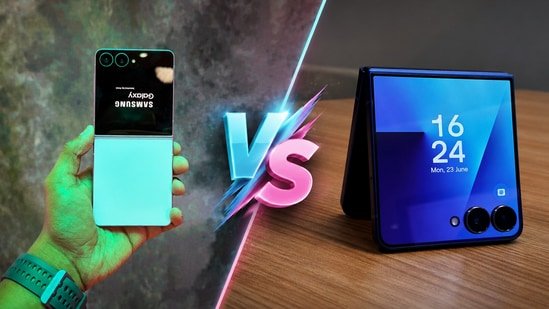
At the Galaxy Unpacked Event 2026, Samsung has finally unveiled the much-anticipated sequel to its Z Fold7 series, the Z Fold8 series. For the first few days, the foldable phones will likely be the darling of the press coverage. What raises my suspicion is that Samsung has introduced not two, but three folding phones.
The first is the standard Z Fold8, or what we call the wide Z Fold8, which features a small 4:3 internal screen suitable for watching videos, reading books, and more. The other one is the Z Fold8 Ultra, which shares the same form and dimensions as the Galaxy Z Fold7 but offers a more robust foldable display, a higher-resolution ultra-wide camera, and a faster processor.
But among the packed lineup, the Galaxy Z Flip8 could emerge as the biggest crowd favourite. Samsung’s clamshell foldables have traditionally enjoyed wider appeal thanks to their compact form factor and pocket-friendly design. This year, the brand has adjusted the Flip8’s proportions to capitalise on the formula that made previous generations so popular. But is that the only meaningful upgrade over the Z Flip7? Let’s find out.
Design and Display: Slimmer in hand, stronger at the fold
In terms of design, Samsung has made the Galaxy Z Flip8 noticeably slimmer than the Z Flip7, both when folded and when unfolded. When open, it is only 0.5 mm thicker than the iPhone Air, currently the slimmest smartphone in the world. When folded, the slimmer profile also makes it easier to slip into a tight jeans pocket. That’s not all; Samsung has shaved 8 grams off the weight, making the Z Flip8 feel more comfortable to carry and use throughout the day.
The display, however, tells a different story. Samsung has not introduced any upgrades to picture quality, as both the cover and internal displays retain the same resolution and refresh rate as the Z Flip7. Instead, the focus has shifted to durability.
Like the Z Fold8 Ultra, the Z Flip8 adopts Samsung’s new Flex Titanium technology. It uses a titanium-alloy film beneath the OLED panel, along with a new titanium plate beneath the OLED-titanium stack, to strengthen the internal display and reduce crease visibility. Samsung has also added a low-reflection finish to the foldable screen, improving outdoor visibility.
Cameras: Familiar hardware, smarter shooting
As with the display specification, the Galaxy Z Flip8’s camera hardware remains largely unchanged from the previous generation.
Samsung has instead focused on expanding the shooting experience through software. Super Steady now includes a new Horizontal Lock option, helping keep videos smoother and better framed when recording action or taking on-the-go selfies.
Samsung has also introduced FlipShot, which lets users personalise the FlexWindow while capturing mirror selfies. Mirror View, meanwhile, turns the cover screen into a more natural-looking mirror, making it easier to check your appearance before taking a photo or stepping out.
Performance and Battery: More power, same endurance
Powering the Galaxy Z Flip8 is Samsung’s new Exynos 2600 processor, the same chipset used in the base Galaxy S26. On paper, it will likely deliver up to 39% higher CPU performance than the Exynos 2500 in the Z Flip7. GPU compute performance is expected to be up to twice as fast, while ray-tracing performance could improve by up to 50%.
In theory, all of these should help the Z Flip8 handle graphically demanding games like Genshin Impact more comfortably. They could also make slightly more intensive tasks, such as editing high-resolution videos, feel smoother.
The battery, however, remains unchanged. Samsung has retained the same battery capacity and charging speeds as on the Z Flip7. This means any improvement in battery life will largely come from the Exynos 2600’s improved efficiency rather than from a larger battery or faster charging.
Software: More helpful, less intrusive
Samsung has also brought the latest Galaxy AI features from the Galaxy S26 series to the Galaxy Z Flip8.
Now Brief delivers personalised updates throughout the day. Now Nudge follows up with context-aware suggestions, such as saving an address or checking a schedule. Samsung has also expanded Gemini Intelligence to work across more than 40 apps and services. Gemini Notebook, meanwhile, keeps notes, images, recordings, and documents together in a single AI-powered workspace.
Interestingly, these features do not appear to require significantly more processing power. They rely largely on software and cloud-based AI models. The Galaxy Z Flip7 should be capable of running them too. Samsung, however, has chosen to keep them exclusive to the Z Flip8 for now.
Conclusion:
The Galaxy Z Flip8 builds on a formula that has already proven popular. It is slimmer, lighter, and packs a more capable processor, while retaining the compact form factor that defines the series. The camera hardware and battery remain unchanged, but Samsung has added useful software refinements and the latest Galaxy AI features. For Z Flip7 owners, the upgrade may not feel essential. Everyone else, however, will find the Galaxy Z Flip8 to be a polished and practical foldable.
