



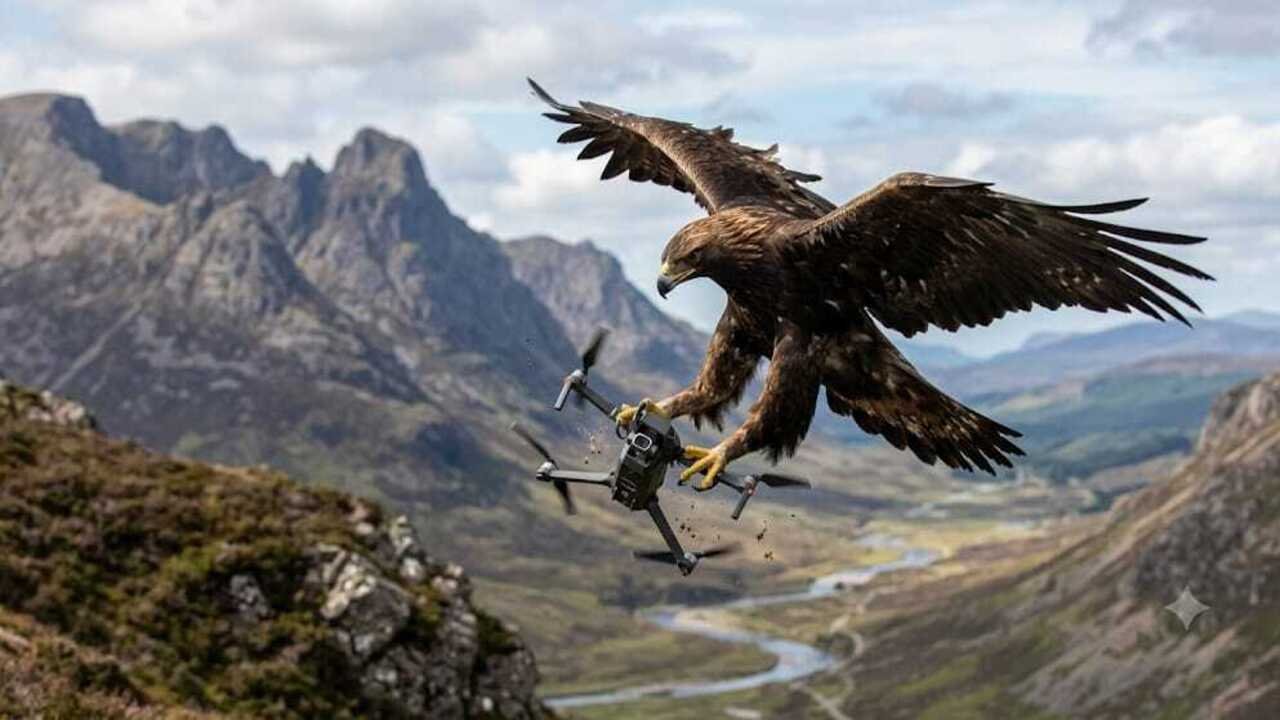
As drones became cheaper and more widely available, they also created new challenges for law enforcement. Unauthorised drones began appearing near airports, public events and restricted government facilities, raising concerns about safety and security. While technologies such as signal jammers and net-launching systems were still evolving, the Dutch National Police explored an unconventional solution inspired by nature. In 2016, officers partnered with a specialist wildlife company to train birds of prey to intercept rogue drones mid-air. The project attracted global attention, demonstrating how an animal’s natural hunting instincts could be adapted to address a modern technological problem. Although the programme was eventually discontinued, it remains one of the most unusual experiments in the history of drone policing.
Why did the Dutch police train Eagles to catch drones
The Dutch National Police launched the project in collaboration with Guard From Above, a Dutch company specialising in training birds of prey for security applications. Their objective was to develop a safe and effective way to remove illegal drones flying over sensitive locations without causing unnecessary risks to people on the ground.As reported by BBC, the concept was based on the hunting behaviour of golden eagles, which naturally swoop down on prey and carry it away using their powerful talons. Trainers conditioned the birds to identify drones as targets by gradually introducing them to different drone models during controlled exercises. Once the eagles successfully intercepted a drone, they were rewarded, reinforcing the behaviour through positive training methods.At the time, authorities believed birds of prey could offer an alternative to electronic countermeasures, particularly in areas where signal jamming might interfere with other communications or where drones needed to be captured intact for forensic investigation.
How were the Eagles trained to intercept drones
Training focused on helping the birds recognise drones as prey-like objects while ensuring they could safely seize them in flight. During demonstrations, the eagles would launch from a handler’s arm, pursue the drone through the air and grip it with their talons before carrying it back to a designated landing area.One of the main concerns was whether the drones’ rapidly spinning propellers could injure the birds. Researchers working with the programme found that the thick, overlapping scales covering an eagle’s legs and feet, together with their exceptionally strong talons, offered significant protection against minor contact with propellers. Even so, trainers continued studying the risks and explored protective equipment to further reduce the possibility of injury.The programme demonstrated that birds of prey could reliably intercept small consumer drones under controlled conditions, attracting interest from police and security agencies around the world.
Why the Eagle drone programme eventually ended
Despite its success in demonstrations, the Dutch National Police announced in late 2016 that they would discontinue the programme after evaluating its practical and financial viability. Maintaining and training birds of prey required specialised handlers, ongoing care and significant operational costs, while drone countermeasure technologies were advancing rapidly.Electronic systems capable of detecting, tracking and disabling unauthorised drones soon became more practical for routine law enforcement, reducing the need for biological alternatives. Nevertheless, the experiment provided valuable insights into non-traditional approaches to drone security and highlighted the remarkable adaptability of birds of prey.Today, the Dutch eagle project remains one of the most memorable examples of wildlife being incorporated into modern policing. Although the birds no longer patrol the skies for illegal drones, the initiative demonstrated how centuries-old falconry techniques could briefly intersect with twenty-first-century technology in an effort to solve an emerging security challenge.
Could Eagles still help catch illegal drones in the future?
Although the Dutch National Police ended the programme, the idea of using birds of prey to intercept illegal drones continues to spark interest whenever drone security is discussed. Experts say the project proved that eagles could successfully capture small drones under controlled conditions, but scaling the concept for routine law enforcement presented practical challenges. The welfare of the birds, the cost of training and maintaining them, unpredictable flight conditions and the rapid advancement of anti-drone technology all limited its long-term viability.Today, authorities around the world primarily rely on radar systems, radio-frequency detectors, jamming devices and specialised drone interception technologies to manage unauthorised aircraft. These systems can operate continuously without the logistical demands of caring for trained animals and are better suited to handling the growing number of drones in modern airspace.Even so, the Dutch experiment remains a remarkable example of innovation inspired by nature. By combining centuries-old falconry techniques with modern security challenges, it showed that unconventional ideas can sometimes offer creative solutions, even if they ultimately serve as a stepping stone towards more advanced technologies.


