



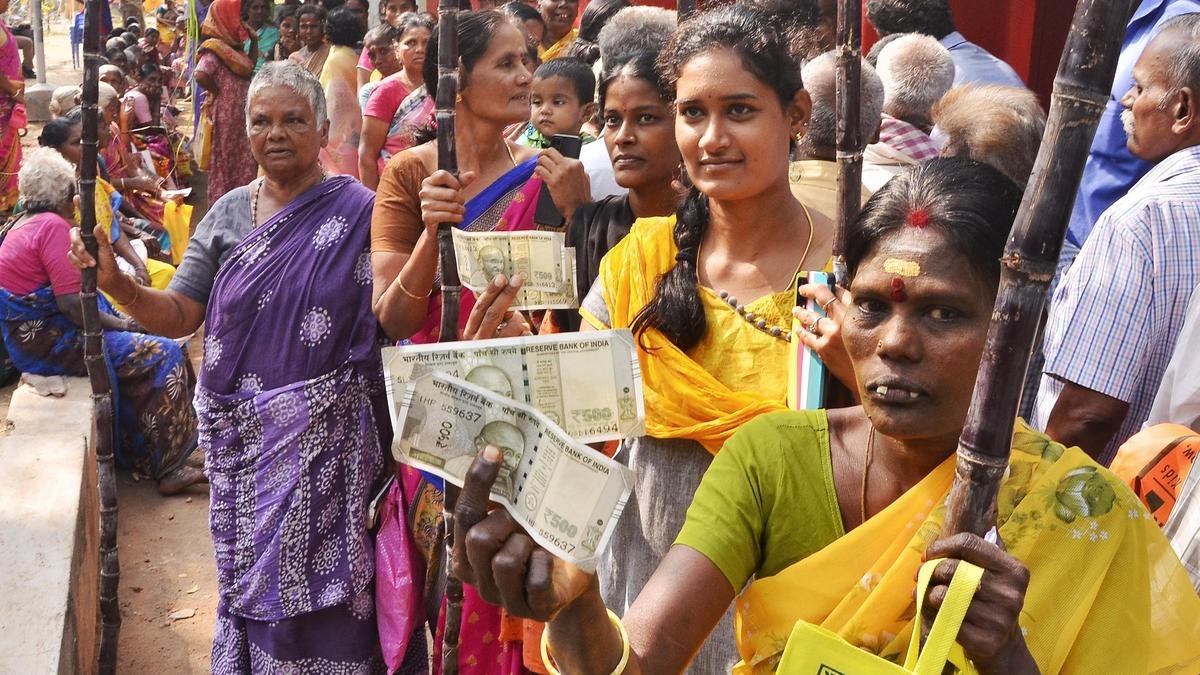
Women receive the Pongal gift items, along with 21,000 provided by the Tamil Nadu government in Madurai in January 2023
| Photo Credit: THANGARATHINAM N
On August 1, the Delhi Chief Minister launched the Lakshmi Yojana which will provide eligible women with an Unconditional Cash Transfer (UCT) of ₹2,500 per month, fulfilling one of the ruling party’s central promises during the Assembly elections. With this, Delhi joins the list of States/UTs which now have such a UCT scheme for women.
Over the last two years, many studies, including the Economic Survey and the 16th Finance Commission (FC) report have raised concerns over the increasing fiscal burden of such schemes. Recent reports show that in States such as Maharashtra and Madhya Pradesh, the number of beneficiaries has been reducing in the name of rationalisation.
In Delhi, even before the scheme has been rolled out, restrictive criteria such as requiring a recommendation from the local MLA or MP have been included, plausibly to keep the numbers in check. Evaluations of these schemes show that the money received by women is mostly spent on useful expenditures such as food, health and education.
The usual barriers to access such as lack of documents, access to banks, and errors in digital records also remain. The question to be asked going forward is whether the finances for these schemes are coming at the cost of other investments in public services such as education and health. The chart below shows the expenditure of these schemes relative to total expenditure and the expenditure of these sectors for some major States.
As a proportion of total State expenditure, expenditure on these UCT schemes range from over 10% in Jharkhand to less than 0.3% in Himachal Pradesh. According to the 16th FC report, almost 44% of State expenditure is tied up in interest payments, pensions and salaries; this indicates that States do not have much space to manoeuvre towards financing new initiatives or investing in necessary infrastructure.
The 16th FC also shows that the States’ social sector revenue expenditure as a proportion of total revenue expenditure has remained stable since 2011-12. However, as a proportion of GDP they show a declining trend since 2020-21, indicating that there has been no commensurate increase in spending on these sectors with the increase in spending capacity.
In Jharkhand, Karnataka and West Bengal, which happen to have the largest UCT schemes, the spending on UCTs is more than half the entire spending on education. The chart below shows expenditure on UCTs as a % of State expenditure on education for select States
Further, in Jharkhand, Karnataka, West Bengal, and Maharashtra, the spending on these schemes exceeds the entire State spending on health. The chart below shows expenditure of UCT schemes as a share of State expenditure on health for select States (in %)
This shows that household benefits notwithstanding, there is a need for informed discussions on what the long-term implications of such schemes might be.
As these schemes expand, they increase the fiscal burden on States, which is likely to generate pressure on other forms of social sector spending, including existing expenditures towards providing health and education services. Given the resource-constrained position of State governments, this is not an unreasonable apprehension. Over time, the implications of underfunded public services must be considered.
Some scholars have been arguing that such cash transfers are a ‘compensation’ for the failure of the state to create opportunities for all. The timing of the cash transfers, immediately before elections, has also led many to call them a ‘dole’. It could be argued that the recent protests demanding better facilities and greater accountability are an indication that people are no longer satisfied with only ‘compensation’ and demand a fair share in resources.
Published – August 17, 2026 07:00 am IST


