



When the supplier sits across the table, is a fleet you cannot build without it, a capability India owns, or one Beijing lends?
TECHNOLOGY & NATIONAL SECURITY
In August 2024, an Indian Army drone slipped its leash. A fixed-wing aircraft lost contact with its operators along the Line of Control near Rajouri, the sort of failure that reads as routine until you ask what the machine was carrying and where its parts were made. In the same stretch of months, the Army quietly cancelled around ₹230 crore of drone contracts meant for the heights of Ladakh. Investigators had found Chinese-origin electronics inside platforms sold as Made in India.
Now move to this month. India is about to place the largest drone order in its history.
Those two facts belong in one sentence, and that is the problem. New Delhi is scaling the biggest unmanned build-out it has attempted on a supply chain its own security agencies have judged unsafe, and it does so this week while seated at the head of its own table, helping write the rules of technology security beside the country that controls the parts.
The order, and the doctrine behind itThe numbers are real even if the contract is not yet signed. The Drone Federation India, an industry body that works closely with the government, told Reuters that the next phase of tactical drone procurement could exceed ₹200 billion, more than two billion dollars, with deliveries expected over eighteen to twenty-four months. That would dwarf recent orders worth around ₹30 billion. The government has spent two years clearing the runway, through emergency procurement powers, faster acquisition, a cut in the goods and services tax on drones to five per cent, and a plan to embed thousands of unmanned systems in every Army corps.
The doctrine behind this is sound. Operation Sindoor in May 2025 was the first time India and Pakistan used drones against each other at scale, and the lesson both sides drew was that cheap, expendable machines can pin down costly air defences. A country that wants to fight that way has to make its own drones, not buy them. So the goal became self-reliance, and its measure became the airframe. That is where the trouble begins.
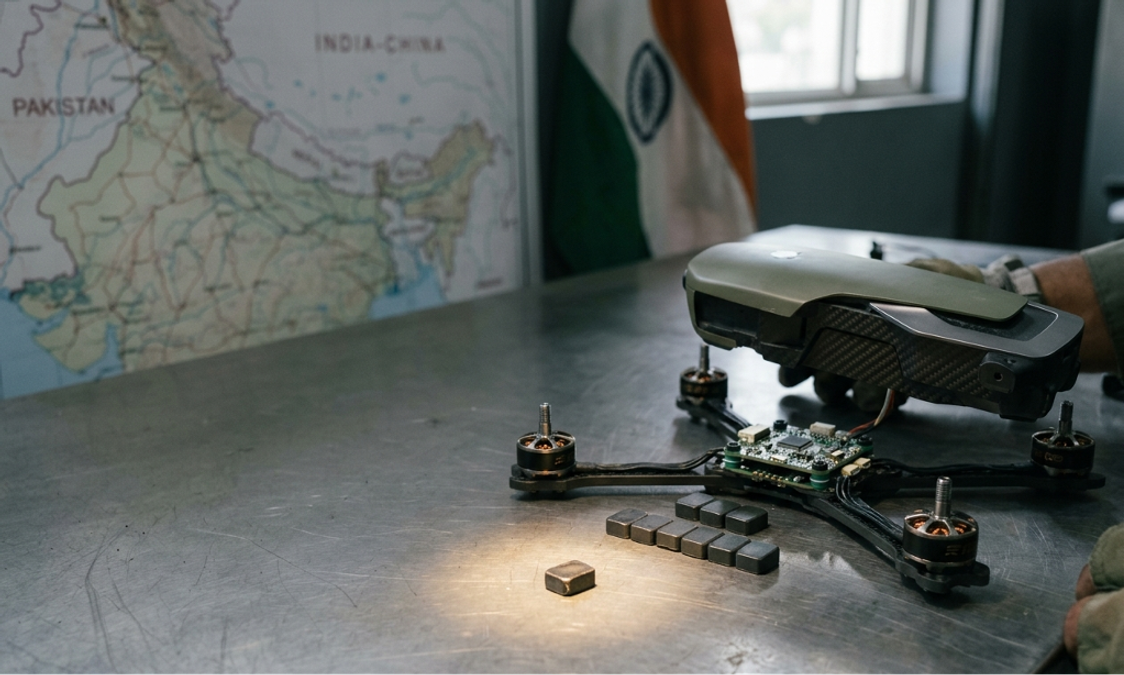
The choke point inside the droneA drone is mostly an argument about its smallest parts. The airframe can be moulded in Pune or Hyderabad, but the pieces that decide whether it flies at all, and how well, are another matter. Industry analysts and defence reporters have traced roughly two-thirds of the critical components inside India-built drones, the motors, the flight controllers, the sensors, the silicon, back to China. The hardest of them to replace is the magnet.
High-performance drone motors run on neodymium-iron-boron magnets, and China processes close to ninety per cent of the world’s rare earths. India imported about ninety-three per cent of its rare-earth magnets from China in the last financial year, and when Beijing last tightened controls, domestic stockpiles were reported to last two to three weeks. There is no Indian source of drone-grade magnets at scale today. Ferrite substitutes exist, but they give away the strength that makes a compact, agile motor worth building.
This is the second-order problem folded inside a reasonable policy. The harder India pushes mass production, the more of these parts it must import, because scaling assembly scales the bill of materials beneath it. Self-reliance counted at the airframe quietly deepens dependence at the magnet.
The forum convened to manage the next generation of security threats seats the supplier that embodies India’s largest one.
A vulnerability the state has already namedNone of this is news to New Delhi, which has acted on the danger more than once and still not closed it. In June 2024 the Ministry of Defence warned drone makers including Dhaksha and Garuda off Chinese components, then suspended and later cancelled the Ladakh contracts. In March 2026, at the National Defence Industries Conclave, the Army Design Bureau unveiled a framework to strip Chinese parts from the supply chain and feed the result into the new Defence Acquisition Procedure. Rajnath Singh said the same week that everything from a drone’s moulds to its software and batteries must be made in India, and that this would be hard precisely because so many components everywhere begin in China.
The framework carries an admission worth pausing on. It accepts that foolproof traceability of these components is not feasible, given re-routing and forged paperwork, and then asks laboratories to certify them regardless. A drone whose lineage you cannot verify is a drone you do not fully own. India is preparing to certify at scale the very thing it concedes it cannot fully trace.
One wrinkle cuts in India’s favour, for now. China suspended its broadest rare-earth export controls in November 2025 under a deal with Washington, and that suspension runs to November 2026, so civilian magnet flows resumed. The part that did not lift is the part that counts here. Beijing still generally refuses export licences for military end-use, and the reprieve expires in roughly the same window in which India expects its new drones to arrive.
The table and the supplierThat window opens onto a striking scene. On 22 and 23 June, New Delhi hosts the BRICS National Security Advisers’ conclave, chaired by Ajit Doval, on the theme of non-traditional security threats and the place of new technologies within them. The agenda includes a review of the bloc’s working group on security in the use of information and communication technologies, the integrity of the digital and hardware supply chains running through every modern weapon. China’s Wang Yi is among the delegates, and a meeting between him and Doval is expected on the margins.
So India convenes a forum to manage technology-supply-chain risk and seats, as an honoured guest, the single largest source of that risk to its own arsenal. The remedy it is building moves slower than the threat. The ₹73 billion scheme the Cabinet cleared in November 2025 to make sintered rare-earth magnets at home aims at a few thousand tonnes of annual capacity over seven years, and independent analysts place any real break from Chinese magnets years away rather than months.
Bottom LineA swarm is only as sovereign as its scarcest part. India can build the airframes and train the crews, and still discover that its rarest inputs, the magnets above all, decide what flies on the morning a war starts. Counting self-reliance at the airframe is a way of not looking at the magnet. The procurement is the easy decision. The hard one is what New Delhi will ground, and for how long, to stop depending on the country it spends this week hosting. When the supplier sits across the table, is a fleet you cannot build without it, a capability India owns, or one Beijing lends?
(The Author studies Computer Science and Artificial Intelligence at Rutgers University, New Jersey, USA. He is interested in emerging technologies and innovation, and can be reached on LinkedIn at @arssh-kumar14)


