


The cable question was never only about how many lines reach India or whose logo is on them. It is about who can fix them when the water is on fire, and who can be ordered to sail away
FUTURECRAFT | TECHNOLOGY & NATIONAL SECURITY
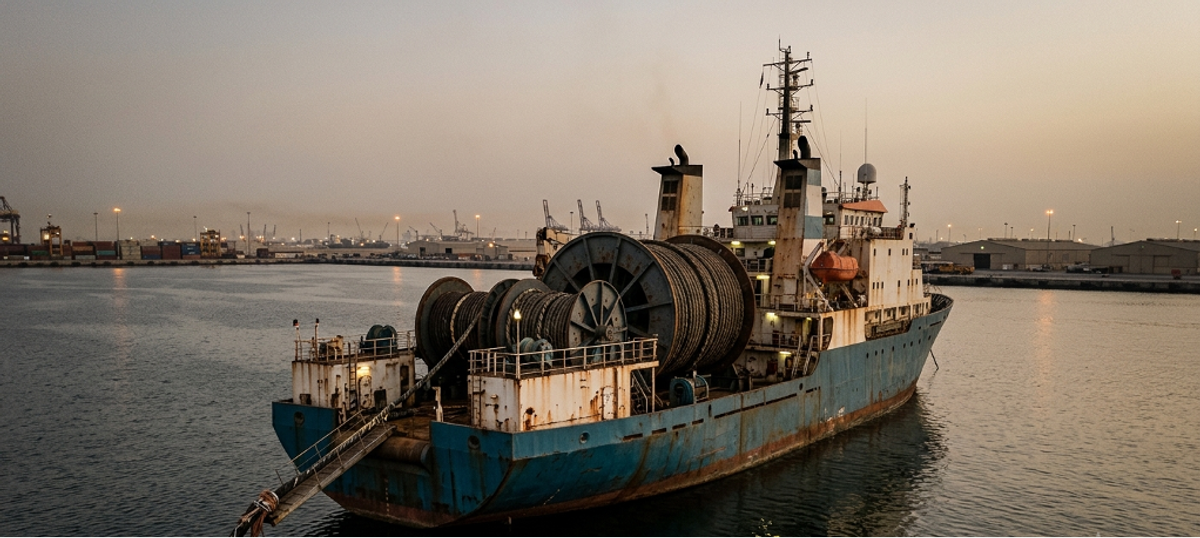
In March 2026, a cable-laying ship called the Ile de Batz dropped anchor in the Saudi port of Dammam and stopped working. Its French operator, Alcatel Submarine Networks, had told its clients it could no longer operate safely in the Persian Gulf and declared force majeure. The water above the seabed it was wiring had turned into a war zone.
The ship was finishing the 2Africa Pearls cable, the Gulf branch that lands in India. It was meant to give India a routing alternative to the Red Sea, which had already become too dangerous to lean on. Most of it now sits on the Gulf floor, laid but unconnected, waiting for a war to end.
India did the sensible thing on paper. It saw the Red Sea risk and joined the consortium that would fund the way around it. Then the way around it became a second war zone, and the contractor went home. The cable India was counting on now belongs to a ship parked in another country’s harbour. That pattern keeps repeating, and it points at a gap India has chosen not to close.
The geography India inherited
Almost everything India does online arrives by sea. Submarine cables carry more than ninety-five per cent of the world’s international data traffic, and India’s share comes ashore at a handful of points. Roughly fifteen cable systems land at fifteen stations across just five coastal cities, clustered heavily around Versova in Mumbai. A lot of bandwidth, a few beaches.
That concentration was always a quiet risk. What changed in the past year is the water. India’s two main cable corridors both run through conflict now. The route west to Europe goes through the Red Sea, where cables were cut repeatedly through 2025. The newer route runs through the Strait of Hormuz, a chokepoint that Iran’s Revolutionary Guard declared closed in early March 2026. For the first time, both corridors are hostile at once.
This is not abstract. In September 2025, two cables near Jeddah, including one operated by Tata Communications, were severed and Indian users felt it. A cut on the ocean floor thousands of kilometres away shows up as a slow morning in Mumbai and Bengaluru. India does not control the water its data travels through, and it cannot.
The ship that was never ordered
Here is the gap. When a cable breaks, someone has to sail out to the fault, raise the cable from the seabed and splice it. India cannot do this for itself. It owns no cable repair ship. Indian operators sign multi-year contracts with two foreign consortia, one in Dubai and one in Singapore, then wait their turn for a vessel that may be working on the other side of the world. India’s own rules add to the wait, requiring clearances from several agencies and a government representative aboard the ship while it works.
The government knows. The National Security Council Secretariat and the Department of Telecommunications have been working on indigenous repair and laying vessels for two years. A study by the state firm TCIL put the cost at roughly three to four thousand crore rupees for the ships and interim facilities. The Navy already has two deep-water diving support vessels from 2022 that could be retrofitted for the job. The project even sits on the Prime Minister’s Office priority-tracking portal, e-Samiksha.
And still no ship. The decision has been put off year after year, even as the threat grew. The sum involved is modest against a telecom sector that earns several lakh crore rupees a year. The cheapest part of the problem is the part that has not moved.
India has learned to fund the cable and forfeit the ship. The first makes it a customer. The second would have made it sovereign.
Trusted, and still someone else’s
The official answer to all this is more cable, and better-placed cable. In February 2026, Sundar Pichai used the India AI Impact Summit in New Delhi to announce America-India Connect, part of a fifteen billion dollar Google commitment over five years. It puts a new international subsea gateway at Visakhapatnam on the east coast, with four routes linking the United States, India and the southern hemisphere. Meta’s Project Waterworth is eyeing Vizag too. Washington is separately backing a “trusted” cable, SCNX3, to Singapore.
On its own terms this is good news. It pulls capacity away from the Versova cluster and adds eastern routes India could never have financed alone. But look at who owns it. The Vizag landing station is being built with Airtel to carry Google’s cables. The move away from one geography lands on the infrastructure of one or two American hyperscalers, routed through American jurisdiction. “Trusted” describes the supplier. It does not transfer control.
So the threat changes shape rather than shrinking. Yesterday the worry was a foreign vessel near a cable, or a war closing the Gulf. A former navy official has claimed the Chinese submersible Jiaolong has operated in areas where Indian cables run, and Chinese researchers have disclosed a deep-sea cutter able to work at seven thousand metres. Tomorrow it is a corporate decision or a foreign court order taken far from Delhi. And the clearance regime that made India a hard place to land a cable is unchanged, so the new gateway inherits the old bottleneck.
The case for renting
There is an honest argument for the status quo. Cable repair ships sit idle most of the time, and the industry runs on shared consortium fleets because owning one rarely pays for itself. And turning a navy vessel into a repair ship risks putting civilian infrastructure in a uniform, inviting the very targeting India wants to avoid.
The argument holds in peacetime. That is also its weakness. A shared fleet works right up until the fleet decides your waters are too dangerous and invokes force majeure, which is exactly what happened in the Gulf in March. Sovereign capability is insurance for the rare bad day, not the ordinary one. India just watched it arrive on two corridors at once.
Bottom Line
The cable question was never only about how many lines reach India or whose logo is on them. It is about who can fix them when the water is on fire, and who can be ordered to sail away. The 2Africa Pearls cable will be joined eventually, once the shooting stops and a foreign ship returns. The open question is whether India will still be waiting on someone else’s ship to do it.
(The Author studies Computer Science and Artificial Intelligence at Rutgers University, New Jersey, USA. He is interested in emerging technologies and innovation, and can be reached on LinkedIn at @arssh-kumar14)
