









On my flight to Berlin in the first week of September, I found myself thinking about the Dyson CameraJet. More specifically, I was thinking about how bizarre the idea sounds when you strip it down to its simplest form: a toothbrush with a camera that uses machine learning to find the gaps between your teeth and fire a jet of water at them.
We now live in a world where AI has found its way into phones, cars, computers and, apparently, toothbrushes. At some point, you have to wonder: how much technology is too much technology?
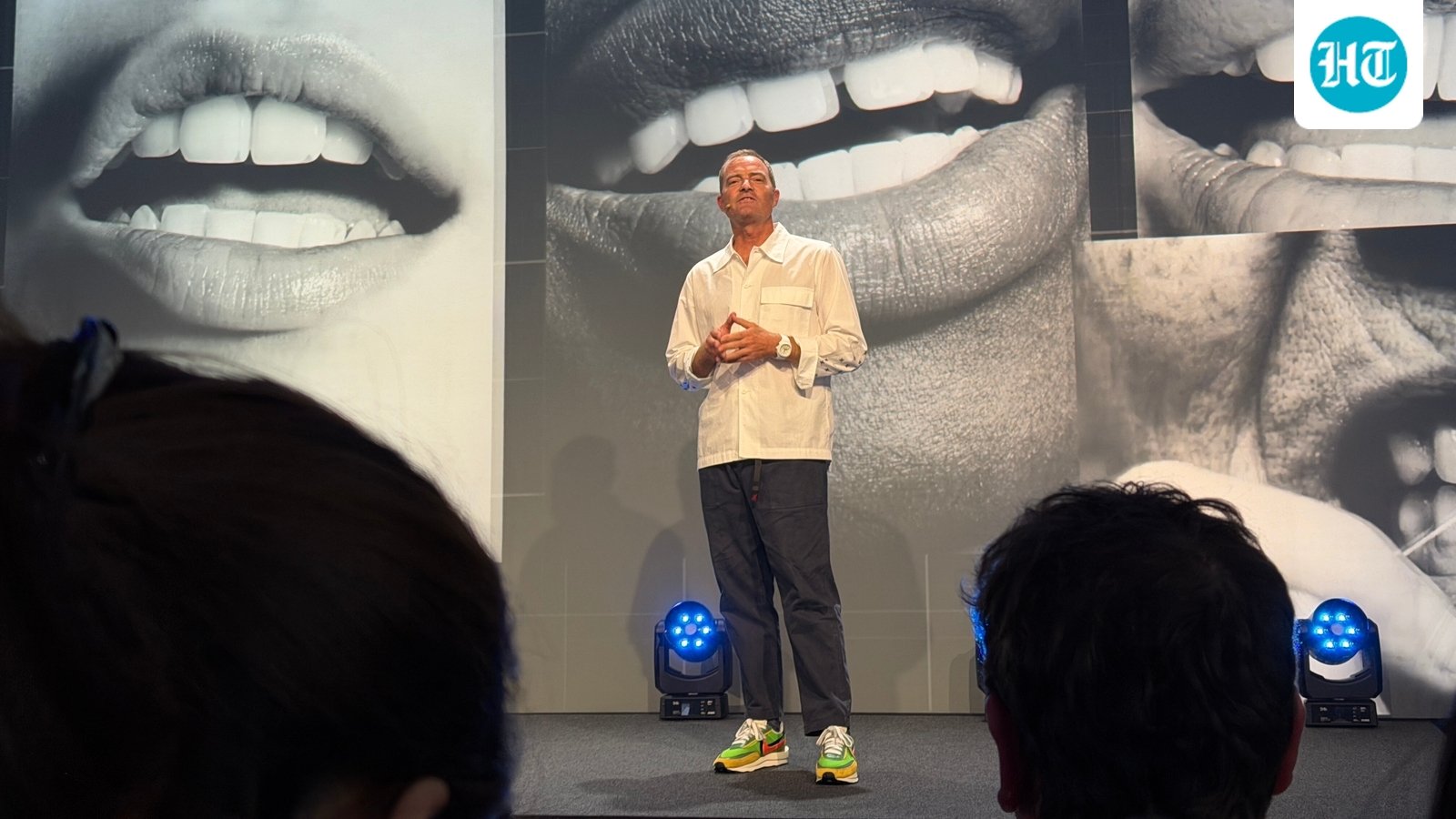
That was one of the questions I wanted to put to Jake Dyson, Chief Engineer at Dyson, when I met him at the Dyson Unveiled event on the sidelines of IFA 2026 in Berlin. At the time, Dyson had not yet unveiled its entire new line-up, but even then, the direction was becoming clear. The company was talking about aircraft-inspired engineering, quieter air purifiers, faster air circulation and a toothbrush that can essentially watch you brush your teeth.
What makes the shift interesting, however, is that Dyson does not appear to see these as departures from its engineering philosophy. For Dyson, the rather unusual design choices are functional first, even when they happen to look rather futuristic.
From aircraft engines to quieter homes
The new HushJet range is perhaps the clearest example.
Dyson’s engineers looked towards aircraft technology, specifically elements at the back of an engine, to understand how air could be streamlined while making its exit significantly quieter. The result is technology that Dyson has incorporated into its new purification machines.
“It’s a silencing exercise,” Dyson explained.
The idea is fairly straightforward. Turbulence creates noise, so if you can make the movement of air smoother, you can reduce the noise it produces. The challenge is doing that while still moving enormous volumes of air.
Dyson says its largest machine, Dyson HushJet Big+Quiet, can produce 333 litres of air a second and project it more than 20 metres, while achieving the company’s highest clean air delivery rate. At the same time, it is designed to purify 99.999 per cent of particles from the air.
For Dyson, then, the rather distinctive shape of these machines is not there simply to make them look like something from an aircraft hangar.
“It’s purely functional,” Dyson said.
The curved design at the top of the machine allows the air to move around it smoothly, without something obstructing its path and creating additional turbulence.
“The nozzle design is the biggest factor in reducing the noise,” he said.
There is also a practical reason why the new range looks so consistent. The HushJet Mini and its larger siblings are essentially the same engineering idea scaled for different rooms and applications. If you have a smaller room, Dyson says, you simply do not need the biggest machine.
Some models also introduce electrostatic filters, which attract particles so they stick to the filters more effectively.
The thinking is therefore less about creating a particular aesthetic and more about allowing the engineering to dictate the aesthetic.
Dyson does not want your purifier to look like an appliance
That does not mean aesthetics have been ignored.
In fact, Dyson appears to be thinking more carefully about how its products exist inside people’s homes.
Dyson has already experimented with different colours across its haircare products, but Dyson believes there is an even stronger reason to consider colour and finish when designing products that remain visible in a living space.
“You have to think a little bit more about how it fits in with their interiors and their interior decoration,” he said.
The goal, he suggested, is to move away from the idea of a conventional appliance.
White plastic, for example, can make a product look too much like an appliance. Dyson would rather it look like a beautiful object, something you actually want sitting in your room.
That inevitably raises an obvious question. If Dyson is already working around purification and airflow, could an air conditioner be next?
Dyson’s response was cautious, but intriguing.
“We’re in the game of purification and airflow, so we’re looking at many things, many other opportunities.”
Then there is the toothbrush with a camera
If the HushJet represents Dyson applying aerospace-inspired thinking to something familiar, the CameraJet represents a rather different kind of ambition.
It is also the product that prompted my original question about whether technology can sometimes go too far.
Dyson’s answer is that the technology is not there simply for the sake of having technology. The camera has a specific job.
The company used 5,00,000 images showing variations in people’s teeth, mouths and gums to train the camera’s machine learning. Once trained, the system inside the toothbrush can identify gaps between teeth and, when it detects one, lock onto it and fire a conical jet precisely at that spot.
The objective is to combine brushing and flossing.
As Dyson put it, conventional flossing is an additional process. You have to brush, then floss, and because it takes time, people do not always do it. The CameraJet is designed to make that process happen while you are brushing.
But getting a camera to do this inside a toothbrush is considerably harder than the concept might suggest.
The camera is tiny. The toothbrush is vibrating. Inside your mouth, there is very little light, and there is saliva. Dyson says it took six years to develop the system.
The company even developed its own non-foaming toothpaste because foam can interfere with what the camera is able to see. The toothbrush can still work with a foaming toothpaste, but Dyson says performance is around 10% lower. Its own toothpaste, meanwhile, has been formulated alongside its mouthwash as part of the company’s dental research.
How much tech is too much tech?
That distinction is particularly interesting because it gets to the larger question surrounding products such as the CameraJet.
AI has rapidly moved from something that felt largely confined to computers and phones into everyday objects. Dyson’s approach, according to its chief engineer, is to use it where it can enable a useful function.
Dyson is already exploring AI for customer service, where it could allow the company to interact with a product, identify potential faults and provide customers with a 3D model and instructions to fix a problem without the assistance of a person.
Dyson also sees machine learning as useful during product development.
But Dyson is not blindly enthusiastic about AI.
He is concerned about the jobs that AI could take away and believes there are areas where the technology could be put to far more consequential use.
“I wish they would focus far more on curing cancer and diseases like that,” he said.
His reasoning is that AI’s ability to process huge amounts of data, health information and DNA could potentially help identify the right chemotherapy for a particular cancer and a particular genetic profile.
For Dyson, the more interesting future is therefore not necessarily AI everywhere. It is AI being used where its ability to recognise, process and act can solve a genuine problem.
That is essentially what the CameraJet is doing, albeit on a considerably smaller scale.
A camera sees something. Machine learning recognises it. The toothbrush responds.
Why Dyson thinks its purifiers could matter in India
The same philosophy applies to air purification, particularly in markets such as India where indoor air quality can become a significant concern during the winter pollution season.
For Dyson, the advantage is not simply how much air its machines can filter, but how quickly they can circulate it around a room.
The company’s machines can project air more than 20 metres, while moving a large volume of air. That allows polluted air within a room to circulate through the purifier faster, helping accelerate the purification process.
The new filters are designed to capture almost all pollutants, while the connected app can show users what pollutants are present in their home and whether they have been cleared.
But there is another element to this that is easy to overlook.
A purifier can be powerful, but if it is loud enough to become annoying, people may not want to live with it.
That is where the aircraft-inspired engineering comes back into the picture.
The compressor provides the power needed to move and filter the air. The nozzle and the shape of the air path then help reduce the turbulence that creates noise.
Power and silence, in other words, are not necessarily competing ideas. They are an engineering problem.
Still, when I put the choice to Dyson in its simplest form, he did not pretend there was no compromise.
“Silence. Ow, no, it depends. If you want pure air, you have to compromise.”
CameraJet or HushJet?
By the end of our conversation, there was only one obvious way to settle the discussion: if Jake Dyson could take home just one of the two new products, which would it be?
The answer was surprisingly personal.
“I would buy the CameraJet,” he said.
The reason is rather simple. Dyson is British, lives in the countryside and, as he put it, does not have a pollution problem.
He also does not floss.
“So I need to. I needed to floss.”
The larger purifier does have its own appeal, though. Asked whether he would pick the big machine or a compact one, Dyson chose the bigger one, particularly for those increasingly hot English summers.
The reason is wonderfully practical: it can project air over your bed and cool you while you sleep.
And when it comes to robots, there is no hesitation. Helpful, not terrifying. If given the choice between a robot that cooks dinner and one that cleans the house, Dyson would rather have the latter.
Perhaps unsurprisingly for someone who says he hates all household chores, he would quite like to have more time.
The engineer behind the machines
There is a quieter thread running through the conversation that says as much about Dyson’s approach as the products themselves.
Dyson says he has had several mentors throughout his career. One taught him about metal fatigue, engineering and how metal is processed and machined. But he does not seem to view mentorship as something that comes from one person alone.
“Everyone I work with, I see as a mentor.”
And perhaps the most revealing answer comes at the very end.
If he were not an engineer, Dyson says he would probably have been an architect. He is interested in architecture and structures, enjoys renovating homes and likes coming up with ideas.
Or perhaps an artist.
It makes the products on display at Dyson Unveiled feel a little less surprising.
The aircraft-inspired purifier, the carefully curved airflow path and even a toothbrush with a camera may look like wildly different ideas. But underneath them is the same instinct: understand how something works, then design around it.
Sometimes that means making an air purifier quieter.
Sometimes it means teaching a toothbrush to see.
And sometimes, apparently, it means putting a camera inside your mouth.


