



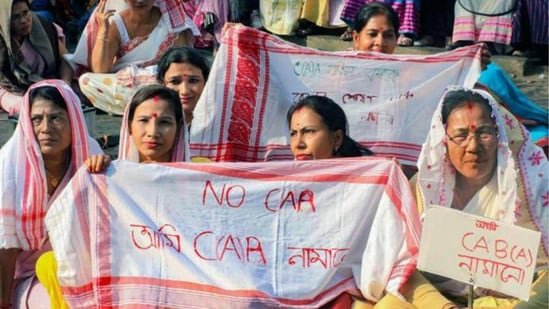
Seven years ago, India saw one of its largest protests in recent history following the introduction of the Citizenship (Amendment) Act, 2019. Soon after its came in, tens of thousands of Indians marched the streets in the bitter December cold of 2019, protesting the implementation of the act, which was deemed a violation of the secularism vowed in the Indian Constitution. These stretched into 2020 before Covid hit, as did a government crackdown.


However, these mass protests began in Assam, where protestors claimed that the CAA violates the 1985 Assam Accord. Fast forward to 2026, CAA remains a key focus in the state, especially as it prepares to head to the polls later this month.
What is CAA?
The Citizenship (Amendment) Act, 2019, was introduced and passed by the Indian government in 2019. The act amends the Citizenship Act of 1955 in order to grant illegal migrants a path to Indian citizenship.
Under the 2019 amendment, the CAA made migrants eligible for Indian citizenship if they belong to the Hindu, Sikh, Buddhist, Jain, Parsi or Christian community and are from Afghanistan, Bangladesh or Pakistan.
This amendment, as per the government, allows religious minorities who fear persecution based on religion to apply for citizenship in India. The act only applies to migrants who entered India on or before December 31, 2014. Certain areas in the North East, such as the tribal areas in Assam, Meghalaya, Mizoram, Tripura and those under the Inner Line Permit system, are exempted.
Assam and the CAA factor
Days before the bill was set to be tabled in the Lok Sabha in 2019, students across Assam erupted in protest against the act. Silent protests at Cotton University soon took a violent turn as the demonstrations grew following the passage of the bill to become law.
While the nationwide protests erupted due to the alleged marginalisation of Muslims as per the amendments, in Assam the focus remained on “protecting the state’s culture and identity”.
The Assam Accord, signed in 1985, brought an end to the Assam militant movement against undocumented migration, especially from Bangladesh, earlier East Pakistan.
Also Read | Making sense of Assam’s discordant response to the CAA
The accord set the citizenship cut-off in Assam to March 24, 1971. Furthermore, under Clause 6, the state was also guaranteed constitutional, legislative, and administrative safeguards to protect and promote the cultural, social, and linguistic identity of the Assamese people.
Under this accord came the National Register of Citizens (NRC), which was introduced to identify illegal immigrants.
In 2019, protestors across Assam stated that the CAA violated the terms of the 1985 accord.
One of the key factors in Assam was that the CAA would allow thousands of immigrants from Bangladesh to become legal citizens of India, which in turn would impact the cultural identity of the north-eastern state.
In 2024, Assam saw fresh protests against the Citizenship Amendment Act after the cut-off date was extended from December 31, 2014, to December 31, 2024.
The All Assam Students’ Union (AASU) and Assam Sanmilita Morcha staged protests and accused the Centre of “burdening” Assam with more illegal immigrants.
Despite agitation in the state, CM Himanta Biswa Sarma of the BJP continues to downplay the impact of the CAA and maintains that the protests against the act were “not based on logic”.
Role in the 2026 elections
As the state gears up for the polls, the Citizenship (Amendment) Act of 2019 continues to play a key role in the state’s politics.
The BJP, led by Himanta Biswa Sarma, has stood firm on the claim that CAA will strengthen Assam’s security and is needed to protect religious minorities, with a heavy focus made on Hindus.
However, opposition parties such as the Congress have highlighted violations of the 1985 Assam Accord by the CAA.
Opposition in the state, which also includes many new regional parties that emerged after the 2019 protests, has also stated that in a state like Assam, which is also a border region, the identity of the indigenous communities takes prime focus, regardless of the religion of immigrants.
Assam will head to the polls in a single-phase election on April 9. The votes are set to be counted by the Election Commission of India on May 4.


