



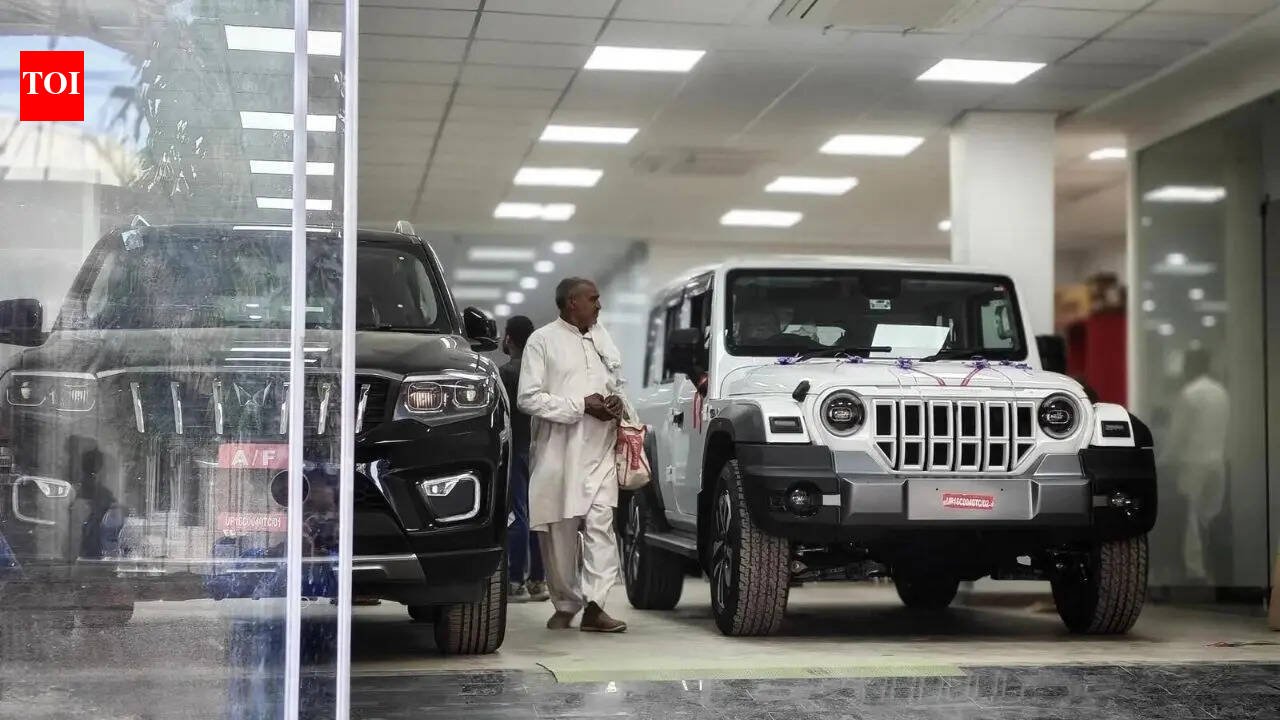
NOIDA: Newly wealthy Jewar, whose rural economy has benefited from commercial activity centred around the airport and compensation landlosers received, is already showing the Delhi-NCR DNA in its love for cars.In the last 2-3 years, most major carmakers have opened booking offices there. Dealers aren’t just happy about the sales, they like the fact that many of their customers don’t insist on EMIs. They just want to make the full payment and drive off with the car.Mahindra opened the first car showroom in Jewar in 2013. The others followed the money. Hyundai, Tata Motors, and Maruti Nexa have all established outlets since 2021-22, as compensation cheques began reaching farmers whose land was acquired for the airport project. Buyers who previously travelled to Noida or Aligarh to purchase vehicles are now finding multiple options near home.Ram Yadav, a store manager at the Mahindra showroom in Jewar, said monthly deliveries have more than tripled since 2021-22. “Earlier, we sold around 15-20 cars a month. Since 2022-23, at least 50-60 cars are delivered every month,” he said, adding that SUVs, particularly the Thar and Scorpio-N, dominate demand. “Many customers also ask for VIP registration numbers. Earlier, buyers hesitated even about the down payment. Now a large number are purchasing vehicles outright.”At the Tata Motors outlet, the shift has been even more dramatic. Sales manager Deepak Singh said monthly figures have risen nearly fivefold — from five or six units to 25-30. “Most customers are purchasing in cash, and many of them are above 50 years of age,” he said.Hyundai’s outlet, which initially relied on village-level stalls before opening a full showroom in 2022, now moves 15-20 cars a month, up from eight to 10 previously, manager Amit Chauhan said.
The most significant change, dealers said, is in how people pay. Where almost every buyer once depended on loans and EMIs, a growing share now arrive prepared to close the deal immediately, in full. “They come prepared and close the deal quickly,” said one showroom executive.Buyers are also gravitating towards higher-end variants, premium accessories, alloy wheels, and customised infotainment systems.The ripple effects extend beyond the showrooms. Jewar is quietly emerging as an automobile hub, with new accessory shops and tyre dealerships opening across the area. Manu Yadav, who ran a small tyre repair shop for cycles and motorcycles, has since renovated and expanded into a full car detailing business offering ceramic coating, interior deep cleaning, scratch removal, and seat shampooing. “Pehle Jewar mein sirf tractor dikhte the (earlier, only tractors were visible here),” he said.For residents, the car has become both a practical necessity and a marker of mobility. With limited public transport and long distances to hospitals, markets, and schools, private vehicles fill a real gap.“Having a car makes daily life easier,” said Ajeet Singh, a farmer from Rohi village who recently bought a vehicle after receiving compensation. “For hospitals, markets or schools, we have to travel to nearby towns.”Harish Singh, from Dayanatpur, said the shift also reflects something deeper. “Earlier, motorcycles were common. Now families prefer cars because roads are improving and incomes have increased. Sometimes, it also denotes a status in society,” he said.


