



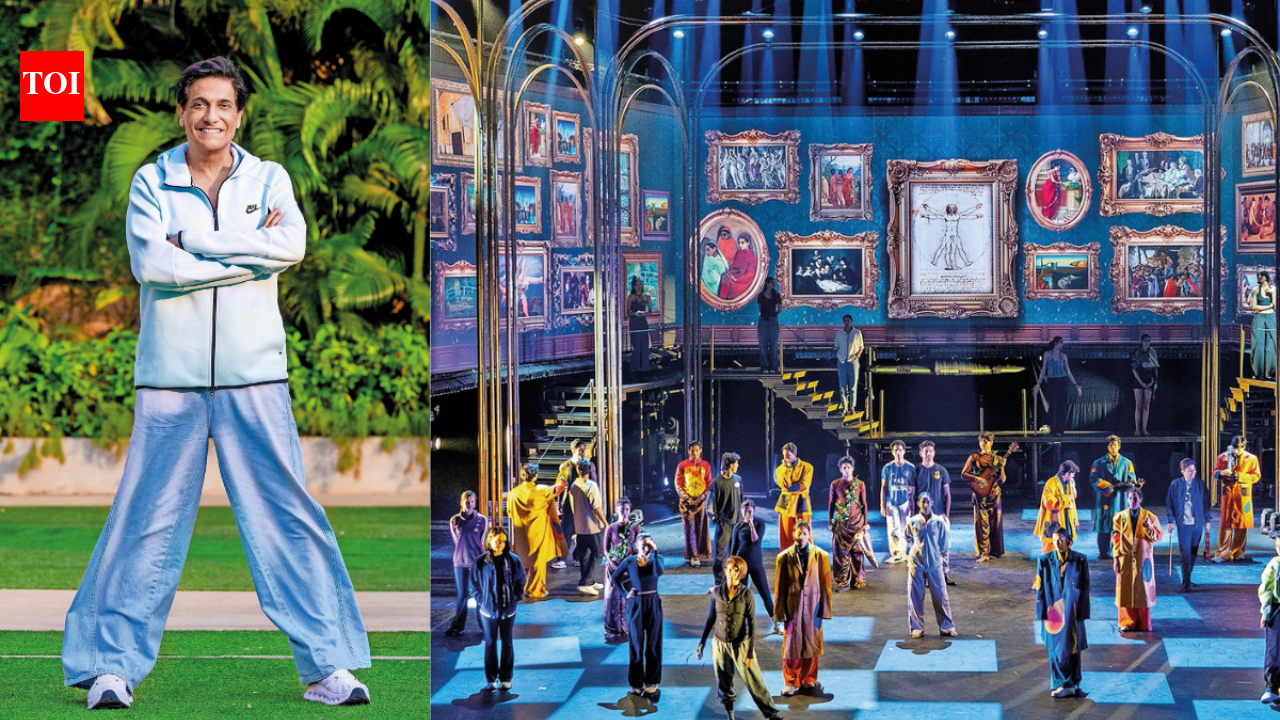
For over four decades, Shiamak Davar has shaped the language of contemporary dance in India, blending global techniques with theatrical storytelling. His latest production, Tesseract – The Geometry of Truth , brought to audiences by The Times of India , is among his most ambitious theatrical explorations yet. The visually immersive musical play merges dance, theatre, music, dialogue and artificial intelligence, inviting audiences to reflect not on where humanity has been, but on what kind of future we are choosing to build.Mounted on a scale reminiscent of grand Broadway and West End spectacles, the production brings together lead performers Megan Murray and Pia Sutaria alongside nearly a hundred dancers, weaving movement, narrative and technology into a sweeping stage experience. As Shiamak Davar takes on the dual role of director and choreographer, he reflects on the challenge of translating an abstract, philosophical idea into rhythm, movement and visual spectacle – while continuing to push the boundaries of what Indian dance theatre can be.To begin with, tell us about your collaboration with The Times of India for Tesseract .I love the fact that this is literally like a tribute to The Times Of India . Being the director and the choreographer, I have tried to keep the script alive. What I really enjoyed was the process. I also thoroughly enjoyed designing the costumes and props, because that’s my forte for all my shows. For me, it’s been a wonderful climb.
The show is anchored by lead performers Megan Murray and Pia Sutaria along with 100 dancers that will bring the narrative to life. The production blends movement, dialogue and storytelling at a scale associated with major Broadway and West End spectacles. As a director and choreographer, what excited and intimidated you about mounting a production of this magnitude?I’m always daunted. I cannot be content or look at projects and think that I’ve arrived. I’m always pushing – pushing myself, the crew, the dancers and choreography. I believe that I am always a work in progress. Every project is as important to me – whether it’s a small project with eight dancers or a thousand dancers for big events. There’s always a lot of work to be done. I’m never really satisfied till the production is entirely done.Read Also | Interstellar, Einstein and the strange elasticity of timeThe theme itself – moving from humanity to science and AI – is philosophical and layered. How do you choreograph something like that?That was the difficult part, to direct and choreograph it because the script weaves into the songs and the songs weave into the script with the audio visuals. My associate director Anahita Oberoi worked with me a lot in blending the scenes with the actors. The script by Zaveri is unusual. It’s literally like another fourth-dimensional script. I like to push boundaries. I want the audience to think, ‘What is this and what are we talking about?’ It’s not a usual love story. It’s something really different from our space. Tesseract will put you on a quest to find the purpose of truth.How did you approach creating choreography which is fluid and simple and connects with the audience,while making it visually dynamic?I had to keep the choreography simple but effective and powerful visually. Since I love designing my costumes and props, I try to blend that with the whole theme of each song. Everything has to become one – the visuals, theme, costumes, acting and the songs. The violin will tell me what to do, the drums will tell me what to do, the script will tell me what to do. You’ve also incorporated ballet and tap – forms that are not as widely explored in India.I have flown in two dancers from LA – Matisse and Aaron – because one does tap dance and the other does ballet. So, there’s ballet, tap, jazz, funk, Shiamak style and contemporary. The script required all of this. Do you see ballet as a dance form growing in India?Ballet is key for all dancers. If there’s no ballet training, it’s very difficult for dancers to push their potential. Even if you’re doing hip-hop, jazz, funk, house – any form requires ballet. When Timothée Chalamet said ballet and opera are not his thing, I think he’s misinformed about the arts. Without ballet, opera and the arts, you won’t understand the discipline. The arts are something else. It’s like God comes within you. Dance, song, acting, poetry, painting – the arts are alive, far more than before.“Tesseract: The Geometry of Truth” is produced by The Times of India, with concept and visualisation by Meera Jain.Experience “Tesseract: The Geometry of Truth”, running from 16 to 22 March 2026 at NCPA Mumbai. Book here


