



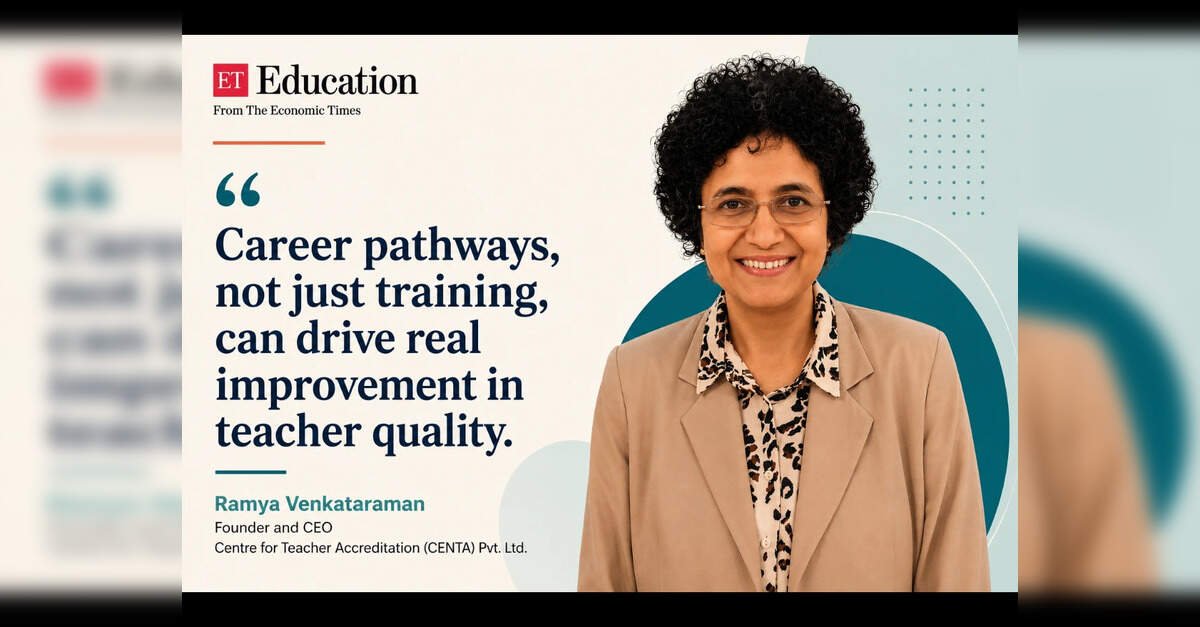
India has expanded access to education significantly, but improving teacher quality requires more than periodic training programmes, says Ramya Venkataraman, founder and CEO of the Centre for Teacher Accreditation (CENTA), which works on teacher competency assessment, certification and professional development.
Ahead of Teachers’ Day, Venkataraman spoke to ETEducation about the need to link teacher competency with career progression, the implementation of the National Professional Standards for Teachers, AI readiness among teachers and how teaching could evolve over the next five years.
Q: India has invested heavily in expanding access to education, but teacher quality remains a concern. Where do you see the biggest gap today?
Ramya Venkataraman: One of the big root causes we have identified through CENTA’s work is the lack of career pathways in teaching. While we talk about teachers needing professional development and improving their competencies, ultimately every professional wants growth in their career and earnings. When that pathway is missing, the pull to improve competencies is also weaker.
We therefore tried to flip the approach. Instead of starting with training or professional development, we started with career growth. We have found that in systems, both private and government, which give value to competent teachers through promotion, salary increases, rewards or recognition, teachers themselves start working on improving their competencies.
Career pathways are therefore a fundamental piece of improving teacher quality. The government is also addressing this through the National Professional Standards for Teachers.
Q: After working on teacher accreditation for several years, what have you learned about the capabilities that distinguish an effective teacher from someone who is merely qualified on paper?
Ramya Venkataraman: Our competency framework, the CENTA Standards, tries to define exactly this. The framework subsequently also contributed to the National Professional Standards for Teachers under NEP 2020.
Our assessment data points to three important areas.
First, the teacher’s own understanding of the subject continues to matter. Today, subject knowledge and resources are widely available. But a teacher’s understanding of the subject affects lesson planning, student assessment and classroom interaction. It also gives the teacher confidence in the classroom. So even when resources are available, the teacher’s own understanding fundamentally changes the classroom transaction.
Second is the ability to understand student misconceptions. A teacher needs to identify what a student has misunderstood and then determine what needs to change in the teaching method or which prior concepts need to be brought in.
Third is the ability to differentiate within a classroom. Every child learns differently and is at a different learning level. The challenge for a teacher is to provide personalised attention while keeping the whole class moving.
Technology, including AI, can support teachers in all of these areas, but these remain very core teacher competencies.
Q: India now has the National Professional Standards for Teachers. What will it take to move from having a framework to implementing it on the ground?
Ramya Venkataraman: The National Professional Standards for Teachers was originally released in 2022. The framework exists, but the question now is what implementation looks like.
The framework draws substantially from the CENTA Standards as well as various international standards. The next step is for every private and government system to determine how competency growth and career growth can be mapped and implemented.
That is where the real work lies. Standards by themselves cannot change the system. They have to translate into how teachers are assessed, how they develop their competencies and how that competency is recognised in their careers.
Q: NEP 2020 has placed significant emphasis on continuous professional development and teacher competency. Six years into the policy, how much real change are you seeing?
Ramya Venkataraman: Continuous professional development was being discussed by governments even before NEP 2020. What I think is fundamentally different about NEP 2020 is its emphasis on merit-driven career growth for teachers.
Because the policy emphasises this, multiple state governments that had been considering merit-based career growth are now more willing to implement it.
We are seeing governments use teacher assessments to select teachers for resource-person roles, special schools and other responsibilities. When assessment becomes part of career progression, continuous professional development gets a boost in a very different manner.
For example, we are currently doing a five-year programme with the Jharkhand government, where the government decided to start with teacher assessment and link continuous professional development to that assessment rather than treating it as a standalone activity.
We hear from teachers in very remote locations who say, “This is how I performed in my assessment, these are the areas I want to improve, and this is what I am testing in my classroom.” That kind of engagement does not come only from pushing training. It comes when teachers get a scorecard showing where they stand and that scorecard gradually has value in the system.
Q: AI is changing how students learn and how teachers plan lessons and assessments. What competencies should every teacher develop, and are teachers adequately prepared for this transition?
Ramya Venkataraman: General awareness and usage of AI are growing, but the understanding of how to use it effectively is much lower. There are also misconceptions and instances of incorrect usage.
At CENTA, we are working on an AI readiness index that looks at three things: the competencies students need in the new world, the competencies teachers need to build those capabilities in students, and how teachers themselves can use AI to their advantage.
All three are important to being AI-ready.
The question is therefore not simply whether teachers are using AI. It is whether they understand how to use it meaningfully and responsibly in their teaching practice.
Q: What role should continuous professional development play in an AI-driven education system?
Ramya Venkataraman: One interesting learning from CENTA’s work is the power of microlearning. Instead of relying only on traditional workshops or programmes, teachers can engage every day with a small, bite-sized piece of learning.
It fits into the teacher’s schedule and links directly to practice. It can also make professional development a more engaging journey.
The larger point is that professional development should not be measured simply by how many programmes a teacher attends. We should focus on the competencies teachers need and create mechanisms that allow them to continuously develop those competencies.
Q: What do you think the Indian school system could look like by 2030 if teacher quality improves significantly?
Ramya Venkataraman: I am hopeful that education will become much more application-oriented and more closely linked to the real world.
That will require teachers to guide students through project-based and real-life learning. Whether you are teaching science, mathematics or social science, the approach can move from teaching topics in isolation to starting with a real-world problem, learning the concepts needed to address it and bringing those concepts together to create a solution.
This also has implications for examinations. While there is a lot of discussion today around the technology, operations and security of exams, we also need to look at exam design.
Are we testing something simply because it is easy to test, or are we testing what is most meaningful in the world of work?
Curriculum, teacher competencies and examinations need to move together. If these three things come together, I think we can have a very different education system over the next five to ten years.
Q: If you could make three changes to India’s teacher ecosystem over the next five years, what would they be?
Ramya Venkataraman: The first would be to emphasise merit-driven career paths across the teacher ecosystem. Whether it is the mainstream school system, the private tutoring market or global mobility, teachers need to see a clear pathway based on their competencies.
The second would be an AI companion for every teacher, built around local context. Today, AI companions exist across professions, including education, but many are built from a global or Western context.
For India, local context means every state and district, urban and rural settings, and different socioeconomic environments. Teachers themselves should also contribute to making these AI companions better.
The third would be more personalised learning for teachers. Rather than telling teachers how many programmes they should attend or which programmes they should attend, we should define the competencies they need and give teachers more flexibility to determine how they want to develop those competencies.
Ultimately, the goal should be to create a system where teachers have the incentive, tools and pathways to keep improving throughout their careers.


