



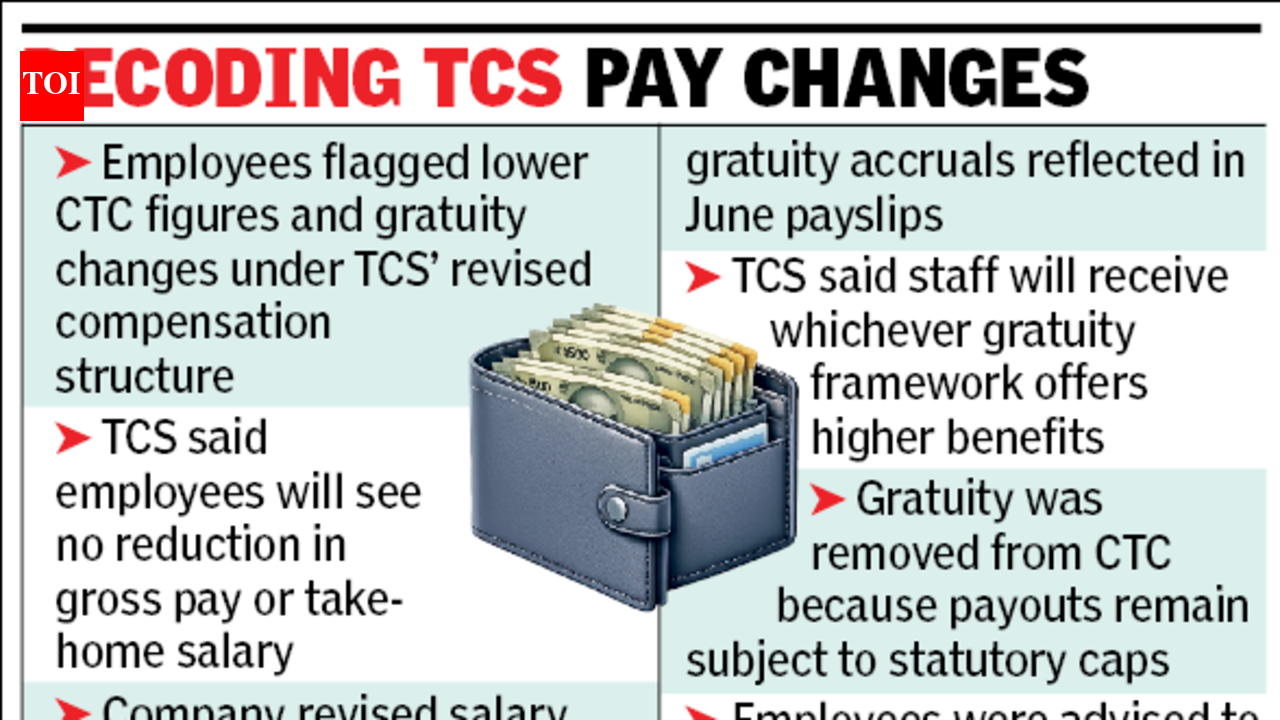
Bengaluru: TCS has clarified that there is no reduction in the salaries of employees, and noted that confusion among employees was the result of the gratuity component not being shown in the latest payslip.The change, it said, was the result of implementation of the new labour codes.The clarification came following a major social media outburst from employees alleging that their latest appraisal letters indicate a reduction in salaries and take-home pay.TCS said even take-home pay is being protected for most employees, and if some do see a slight reduction, that is more than made up for in later payouts like PF and gratuity.“There has been no reduction in employees’ gross pay or net pay,” a TCS spokesperson told TOI.Several employees questioned why gratuity was excluded in the latest compensation letters. TCS said employees may see a higher gratuity value reflected in their June payslips. This, it said, follows changes under the Code on Social Security, 2020, which links gratuity calculations to “wages” rather than only basic pay.Documents reviewed by TOI show that under the revised wage structure, components such as basic pay, city allowance and personal allowance are classified as part of wages under the new labour codes. In contrast, house rent allowance (HRA), conveyance allowance, provident fund (PF) contributions, superannuation / NPS contributions and statutory bonus are classified as exclusions.Performance-linked variable pay, company-paid health insurance premiums, ESIC contributions and other performance-based incentives are treated separately and are not considered part of wages.TCS said employees would receive gratuity under either the TCS Gratuity Scheme or the Social Security Code framework, depending on whichever provides a greater benefit. The gratuity multiplier will depend on an employee’s tenure as of July 1 this year, and some employees may not see any change if the existing TCS gratuity structure remains more beneficial.Addressing concerns around the exclusion of gratuity from CTC, the spokesperson said: “Earlier, gratuity was shown as part of CTC. Under the new wage code, gratuity accruals have increased because calculations are now linked to wages rather than just basic salary. Employees will see higher gratuity accruals reflected in their pay slips.”The company added that gratuity was excluded from CTC as a conservative measure because gratuity payouts remain subject to a statutory cap. Employees comparing compensation should remove gratuity from previous-year CTC calculations and compare on a like-for-like basis, it said.In its latest appraisal cycle, TCS rolled out average salary increases of around 5% across the company, with increments varying based on performance ratings. Employees in the A+ category received salary hikes ranging from 9% to 12%, while those in the A band saw increases of around 5% to 8%.TCS keeps WFO linked to variable payTCS’ internal compensation documents show that employee performance pay continues to link to work-from-office (WFO) compliance and deployment metrics. Employees with a WFO index of 85% or above receive 100% of their performance pay, while payouts progressively decline at lower compliance levels and drop to zero for employees with attendance below 25%.The policy further states that the deployment index (DI) impact is applied sequentially to the previous quarter’s average performance pay after accounting for WFO compliance.TCS revised its variable pay framework in 2024 to formally include work-from-office compliance as a key parameter. The company also put on hold final anniversary appraisals for some employees due to WFO non-compliance in previous quarters.When TOI reached out, a TCS spokesperson said: “WFO is still linked to the variable pay component with some rationalisation that is beneficial for employees.”An illustration in the internal document reviewed by TOI shows that an employee with an average quarterly performance pay of Rs 1,000 and a WFO index of 77% would see the payout reduced to Rs 900. A further deployment-index adjustment would reduce the final payout to Rs 810.The document also clarifies that salary revisions during a quarter will not alter the calculation methodology. “The impact of the WFO Index and DI on performance pay shall be applied to the average performance pay of the previous quarter,” it stated.The performance-pay framework is part of a broader restructuring of compensation and benefits following the implementation of India’s labour codes. TCS told employees the move aimed at bringing “consistency and standardisation in wages across grades and levels.”


