


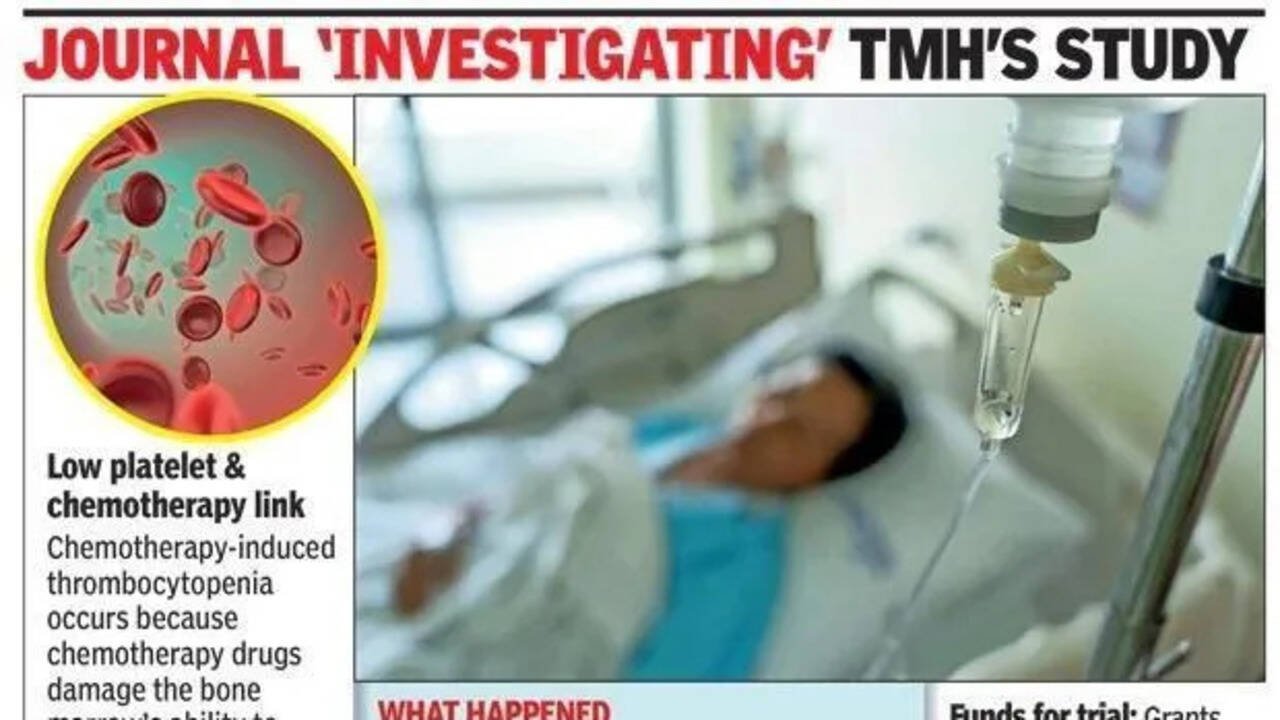
Mumbai: A new research article by Tata Memorial Hospital (TMH) claiming that papaya leaf extract pills help raise platelet count in chemotherapy patients has come under global scrutiny.The Journal of Global Oncology, a peer-reviewed medical journal that published TMH’s paper a few days ago, is “investigating” the study after Kochi-based hepatologist Dr Cyriac Abby Philips —widely known as ‘The Liver Doc’ on social media for his work debunking pseudoscience—requested it to conduct an internal review.The online version of the research paper now carries a disclaimer: “The journal has been alerted to potential concerns regarding the reproducibility and clinical interpretation of the reported findings in this article and is currently investigating. Readers should interpret with caution.”The study began with 219 patients, but after excluding certain individuals, the researchers narrowed the final count to 198, with 69 in placebo. They ultimately concluded that while longer follow-up is required, their findings suggest that the pills are an affordable intervention for chemotherapy-induced thrombocytopenia (low platelet count) and may help maintain chemotherapy intensity.This is one point of contention raised by Dr Philips. He noted that in the group taking the papaya pills, the researchers removed patients who did not recover before calculating the final results. “You can see the number of patients who recovered stays frozen at 83, while the denominator (total number of people in the study) shrinks from 146 down to 129,” he explained.By removing only the failures while leaving every success in place, the researchers effectively lifted the papaya extract’s recovery rate from about 57% to about 64% without a single additional patient actually recovering, Dr Philips added. Besides, he noted that in the placebo group, some patients who did recover were excluded from the final analysis.The study’s lead author Dr Vikas Ostwal said, “The journal has reached out to us with queries, which we are currently addressing as part of standard protocol. We are confident in our research. Our patients have been receiving the extract pills, and their platelet counts have consistently risen by day 4, give or take a day.”The pills for the trial were provided by Micro Labs Private Ltd, and the study received extramural grants from Zydus Pharma Pvt Ltd and Lupin Pharma Pvt Ltd; the latter also sells the extract pills under the brand name ‘Caripapa‘. Dr Ostwal said while the researchers were aware of the funding sources, none of them, including himself, knew that one of the funders sold these pills.Dr Philips also raised concerns that the study’s primary endpoint was moved from day 7 to day 4. A trial’s primary endpoint must be fixed before results are analysed. He noted that the original registration and protocols defined the primary endpoint as ‘platelet recovery by day 7′, yet day 4—which was intended only as an interim check—was used instead.“A trial produces endless data,” Dr Philips said. “If researchers decide after seeing the results what counts as the ‘primary’ endpoint, they can almost always find a positive outcome by pure chance. Deciding in advance is what separates real science from a lucky guess. It is the reason we trust a study’s findings when outcomes are positive.”A biostatistician retired from a public health institution concurred, saying that altering a primary endpoint post-analysis, combined with the exclusions in both arms, is a “red flag” that undermines the reliability of the study. “There could be a clinical benefit that the doctors observed and tried to fit into the data; on paper, there is certainly an issue.”Dr Amar Jesani, one of the founders of Indian Journal of Medical Ethics and former member of the ethics committee at Tata Hospital, said, “There can always be differences of opinion. Science cannot be without conflict. What is not acceptable is something that is done unscientifically, which has to be proved in this case. One way to move forward is for Tata Memorial Hospital to release raw, anonymised data into the public domain.“Experts said while the journal’s investigation will be vital, a fresh clinical trial would help prove or disprove the findings.Meanwhile, Dr Philips said a famous institutional name produces a halo effect for journals. “Peer review was never built to catch fabrication or arithmetic that does not add up,” he said. “It runs on an assumption of good faith.”TMH director Dr Sudeep Gupta was unavailable for comment.
