






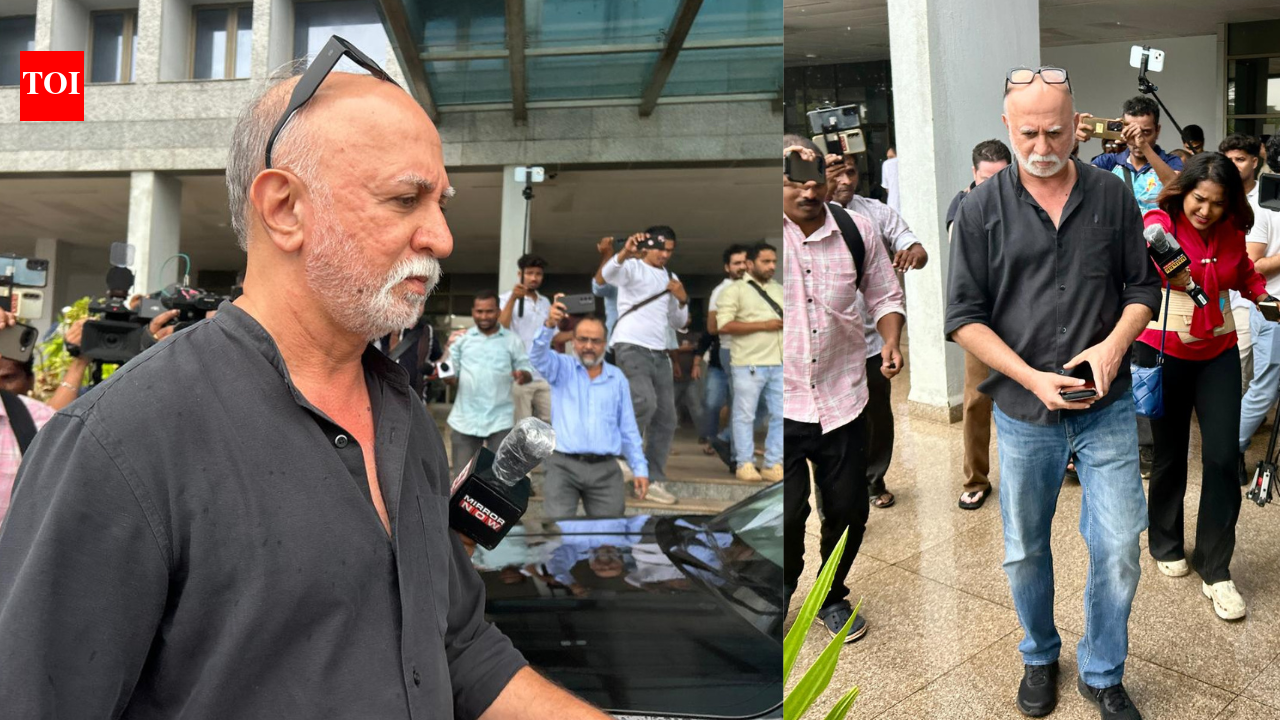
PANAJI: The Bombay high court’s decision to overturn former Tehelka editor-in-chief Tarun Tejpal’s 2021 acquittal in the 2013 sexual assault case has brought fresh focus on the evidence, the victim’s testimony and the conduct of the original trial.The Goa bench convicted Tejpal under multiple provisions of the Indian Penal Code (IPC) and sentenced him to 10 years’ rigorous imprisonment, with the sentences running concurrently.The court also directed him to pay fines totalling Rs 10.1 lakh to the victim and granted him four weeks to surrender, after considering his request.Here are 10 key developments from the judgment:
1. HC overturns 2021 acquittal, convicts Tejpal
The Bombay high court at Goa reversed the May 21, 2021 acquittal handed down by the Additional Sessions Judge, Mapusa.A division bench of Justice Neela Gokhale and Justice Amit S Jamsandekar convicted Tejpal under Sections 376(2)(f), 376(2)(k), 354, 354A, 354B, 341 and 342 of the IPC.The court’s ruling effectively overturned the trial court’s finding and held Tejpal guilty in the 2013 case.
2. 10-year jail term, Rs 10.1 lakh fine
The high court sentenced Tejpal to 10 years’ rigorous imprisonment each under Sections 376(2)(f) and 376(2)(k), with the sentences to run concurrently.It also imposed additional concurrent sentences for offences relating to outraging a woman’s modesty, sexual harassment, disrobing, wrongful restraint and wrongful confinement.The fines imposed on Tejpal total Rs 10.1 lakh, which the court directed to be paid to the victim.
3. Two alleged assaults inside hotel lift
The case relates to two alleged incidents at the Grand Hyatt in Goa during Tehelka’s THiNK Fest in November 2013.The victim, who was then working as a journalist with Tehelka, was accompanying Hollywood actor Robert De Niro, the festival’s chief guest.The alleged assaults took place inside a hotel lift on November 7 and 8, 2013.
4. Apology emails became key evidence
The court placed significant weight on two emails sent by Tejpal to the victim on November 19, 2013.The bench treated the formal and personal apology emails as effectively acknowledging a non-consensual sexual liaison.The defence had argued that the emails were written under pressure from Tehelka managing editor Shoma Chaudhury and Tejpal’s sister.The court rejected that explanation.
5. Victim’s testimony called ‘sterling quality’
The bench found the victim’s evidence consistent and credible despite extensive cross-examination.The judgment noted that she faced nearly 1,000 pages of cross-examination over 18 hearing dates.Her account was also found to have corroboration from seven witnesses, including friends, her mother and her now-husband Aman Sethi.The court therefore relied substantially on her testimony while reaching its conclusion.
6. HC criticises trial court’s treatment of victim
The high court sharply criticised aspects of the original trial, particularly the manner in which the victim was cross-examined.The bench found that questions about her sexual history and personal relationships were invasive and humiliating and amounted to harassment.It said the statutory protections under the Indian Evidence Act had not been properly respected.The court observed that the proceedings had effectively treated the woman “as if she were on trial.”
7. Court rejects ‘ideal victim’ expectation
The bench also rejected the notion that a sexual assault survivor must behave in a particular manner after an alleged assault.It criticised the trial court for expecting the victim to display stereotypical signs of trauma or behave like an “ideal victim”.The high court held that such expectations have no basis in law and cannot determine whether a survivor’s account is credible.
8. CCTV corroborated the timeline
While there was no CCTV camera inside the lift where the alleged assaults took place, the court considered footage from outside the lift.The footage showed Tejpal pulling the victim by her hand into the lift.It also showed their appearance again minutes later.The bench found that the footage corroborated the timeline and circumstances surrounding the alleged incidents, even though the assault itself was not captured on camera.
9. Court rejects extortion, character-assassination claims
The defence had alleged that the victim’s complaint was motivated by financial or political considerations and that she was seeking an exit package from Tehelka.The high court rejected those arguments.It held that her demand for compensation and an internal inquiry was legitimate, particularly in the context of the Vishaka Guidelines on sexual harassment at the workplace.The court did not accept the defence theory that the complaint had been fabricated for financial or political motives.
10. Position of power weighed against Tejpal
The court also considered Tejpal’s relationship with the victim while assessing the seriousness of the offence.He was not merely her employer but also her mentor and a friend of her father.The bench held that he occupied a position involving dominance, control, trust and authority over the victim.This position of power was significant in the court’s decision to convict him under the aggravated rape provisions of Sections 376(2)(f) and 376(2)(k), rather than treating the case as one involving only the basic offence of rape.
What happens next?
Tejpal has maintained his innocence and indicated that he will challenge the Bombay high court’s verdict before the Supreme Court.The latest development is that the high court has given him four weeks to surrender, while the conviction and 10-year sentence remain in place unless stayed or modified by a higher court.


