


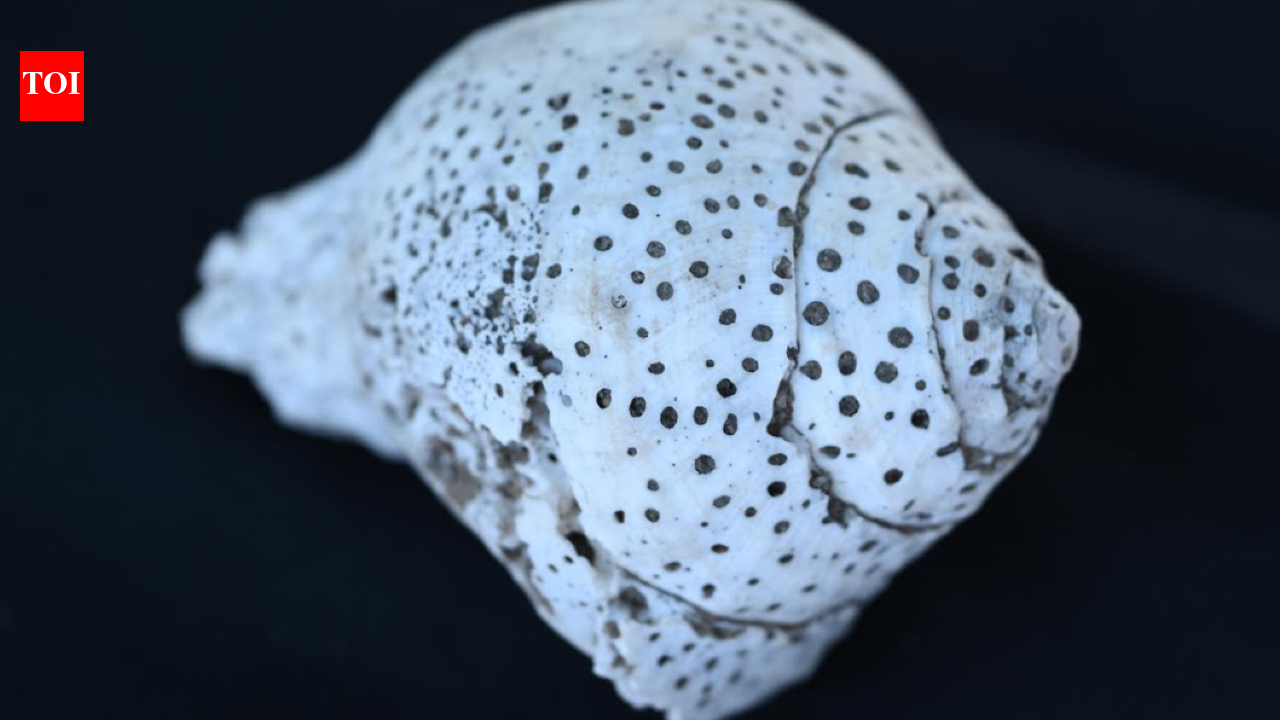
CHENNAI: Excavators from Tamil Nadu state archaeology department have unearthed an ancient shell industry that once spread over 200 acres at Pattanamarudur, off the Gulf of Mannar, in Tuticorin district. They found engraved conch shells, shell ornaments such as bangles, beads, Chinese celadon-ware, coins of Pandya and Vijayanagara kingdoms and huge deposits of used conch shells.Archaeologists said conch shells are aplenty in the shallow waters of Gulf of Mannar. There has been evidence of shell ornaments being used in today’s Tamil Nadu some 3,500 years ago. The latest discovery is expected to throw more evidence on the methods and designs, besides the civilization’s cultural contacts with the world.Minister for archaeology A Rajmohan said it highlights the region’s importance as a major centre for shell craft and maritime trade in ancient Tamil Nadu. “Though we have found shell industry units at Alagankulam, Korkai, Arikamedu and Kodumanal from early historic period (Sangam Age), this is the biggest ancient shell industry found in Tamil Nadu so far,” said professor K Rajan, adviser to Tamil Nadu state department of archaeology (TNSDA).The coins and pottery show trade contacts with foreign countries. “We have found four varieties of Chinese celadon ware at the site. Chinese coins were found in the same region in other sites as well. These shell objects can give us clues about the social connection, interaction and ancient trade,” said V P Yathees Kumar, joint director (in charge) of TNSDA, who is part of the team that worked at the site.
“We also found a ring well and terracotta channels that could have been used for industrial purposes. Further excavations are needed to date the site,” said R Ajay Kumar, excavation director of the site.Arati Deshpande Mukherjee, an expert on shell objects from Deccan College in Pune who visited the Pattanamarudur site recently, told TOI that the tradition of making shell bangles continued till the medieval period in Tamil Nadu. Recently, the excavators found engraved conch shells at a burial site in Adhichanur, an Iron Age site, near Tirukkoyilur in Villupuram district. “It shows ancient people used conch shells for rituals,” Mukherjee said.The earliest evidence for the use of shell ornaments emerged from Molapalayam, a Neolithic site near Coimbatore which was dated 3,500 years ago. “The shell objects including beads, owl-shaped amulet found from Molapalayam were made of marine shells, indicating the connection with coastal areas of Tamil Nadu as well. This is evidence of continuous use of shell objects from the Neolithic period to the medieval period,” said archaeologist V Selvakumar, who excavated the Molapalayam site.
Sangam literature also mentions shell ornaments and most of the early historic sites including Kodumanal, Keeladi, Alagankulam, Korkai and Arikamedu have yielded shell objects.However, wearing these objects went out of fashion in Tamil Nadu probably after the medieval period. “The earliest shell objects were found at Harappan sites. The practice almost vanished from across the country in the later period except for West Bengal, where some sections of women still wear shell bangles. These ornaments were sourced from Tuticorin,” Mukherjee said.
