



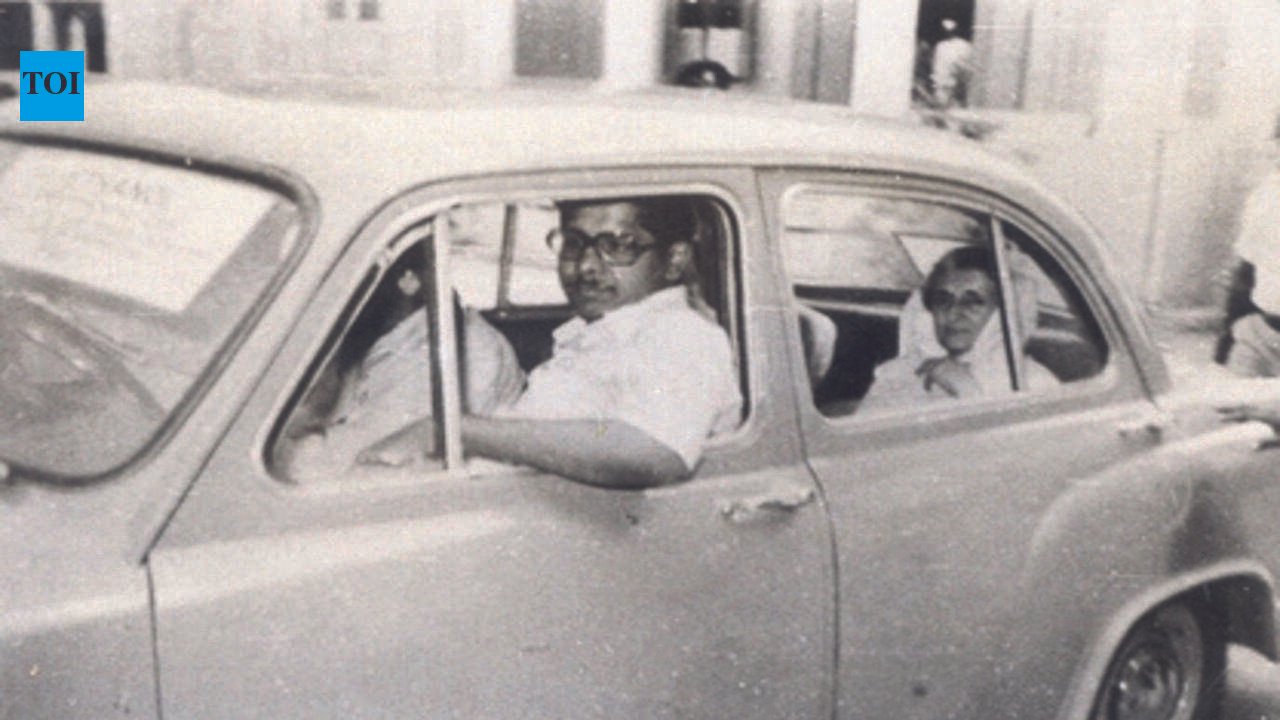
Five decades before ethanol blending became a national policy, engineers in Tamil Nadu had demonstrated that cars, two-wheelers and buses could run on the fuel.The experiment began in the 1970s, after petrol prices rose from `4 to `6 a litre in 1973. Faced with the prospect of rising fuel costs, the Tamil Nadu govt asked professors at the Internal Combustion Engine (ICE) Laboratory of the College of Engineering, Guindy (CEG), to explore alternative fuels.A team led by Professor T R Jagadeesan modified petrol engines to run on 100% ethanol, replacing the carburettor, ignition system and the cooling and heating system.“Ethanol is a good fuel for a petrol engine. It has a high flame speed and burns without producing black smoke,” says Jagadeesan. Its main drawback is mileage. “The heat energy produced using ethanol is only about 60% of that from petrol. And this affects mileage.”The difference was evident in the team’s road tests. In a 1979 trial, a car ran 7.2km per litre on ethanol, compared to 11.46km per litre on petrol. On highways, the corresponding figures were 9.38km per litre and 14.9km per litre. An Ambassador car which was given to the research team, recorded 6.2km per litre on ethanol against 9.54km per litre on petrol in a city road test on Jan 21, 1980. The researchers found that engine modifications could improve ethanol’s performance. They increased the compression ratio of a Fiat car engine from 7:1 to 11:1 and modified its carburettor and other components. At the normal compression ratio, the ethanol-powered engine recorded a thermal efficiency of 26%, compared with 25% for petrol. With the higher compression ratio, efficiency rose to 32%.The team then tested the technology on a 2,000 km runwith two cars, from Chennai to Ooty, on to Kanyakumari and back to Chennai. The vehicles negotiated hill roads and could be restarted at Ooty without difficulty. The project caught the attention of chief minister M G Ramachandran, who wanted Ambassador cars at the state secretariat to be run on ethanol. Vehicles of senior officials were soon operated on ethanol and brought to Anna University laboratory for refueling. The technology was also demonstrated to Prime Minister Indira Gandhi and finance minister R Venkataraman. The demonstrations generated interest, but the project did not receive approval for large-scale implementation. “Perhaps we were ahead of our time,” says Jagadeesan. The main obstacle was the source of the fuel. At the time, ethanol production was closely linked to sugarcane. Using food-linked resources to produce fuel raised concerns over food security. An ethanol programme, policymakers feared, could divert agricultural produce away from consumption.The team also tested ethanol fuel in diesel engines used by farmers and a bus engine provided by Ashok Leyland. They achieved 80% ethanol blend in diesel motor pump set while 40% blend was achieved in the bus. Because ethanol and diesel do not blend easily, the two fuels were supplied separately. The research, conducted between 1975 and 1985, was presented at international forums in the UK, US, Canada and Brazil.“We proved five decades ago that 100% ethanol could be used in modified petrol engines. Even after five years of testing, the engines showed no damage. The wear and tear was similar to what happens when petrol is used,” says Jagadeesan.Anna University now plans to revive the work, studying ethanol performance at different compression ratios with a focus on flexible-fuel vehicles. “The case for ethanol as an alternative transport fuel has strengthened. Ethanol can now be produced from several sources, including agricultural residues, potentially reducing the pressure on food crops,” says V Kumaresan, registrar (in-charge). The university will also be part of an ethanol research project involving IIT Madras, universities from China and Brazil. The Tamil Nadu govt has allotted a research grant of `5 lakh to the team.FUEL A DREAMIndia’s ethanol blended petrol programme aims to improve energy security, support farmers, and reduce environmental impacts, while promoting use of domestically produced renewable fuel.India’s E20 policy, introduced under the programme, is a nationwide mandate requiring fuel retailers to sell petrol blended with 20% ethanol and 80% gasoline. India has fast-tracked the nationwide rollout of E20 fuel, with ethanol blending increasing from less than 1.5% in 2013-2014 to 20% in 2025-2026, five years ahead of schedule. The move though has sparked concern that it will lower fuel efficiency, accelerate corrosion and damage components not designed for higher ethanol content.India imports more than 80% of the crude oil it consumes. Ethanol produced from Indian sugarcane, maize and rice offers a way to blunt that exposure using resources grown at home.Ethanol blending is a globally accepted practice. Several major economies such as the US, Brazil and Japan have built ethanol into their fuel strategy.Ethanol blending, pros and consPros: Cuts crude imports and saves foreign exchange; gives farmers and distilleries a steady, assured buyer for surplus grain, cane and maize; burns cleaner than petrolCons: Lower energy content can mean lower mileage; food-versus-fuel concerns remain, the same worry that held back the Tamil Nadu experiment. Sugarcane and rice are also water-intensive crops
