


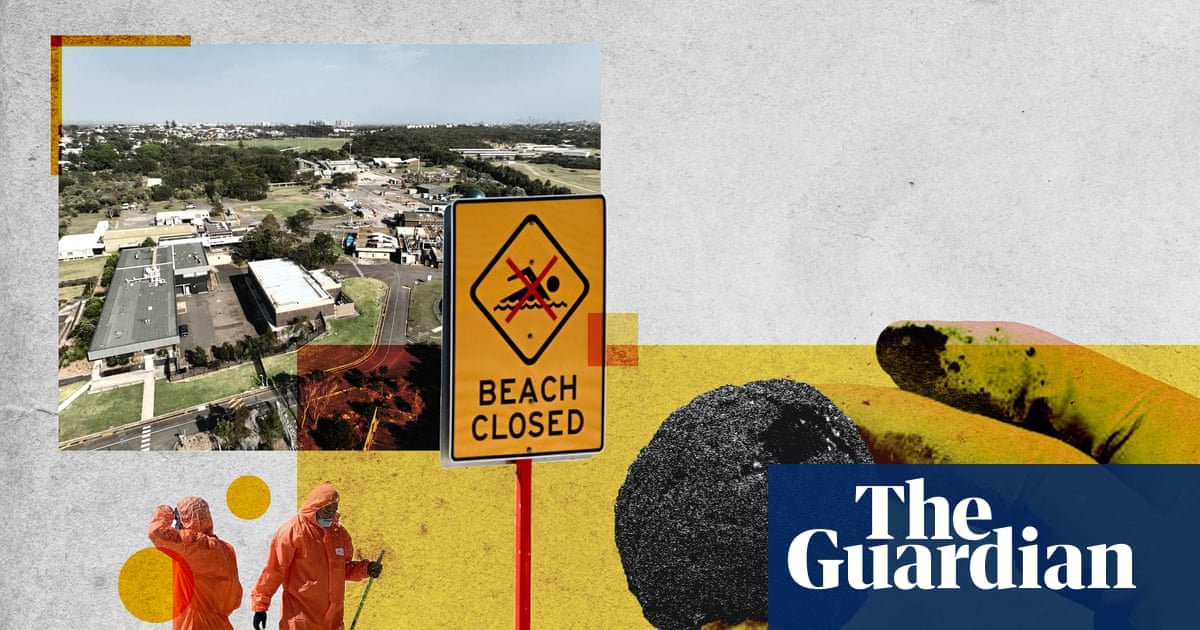
The New South Wales environment watchdog has ordered Sydney Water to remove fats from its Malabar wastewater treatment plant, a month after Guardian Australia revealed a huge fatberg was responsible for the poo balls that closed beaches last summer.
Sydney Water isn’t sure exactly how big the fatberg is because it can’t easily access where it has accumulated. It could be the size of four Sydney buses.
Fixing the problem would require shutting down the ocean outfall – which reaches 2.3km offshore – for maintenance and diverting sewage to “cliff face discharge”, which would close Sydney’s beaches “for months”, a secret report obtained by Guardian Australia using freedom of information laws states.
This has “never been done” and is “no longer considered an acceptable approach”, the Sydney Water report from August 2025 acknowledges.
The Environment Protection Authority (EPA) said on Monday it had issued a pollution reduction program to Sydney Water “requiring a range of significant works, including fat removal from the Malabar deep ocean outfall bulkhead area, to reduce the likelihood of further debris balls washing up on the state’s beaches”.
“The requirements on Sydney Water include a range of short, medium and long-term actions including removing the build-up of fats, oils and grease from a hard to access bulkhead area of the deep ocean outfall,” the watchdog said in a statement.
Sydney Water was also ordered to develop “a system to capture debris overflowing from the sewer during severe wet weather events”; conduct “a study into the formation and weathering of debris balls to make it easier to track them”; and consider “AI or other technology to monitor for the formation of debris balls”.
The NSW EPA executive director of operations, Steve Beaman, said Sydney Water was “responsible for ensuring it doesn’t pollute our beautiful beaches and this important work is a step towards that”.
“Debris balls are a complex problem and the EPA will continue to regulate Sydney Water to protect our precious natural environment.”
The August 2025 report reveals “the working hypothesis is FOG [fats, oils and grease] accumulation in an inaccessible dead zone between the Malabar bulkhead door and the decline tunnel has potentially led to sloughing events, releasing debris balls”.
The bulkhead door is usually under water, and can only be opened at low tide and during low flows in the system. The report states it is impossible to safely go beyond the stopboards. The huge fatberg is thought to be in a 300 cubic metre chamber beyond the stopboards.
Sydney Water is already regularly cleaning the accessible part, which is itself “an extremely risky operation”. In April 2025, it removed 53 tonnes of accumulated FOG, including debris balls, the report states.
The debris balls first closed beaches in October 2024. A month later, Sydney Water acknowledged the balls “may have absorbed wastewater discharge, which was already present in the water while forming”, but insisted “they did not form as a result of our wastewater discharges”.
Subsequent reporting by Guardian Australia revealed this statement was not true.
Earlier this month, Sydney Water’s managing director, Darren Cleary, admitted as much, telling the ABC: “In hindsight, looking back, clearly the evidence is saying it most likely was the ocean outfall. So with the benefit of hindsight, yes, those earlier statements have been shown to be not factually correct.”


