






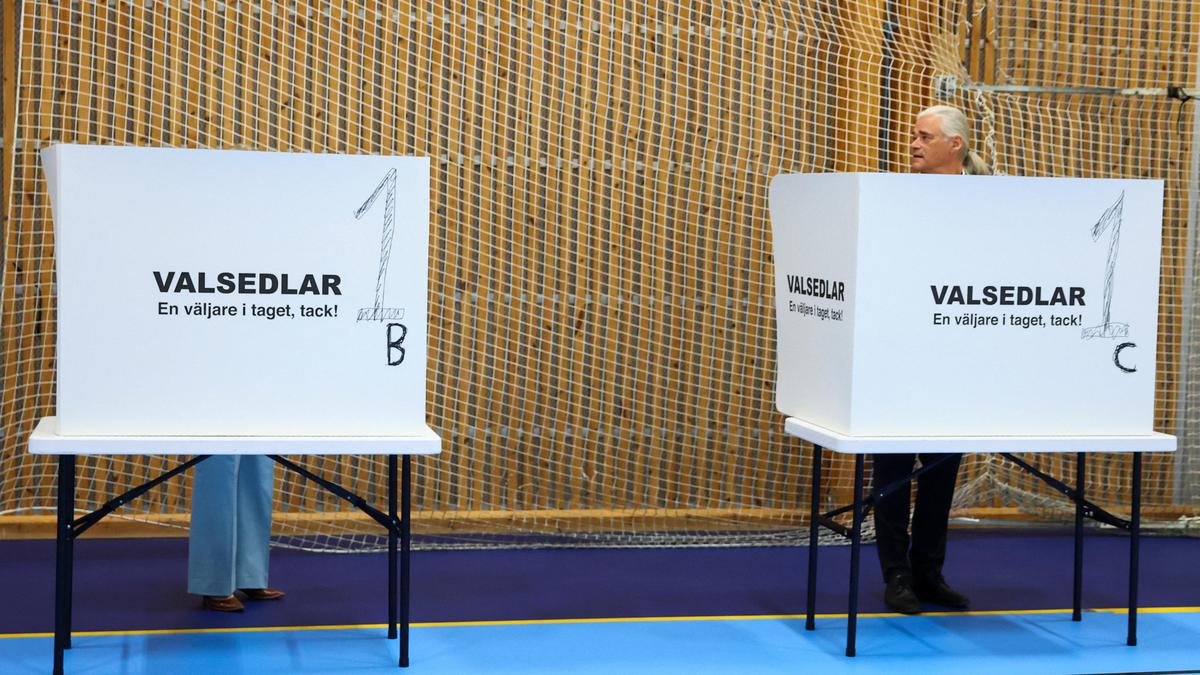
Swedes were voting in a closely fought election on Sunday (September 13, 2026) that will either bring a far-right party into government for the first time or shift the country back towards the liberalism it has long been known for.
Sweden’s centre-left opposition holds a narrow lead over the ruling right-wing bloc ahead of the September 13 election for parliament, several opinion polls have shown this week.
But Prime Minister Ulf Kristersson, who has trailed in opinion polls throughout his four years in office, has been catching up in the final weeks of campaigning, with rival Magdalena Andersson and her Social Democrats losing ground.
Mr. Kristersson has pledged to bring the far-right Sweden Democrats into government if his bloc wins.
“We can unify parties, voters and issues into joint action. That’s why we get things done,” he told reporters this week.
Critics say his government’s agenda is undermining civil liberties while forcing immigrants to conform more closely to Swedish cultural norms or leave the country, urged on by both inducements and penalties.
“We’ve become a harder society, a quieter society, but also a poorer society as we’ve had growth far below our potential and where households see their pay checks buy less and less,” Ms. Andersson told Reuters, adding that uniting people had made Sweden strong.
Supporters of the right-wing bloc say its policies have helped curb gang violence and cut immigration dramatically, and that a victory would amount to a public endorsement of that approach and more in the same vein in the years ahead.
Electoral success for the Sweden Democrats is likely to be welcomed by Europe’s rising far-right parties, boosted by a significant win in a German state election this month by the anti-immigrant Alternative for Germany.
Another Country
Polling stations in the EU member state of 10 million people, which joined NATO after Russia’s full-scale invasion of Ukraine, opened at 8 a.m. (0600 GMT) with exit polls due soon after they close at 1800 GMT and data giving an indication of the result at around 1900 GMT.
Voters in Rinkeby, an area designated by the police as extremely socially deprived, were worried things might get worse for them.
“They target Muslims; they single out Muslims and immigrants. But immigrants contribute to society,” Kahin Ahmed, 57, a sociologist who came to Sweden from Somalia as a refugee told Reuters.
“A quarter of those working in healthcare are immigrants. If immigrants stayed home for a single day, Sweden wouldn’t function,” he said.
Over the last four years, the ruling minority coalition — backed by the Sweden Democrats — has abolished permanent residency for refugees, tightened welfare rules and boosted expulsions of those without a right to stay.
Voting on Saturday (September 12) in Rinkeby in northern Stockholm, Sweden Democrat leader Jimmie Akesson said the suburb, home to one of the country’s biggest Swedish-Somali populations, “doesn’t look like Sweden”.
The Sweden Democrats have pledged to ban both the niqab and the burqa if they get into government. Mr. Akesson told Reuters such dress “reflects values that I don’t think belong in Sweden”.
Building a government
The right has already agreed to form a four-party government led by Mr. Kristersson if they win, while Ms. Andersson’s path to power is more uncertain.
The election could ultimately be decided by whether the Liberals surpass the 4% threshold to win seats in parliament, bolstering a right wing that includes Moderates, Christian Democrats and, since being invited by Mr. Kristersson earlier this year, Sweden Democrats.
The Sweden Democrats have already spent four years propping up Mr. Kristersson’s minority government in parliament, building credibility with the broader right-wing bloc.
Meanwhile, the rival blocs have converged on several voter priorities, including support for Ukraine, military rearmament and relief for households hit by the cost-of-living crisis.
While the opposition Social Democrats, Greens, Left Party and Centre Party broadly agree on the need for higher welfare and public spending, divisions persist on many issues, including immigration, where Ms. Andersson’s party wants a more restrictive line than some of its would-be partners.
They are also at odds over issues including a tax on billionaires and building new nuclear reactors, while the Centre refuses to support a government that includes the Left Party, increasing the challenge Ms. Andersson would face to form a cabinet.
Published – September 13, 2026 04:23 pm IST


