


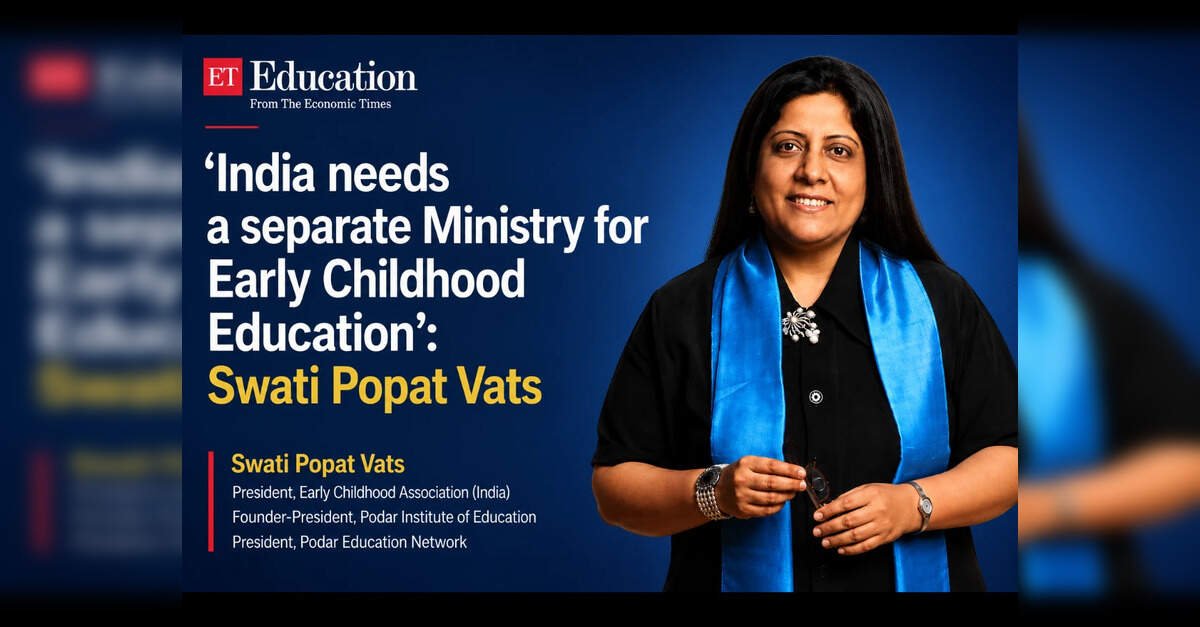
Swati Popat Vats, President of the Early Childhood Association and Founder-President of Podar Institute of Education, is one of India’s leading voices on early childhood education. With over three decades of experience in curriculum development, teacher training and policy advocacy, she has played a pivotal role in shaping conversations around foundational learning. In an exclusive interview with ETEducation, she shares her views on the implementation of the National Curriculum Framework (NCF), teacher training, foundational literacy and numeracy, digital learning, and why she believes India needs a dedicated Ministry for Early Childhood Education.Q. The National Curriculum Framework (NCF) for the Foundational Stage has been in place for some time. Are Indian preschools truly moving away from rote learning, or does academic pressure still begin too early?
Swati Popat Vats: We conducted a survey about a year ago and found that only 45% of teachers were aware of NCF 2022, while around 58% of private preschools had implemented parts of it. The biggest challenge isn’t schools; it’s parents. Unless parents understand why these reforms matter, schools will continue to struggle with implementation.
We’ve moved from dial phones to smartphones. Why, then, do we want our children to continue learning through outdated practices when better, brain-based approaches are available?
Q. Concerns over screen time and AI exposure among young children are growing. Where should parents and educators draw the line?
Swati Popat Vats: Before giving children technology, we must teach them how to use it responsibly. We teach road safety from an early age, but we don’t teach technology safety. Children should understand how screens should be used, when they should be used and what content is appropriate.
I’ve developed what I call a Digital Panchadi, inspired by NEP 2020‘s five-step learning process. Technology shouldn’t be introduced during the initial stage of learning or when children are deeply exploring a concept. Used appropriately at other stages, it can complement learning without replacing real-world experiences.
Q. Foundational literacy and numeracy are at the heart of NEP 2020. Where do you see the biggest implementation gaps, especially beyond metropolitan cities?
Swati Popat Vats: The biggest gap is timing. If education officially begins at the age of three, then foundational literacy and numeracy must also begin through concrete experiences at that age. Instead, we often delay meaningful learning until six years of age.
Nearly 85% of brain development happens between the ages of three and six. If we fail to build strong foundations during those years, we shouldn’t be surprised when later assessments show children struggling with reading and mathematics.
Children first need to experience concepts before they encounter symbols. That’s how the brain naturally learns.
Q. Parents today are more anxious and involved than ever before. What are the biggest parenting mistakes affecting children’s learning and emotional development?
Swati Popat Vats: The first mistake is underestimating the importance of the early years. Parents worry about universities while ignoring the stage where the foundation of a child’s learning is actually built. Second, don’t choose a preschool based only on its brand. Choose it based on the quality of its teachers. A poor teacher during the early years can affect a child’s learning for life.
Third, stop listening to everyone around you. Trust your instincts as parents instead of constantly comparing your child with others.
Q. Teacher quality varies significantly across preschools. Does India need stricter standards for early childhood educators?
Swati Popat Vats: Absolutely. We have B.Ed. programmes, but no uniform professional qualification for early childhood educators. Some teachers complete two-month courses, others three-month programmes.
At the very least, India should introduce a mandatory one-year qualification for preschool teachers. Alongside better training, we must improve salaries. Unless teaching becomes an attractive profession, we won’t be able to bring talented people into early childhood education.
Q. How can schools and parents balance academic readiness with childhood?
Swati Popat Vats: Never compare a child with another child. Compare them only with their own previous performance. That’s how children build confidence and develop a growth mindset. Parents also need to resist the urge to push children into excessive competition at a very young age. The early years should focus on exploration, curiosity and joyful learning rather than constant performance.
The only race children need to be in is the human race. First, make them human before trying to make them achievers.
Q. If you could recommend one policy reform that would have the greatest impact on India’s early childhood education ecosystem, what would it be?
Swati Popat Vats: India needs a separate Ministry for Early Childhood Education. Today, responsibilities are split across ministries, and early childhood doesn’t receive the focused attention it deserves.
If India truly wants to become a developed nation by 2047, it must invest where human potential is built—in the early years. The children who will shape that future are either being born today or are already entering preschool.
Q. Looking ahead to 2035, what will define a high-quality preschool?
Swati Popat Vats: Three things.
First, qualified teachers who understand child development, not just theory.
Second, schools should stop obsessing over fancy infrastructure and expensive toys. Children don’t need luxury classrooms to learn.
Third, schools must treat parents as partners. Without parental engagement, lasting educational change is impossible.
