


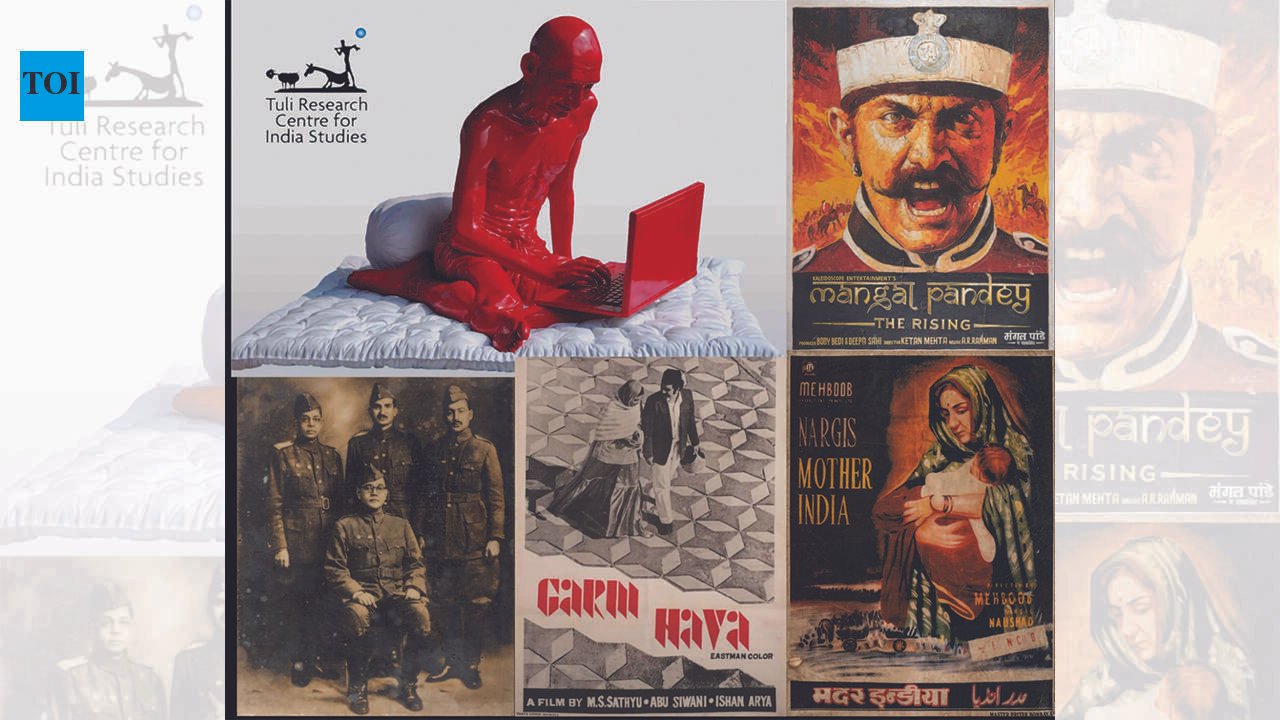
History rarely survives through dates alone. It lives in photographs, newspaper pages, paintings, books, songs, slogans and even ordinary objects that become witnesses to extraordinary times. That idea lies at the heart of Swaraj: Revisualising India’s Political History, an exhibition presented by The Tuli Research Centre for India Studies (T.R.I.S.) and curated by its founder, Neville Tuli. Opening at the Visual Arts Gallery, India Habitat Centre, New Delhi, on August 12, the exhibition brings together artworks, photographs, books, prints, film publicity art, memorabilia and visual, textual and audio archives to trace India’s long journey towards political self-rule and self-discovery.Rather than presenting history as a distant sequence of events, Swaraj looks at how India experienced, recorded and remembered its political transformation. The journey begins with early European coastal views of India and the intellectual awakening of the Bengal Renaissance before moving through the First War of Independence in 1857 and the emergence of Indian printing presses, political propaganda and photojournalism. Cinema and visual culture also find their place in this evolving narrative.Symbols that shaped India’s political imagination — Bharat Mata, Mother India and the evolving Tiranga — feature alongside representations of Mahatma Gandhi, whose image and ideas became powerful instruments of political mobilisation.The exhibition also brings together figures central to India’s political and intellectual awakening, including Swami Vivekananda, Dadabhai Naoroji, the Tagore family, Bal Gangadhar Tilak, Rash Behari Bose, Annie Besant, C. Rajagopalachari, Jawaharlal Nehru and Netaji Subhas Chandra Bose. But this is not a straightforward story of nationalist triumph. Swaraj also enters the more difficult chapters of India’s political history — Partition, the framing of the Constitution, the integration of princely states, the Emergency, wars, communal tensions, protests and people’s movements that challenged established power.For Tuli, political history is also a history of representation. Newspapers, journals and magazines appear alongside photographs by Felice Beato from 1858, Henri Cartier-Bresson’s images from the final days of Gandhi’s life, and Reuters photographs documenting violence, protests and political upheaval in the 1980s and 1990s. Art provides another perspective. Works associated with Chittaprosad, Gobardhan Ash, Ramkinkar Baij, Qamarul Hassan, Altaf, Prokash Karmakar, Vivan Sundaram and Sudhir Patwardhan reflect different periods of social anxiety, injustice, aspiration and change.Some of the exhibition’s most telling pieces are also among its most ordinary. Matchbox tin covers bearing misprinted names of Swadeshi leaders from around 1921, Ramendranath Chakravorty’s Gandhiji at Dandi, Chittaprosad’s 1942 Quit India, photographs from the Madan Mahatta Archives and Gigi Scaria’s Who Deviated First? demonstrate how political memory can exist beyond official documents and monuments.The exhibition also looks towards a younger India. Its concerns — freedom, identity, justice, democracy and belonging — are placed alongside the impatience and idealism of young Indians today, suggesting that the questions that animated earlier generations have not entirely disappeared. The exhibition concludes with Gandhiji in Contemporary India, turning the focus towards the continuing relevance of Gandhi amid contemporary debates around dissent, democracy, citizenship and India’s evolving identity.In the end, Swaraj is less about looking back than about examining what history leaves behind — what a nation remembers, what it forgets and what it chooses to carry forward.The exhibition will be open to visitors from August 12 to 16, between 11am and 7pm, at the Visual Arts Gallery, India Habitat Centre, Lodhi Road. A preview is scheduled for August 12 at 6pm, and entry is free. For those willing to spend an afternoon with India’s visual and political memory, SWARAJ offers an opportunity to see the country’s history not as something finished, but as something that continues to shape the present.
